Showing posts with label Leadership style. Show all posts

Wednesday, 22 January 2020

Putin Improves Russian Constitution


On January 15th, my wife and I watched the Russian language broadcast of Vladimir Putin’s Presidential Address to the Federal Assembly, January 15, and proposed changes to the Russian Constitution. We agree that Putin was genuine and revolutionary, and presented himself as a world statesman.

Note that Russia provides an ‘open’ English translation, but Canada and the US governments do not provide translations for foreign governments.

Putin, now 67, has been in power since 1999 — more than 20 years. In 2024 his current term ends and he will step down, unless an early election is held. The system he has put in place should continue into the future. Russia deserves to maintain its moral authority in which it and the former Soviet Union won World War II and defeated the The Third Reich at a cost of over 27 million citizens.

Our impression is nearly the opposite of most Western news commentators critical of Putin for allegedly seeking to enhance his power, and his behaviour contrasts with most western politicians who appear more focused on getting reelected than serving their constituencies.

Putin introduced his proposals with this introduction:
The Presidential Address to the Federal Assembly is delivered at the very beginning of the year for the first time. We need to address large-scale social, economic and technological tasks facing the country more quickly and without delay. … Our society is clearly calling for change. People want development, and they strive to move forward in their careers and knowledge in achieving prosperity, and they are ready to assume responsibility for specific work. Quite often, they have better knowledge of what, how and when should be changed where they live and work, that is, in cities, districts, villages and all across the nation … And, I repeat, they must be actively involved in this process.
Putin said although the potential of the 1993 Constitution is far from being exhausted, he suggests ‘a number of constitutional amendments for discussion, ... for the further development of Russia as a rule-of-law welfare state where citizens’ freedoms and rights, human dignity and well-being constitute the highest value.’

Here are Putin’s main proposals for a public vote:
  • Education National Project — Across the vast country, more day nurseries, teacher training, computers, student lunches, teacher aides and support. More university scholarships for medical specialists and technology.
  • Birth rate — Financial support for 2 child couples.
  • Internet — Free to all citizens.
  • Democracy — Move some powers from the President to the Duma (Parliament).
  • Medical — Enhanced free healthcare and medicine.
  • Wages, Pensions— Living minimum wage.
  • Military — No budget change. Now about 10% of USA budget. No threat of war.
  • Residency — Any future President should live in Russia continuously for 25 years.
  • Citizenship — Civil servants barred from holding multiple citizenship.
  • President term limit — 2 consecutive terms.
  • State council — Increased scope and powers.
In compliance with Putin’s proposals, 18 of the 23 members of the Federal Cabinet of Russia stepped down, and 5 remained. Most news focused on Prime Minister Dimitry Medvedev who was replaced by Mikhail Mishustin.

Many speculate that Putin will try to manage the more strategic and powerful State Council for the rest of his life. ('The World Is Experiencing a New Form of Autocracy,' The Atlantic, March 2020.)

Russian insider, Abbas Gallyamov, a former government speech writer, reported on his Facebook page (January 21, 2020) that Putin removed 3 people strongly disliked in certain parts of society — the ministers for culture and education, and a deputy prime minister who oversaw sport at the height of a doping scandal. Previously the Kremlin said it would appoint who it wanted and didn’t care if people didn’t like their choice. Now the logic has changed and the authorities do not want to irritate society. It appears that public opinion matters. But, the new cabinet needs more business leaders to improve the economy. In general, there are no major changes to government ideology.

Russia-born writer Dmitry Orlov explained in his blog what Putin is trying to accomplish and ended with '... three elements ... missing ... from the proposed constitutional changes: titular nation status for Russians, their right of return, and right of self-determination for long-term de facto independent regions.'

In general, my wife and I believe that Russia is emerging with a new human face in a changing world, while most ‘Western media ... was aghast. “What is Putin up to?” ’ …’ What’s going on? … ‘’a major shakeup’.

I must repeat: Bashing Putin and Russia is Dangerous (November 4, 2016).

Despite the confusion in Western media, Putin's proposals have received many positive reviews:

Thursday, 3 October 2019

Talking to Youth at Global Climate Strike

By Henry Beissel,  HenryBeissel.com  (His 5th appearance on my blog)

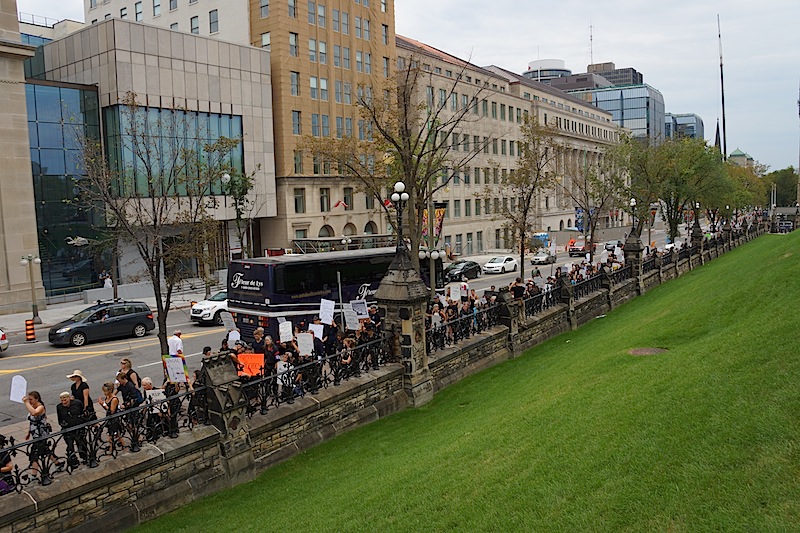
On September 27, 2019, I joined the young folk who decided to march in Ottawa, protesting the duplicity of politicians who talk about climate change, but do nothing to prevent an ultimate environmental disaster.

128 Wellington street, at O'Conner street, next to Parliament Hill, Ottawa.
Photo by Dr. Lev Tarasov.

At first, I felt a little out of place as I walked with boys and girls whose great grandfather I could be. I also felt that some of them looked at me askance and I'm not sure that I didn't see a glint in their eyes signalling: ‘Hey, old man, we're inheriting this mess from you!’

It may just have been my conscience. It's true that I've seen the climate crisis creeping up on us for almost half a century and I have raised my voice in protest on various occasions and in various media. But it is also true that I haven't done enough to prevent this disastrous environmental crisis from spinning out of control.

Anyway, as the young folk were standing around on the hill, waving their signs and occasionally breaking into some protest slogans, I walked up to some smaller groups to thank them for having both the insight and the courage to make their voices heard against the current Climate Change. I thanked them, saying that they made one of my dreams come true, that the young would rise up against those who triggered the crisis and refused to take the necessary steps to end it.

That broke the ice, and I chatted with a number of groups and found them determined to continue protesting until the politicians would listen and introduce the changes necessary to prevent an environmental disaster.

I ended each of my conversations with a warning.
‘Don't trust the politicians’. I said, ‘they will make you all kinds of promises even while they have no intention of keeping them — so long as they can stop you marching and protesting.’
I was astonished but pleased to hear that they had no illusions about the duplicity of politicians.
‘If they think’, one of them said, ‘they can silence us with empty promises, they have another thing coming. Just wait and see!’
On the whole, my conversations with the protesters gave me new hope. They have a healthy skepticism towards politicians and they're not going to give up until there is tangible action against climate change.

My final warning to them was:
‘Action against climate change at the government level is extremely important, but ultimately we can prevent a disastrous environmental collapse only if all of us, that is all of you and the rest of the people, lower their demands on the world. You must be prepared to reduce your standard of living, you must be content with less, drive less, travel less, consume less if climate change is not to destroy us all.’
That astonished some of them and I could see I'd given them something to think about. I hope some of them realized that protesting is not enough, we must also be prepared to change our way of life to live within the limits of what nature can provide, especially for a species in a state of population explosion.

Images

15 photos by co-marchers, sister and brother: Tamara Tarasoff and Dr. Lev Tarasov.

Videos by Ken Kensky Billings, Digileak Canada, of four groups at the Climage Strike Protest on Parliament Hill:

Sunday, 13 March 2016

Film review: Where to Invade Next

Where to Invade Next is a provocative and humorous film about how to improve American life with proven successful examples from other countries.

The 110-minute documentary was produced, directed and narrated by Academy Award winner Michael Moore.

Moore visits Italy, France, Finland, Portugal, Norway, Slovenia, Germany, Tunisia, and Iceland to show how those countries successfully deal with social issues by spending less on war, more on citizens.

He meets with CEOs, Ministers of Education, a former President of Iceland, an American teacher in Finland, and others, to reveal fascinating simple solutions, such as:
  • Focussing more on the ‘we’ rather than the ‘I’. This means working for the common good of all instead of working to become rich.
  • Favourable working conditions and good wages which allow for paid maternity leave for women that give birth to babies, and provide free paid vacation time to the workers.
  • Gourmet meals for school children.
  • Free education to all.
  • Equality in work and opportunity for women.
  • Enlightened rehabilitation of prisoners.
  • Liberal attitude to drugs.
  • The application of the rule of law to all, including bankers and CEOs who take advantage of the public good. Equality is the way to ensure that the gap between the rich and the poor is greatly narrowed.
  • Universal medical, hospitalization, and drug services to all citizens.
  • Infrastructure of public facilities have to be based largely on human needs rather than on profit.
The film was released in 2015 months before the national elections in November 2016, to challenge Americans to follow proven policies used by other countries. Moore says: ‘If they can do it, surely we can.’

This review is formatted similar to Where to Invade Next, Wikipedia

—————
Comments: Beginning in 2024, you can only self-enter a Comment below with a 'Google Account' (gmail). This prevents irrelevant anonymous comments (spam and admail).  If you do not have a Google Account, email your Comment to KJTarasoff@gmail.com for posting.

Monday, 1 February 2016

Q67: P. V. Verigin against Independent Doukhobors?

From: Kim Kanigan, Australia, January 26, 2016:

I read in numerous accounts that in 1914 Peter V. Verigin told the Canadian government that Independent Doukhobors, who leave his commune, do not deserve military exemption.
  • What is the source of this statement?
  • Is there a document to proof this?
  • Where can I see this evidence?

Answer

This occurred in 1917, not 1914.

In 1899, about 7,500 (1/3) of all Doukhobors had arrived in western Canada. Most but not all were followers of Peter V. Verigin as successor leader to Lukeria Kalmykova in Russia. The majority of those who remained in Russia were not followers of Verigin who was arrested and exiled.

The Society of Friends (Quakers) in London, Canada and USA together with Tolstoyans coordinated their migration, donated food, supplies and volunteers for education and medical care. Thanks to their help, many Doukhobors went to school and quickly adapted to their new home and independent freedom.

In December 1902, more than three years later, P.V. Verigin arrived in Canada to nearly 8,000 Doukhobors already divided. The majority were harassed by a small protesting group, and a minority were not his loyal subjects.

Rather than dealing with the situation in Saskatchewan and accepting homestead land, Verigin evicted his opposition and isolated his followers. In 1906 he returned to Russia (just months before the Canadian Government on June 1, 1907 began to cancel Community lands) claiming all would move back, probably a bluff to pacify zealots. In 1908 he got bank loans to buy land in the interior of British Columbia where he resettled two-thirds of his followers by 1913. He forbid contact with Independents under penalty of expulsion from his Christian Community of Universal Brotherhood (CCUB).

In 1916 the ‘Society of Independent Doukhobors’ was formed largely to have a voice in preserving their central core values involving military exemption status.
….The organization was made necessary when the Government demanded that the Doukhobors sign National Service cards, as an acknowledgement of their exemption status. Naturally, this demand brought some uneasiness. In January 1917, Peter G. Makaroff, a young Doukhobor lawyer, led an Independent delegation of five men to Ottawa. They stated that they were quite willing to sign the cards provided their religious beliefs were respected. As an offset to military service, they offered to pay a double measure of taxation if necessary. Moreover, the delegates pointed out that the Doukhobors in Western Canada had been giving active support to the greater production campaign and had placed as much of their land as possible under crop. Before leaving Ottawa, the Honourable Arthur Meighen explained to the delegation the National Service Act and assured them that ‘no interference with the privileges enjoyed by the Doukhobors was intended.’ Upon returning home, the delegates presented a full report at a large one-day conference of Doukhobors in Verigin, Saskatchewan…. (‘No Interference with Doukhobors,’ The Citizen (Ottawa), January 15 1917, cited in Tarasoff, Koozma J. ‘In Search of Brotherhood: The History of the Doukhobors,’ 3 volumes, unpublished, 1963, pages 496-497.)
During the Conscription Crisis of 1917, Verigin petitioned the Government of Canada to not exempt Independent Doukhobors from military service. In October 1917, he wrote to the Minister of Justice:
At the present time, I, Peter Verigin, the representative of Doukhobor community, do not recognize the second party as Doukhobors and consider that these people must be liable to be conscripted for military service on the same basis as other citizens of Canada, because the members of this party have free homesteads of the Dominion land and became British subjects for this particular land, and have firearms in their homes, and, therefore, they have to defend the crown of the British empire the same as all other citizens of Canada. (Petition by Peter V. Verigin to Chas.J. Doherty, Minister of Justice. PAC Photostat, OIP-DLB, R.C. 15, B.1, vol. 494,483 (14); ‘Doukhobors Are Divided in Opinions’, Regina Post, October 12, 1917.)
Ironically, while striving to build a ‘universal brotherhood’ he attempted to persecute his banished brethren with the aid of secular agencies. His petition was denied. To the wisdom of the government, it confirmed the law that all Doukhobors of conscience remain exempt from military service in Canada, free to perform alternative service or, if absolutist, given jail time.

Bushies and Barons: Kuranda Kisses, Blues magazine, September 2010, is an article about Kim and Lesle Kanigan in Kuranda, Queensland, Australia.

More: Questions and Answers, Comments

Sunday, 4 October 2015

Vote for Good Government

Cross-Canada Harperman Sing-Along
After almost 10 years in office, Prime Minister Stephen Harper and his Conservative government have become a political liability for many Canadian citizens at the time when the country is facing a federal election on October 19th, 2015. This dissatisfaction was highlighted with 100s of people participating in two high profile events here in Ottawa to influence votes:

Memorial March for the Victims of Harperism
I attended both events, heard the sounds of deep dissatisfaction and photographed the discord. See my 36 photos of Cross-Canada Harperman Sing-Along, and  134 photos of the Memorial March for the Victims of Harperism. See links to multimedia coverage by 7 other journalists, 1000+ photos.

It now seems that the Harper Government has managed to alienate many of its citizens with a series of scandals, paranoid behaviours and secrecy, using fear as a controlling mechanism in governing, and public embarrassment in the lack of diplomacy on the world stage — with 'no credibility with essential players'.
  • The Mike Duffy affair for improperly claiming over $90,000 of living expenses was an exercise in public deception.
  • The Conservative Senate fiascos since 2007 have brought dishonour to this Parliamentary institution. Perhaps now is the time to consider dissolving the Senate.
  • The ill-defined Bill-C51 was an overkill reaction to handling crimes, resulting in a threat to civil rights. Much of the Government's spin on terrorism and security is a hijacking tactic for votes.
  • Scientists and others have been muzzled from speaking out, resulting in a climate of fear and intimidation in the civil service.
  • Greatly cutting the budget of CBC has reduced the capacity to report accurately indepth news abroad.
  • The close of the long form Census was a reflection of the Conservative’s negative attitude towards science.
  • Closing down the Canadian Wheat Board has hurt many prairie farmers, resulting in lower prices of grain and erratic transportation schedules. 
  • Bill C-42 was an attack on citizenship, giving the power to the government to deport any citizen at its will.
  • The Auditor General exposed 'unprecedented incompetence' on the F-35 plane procurement scandal.
  • Rejection of the UN Kyoto Protocol to climate change was a slap on our commitment to clean up our environment. Climate change is a matter of human rights such as the right to life, the right to health, the right to adequate food and the right to water.
  • Shutting down parliamentary debate on important issues by using omnibus bills is a travesty of democracy.
  • The government was implicated in the 2011 Canadian federal election voter suppression scandal known as Robocall.
  • Lacking diplomacy on the world stage is not in keeping with the behaviour of a good statesmen. An example of this is Harper’s uncouth behaviour towards President Vladimir Putin of Russia. Remember that civilized people talk.
  • In November 2014, a resolution was brought before the United Nations that condemned Nazism. It was opposed by Canada, the US and Ukraine. What is the point of having Remembrance Day if nothing is remembered?
  • Militarizing Canadian society has been a cost to our stature in the world as a peace-keeping country. We need to awaken our consciousness about who we are, and what we need to do to regain our voice and leadership role for peace in the global community.
The list of missteps by the Conservative Government in Canada goes on. It is time for a change. Good government is urgently needed to meet the many human needs of our citizens and to bring civility and real democracy to the country.

On October 19th Canadians have an opportunity to go to the polls. ‘Vote for honest politicians’ advises Paul Maillet of the Center for Ethics Peace Services. Yes, stand up and be counted! Let us reclaim our country as one that is respected around the world for its honesty, good governance, universal health care, clean environment and a supporter of nonkilling peace.

More
  1. Harperman writer decides it’s time to go, sing out for change, by Kathryn May, Ottawa Citizen, October 3, 2015: A9.
  2. Open Letter to Canadians. Time To Re-Establish Canada As A Global Citizen For Peace, by Paul Maillet, Center for Ethics - Peace Services, Unpublished Ottawa, October 3, 2015.
  3. Steve Paikin, The Agenda, TVO. Michael Harris: Harper in the Hot Seat. YouTube, 30 minutes, 2015. 
  4. Teresa Healy and Stuart Trew (editors). The Harper Record 2008 - 2015
  5. Ed Finn (ed.). Canada after Harper: His ideology-fuelled attack on Canadian society and values, and how we can resist and create the country we want. 2015. See review by Meg Borthwick in Rabble.ca, Oct. 8, 2015. 

Saturday, 19 January 2013

Q54: Doukhobors and Hereditary Leadership?

From: Larry Ewashen, Words of Wisdom.

Did Doukhobors once believe in hereditary leadership?


Answer by Koozma J . Tarasoff:

In my opinion, as an Independent Doukhobor, the principle of hereditary leadership is problematic to the Doukhobors today on at least two counts:
  1. It is contrary to the basic egalitarian principle of Spirit Wrestlers of the 'God Within each'. Just consider how repugnant are the following arrogant sectarian concepts that are cited: the concept of the 'righteous ones', the 'true people', whose 'intellect is well above' other people. Also, there are said to be 'prophets' and 'Christs' who professed the truth to people. These concepts, in my opinion, are narrow self-serving and are an excuse for power and control, a practice often used in early human development. That was then, but today they have little universal appeal for common humanity.
  2. It is stated that the highest form of wisdom 'among the true people, among the Doukhobors, was always transmitted and still is in a hereditary way from leader-father to leader-son.' That statement is a classic aristocratic case of the primogeniture principle that historically has supported kings, queens, tsars and popes. This is NOT a Doukhobor principle and is contrary to its very essence. Primogeniture is colonial thinking and is largely anti-democratic in spirit. We have to acknowledge that there are those people who support the 'hereditary' principle of leadership, but they are misled in believing that this is part of the Doukhobor movement (since 1895). A record of oral tradition was published in 1909 (Psalom 310, p. 234) by Vladimir Bonch-Bruevich in Zhivotnaya Kniga Dukhobortsev [Doukhobor Book of Life] as purportedly supporting the hereditary line. The sample appears to be skewed in favour of the believers of leaders who do not question the basis of their beliefs, rather their views relate to old outlived customs, which in the present day judgement do not form the central core of Doukhobor values and philosophy. History, as I understand it, needs to be interpreted in the light of new information through a process of evolution. Ultimately, each society has to choose what is appropriate for its time.