Thursday, 13 June 2013

Peace Day Message 2013

Peter’s Day — June 29 — Peace Day

Dear Brothers and Sisters in Spirit,

Getting rid of militarism and war should be of central concern to all of us as humans, just as cannibalism and slavery have officially been abolished years back. Nonkilling should be the legacy of ourselves, our children and their children.

The idea of killing another member of our species is contrary to everything that we have been taught by all religions. The Commandment 'Thou shalt not kill' and the Golden Rule of doing unto others what we wish them to do unto us, are the standard rules of the road of how we ought to behave in our family, in our community and in the wider world.

In my youth, my mother used to say to me and my friends, 'Do not point a gun at another person because it is wrong to hurt another human being.' My mother believed that a future based on nonkilling was possible.

Our ancestors the Spirit Wrestlers / Doukhobors said 'Get rid of all guns!' On midnight of June 28-29, 1895 (Old Calendar), some 7,000 Russian activists in three districts of the Caucasus (between the Black and Caspian Seas) burnt their weapons that they had accumulated over the years. Their voice was loud and clear: get rid of the institution of violence and wars and instead choose the human path of cooperation, compassion and love.

As we commemorate this memorable historic event, let's remind ourselves and our children about the message of helping to create a culture of peace in our midst. Remember that we all have the spirit of beauty and love in each of us; therefore it is wrong to kill another human being.

Let's support the creation of Departments of Peace in the world. In Canada, for example, let's write our Parliamentarians to support the Private Member's Bill C-373 designed to create a cabinet level Department of Peace in Canada's Parliament. Let's cease to be slaves of killing and instead add our weight to being creative peace-making pioneers as have Lev Tolstoy, Mahatma Gandhi, Martin Luther King and other Masters of human behaviour have done in their time. Let's believe that the military industrial complex is on the way out and that a new era of human development is on the way in. Let's make real history happen by giving hope to civilization. Act now!

Koozma J. Tarasoff
Ottawa, Ontario, Canada

New Video About Georgian Doukhobors

Review by Koozma J.Tarasoff of Doukhobors: Community of Faith, a video documentary by Russian TV, June 7, 2013: (28 minutes). Copyright by "RT" and "TV-NOVOSTI" 2013.

Studying Doukhobors from their roof-top.

The opening image is a 1893 sketch of the Doukhobor village Gorelovka, Tiflis province, Russia, by H.F.B. Lynch. Russian Television (RT) sent a Georgian video crew to produce this documentary. The opening sound track is sprinkled with singing and snippet previews of this 'sacred place.'

The 29 minute video is divided into 5 sections titled: People (at minute 2:48); Vasily (3:30); Nikolay (6:38); Mikhail, Kuzma, Tatyana (9:00); Community of Doukhobors; Ads (12:04 for 2 minutes); Faith (14:12); Easter (15:20); Exodus (19:17); Neighbors (20:42); and Sacred Place (25:30) the cemetery.

Roof-top views

Presented mostly in English over Russian dialogue, the introductory printed text along with another text further on explains the context of this film:
  • RT teams up with a couple [video journalists Niko and Magda] from Tbilisi, Georgia, who travel south of the country to explore the community of the Dukhobors — a Christian group that believes God lives inside humans, not in an organized church. See how this group managed to preserve their way of life for centuries.
  • In 2013 a young couple traveled from Georgia's capital, Tbilisi, to the south of the country. This region is home to a breakaway Orthodox group. Known as the Dukhobors, they reject all church rituals and iconography and have managed to preserve their way of life.
This is one of the better films on the Russian Doukhobors for several reasons. It is tightly edited. Their philosophy is clearly articulated. The tone is upbeat, friendly and informative. Unlike previous videos in Georgia which focused on women, here men and children are included. The video quality and color are beautifully done.

The story is quickly paced from the time the crew leaves Tbilisi by car, arrives in Doukhoboria, climbs on top of a heritage earth house with a green grass roof, where they view the world of the few remaining Doukhobors in a village now occupied with Armenians and Adjarians (Muslim Georgians). The journalists ask many questions in voice over, which are eventually answered by the subjects in interviews. They translate most of the Russian in subtitles, and give insightful commentary throughout.

The journalists describe their roof top view as if it was 'from another planet.' The old Doukhobor village has given way to 'a Caucasian ghetto.' There is nostalgia for the old Soviet era when living together was a pleasure, cleanliness was a virtue, education was free, orderliness, culture and a job gave rhythm to life. There was a view of a public school with only several children present; they were reciting Russian, Georgian, and Armenian alphabets.

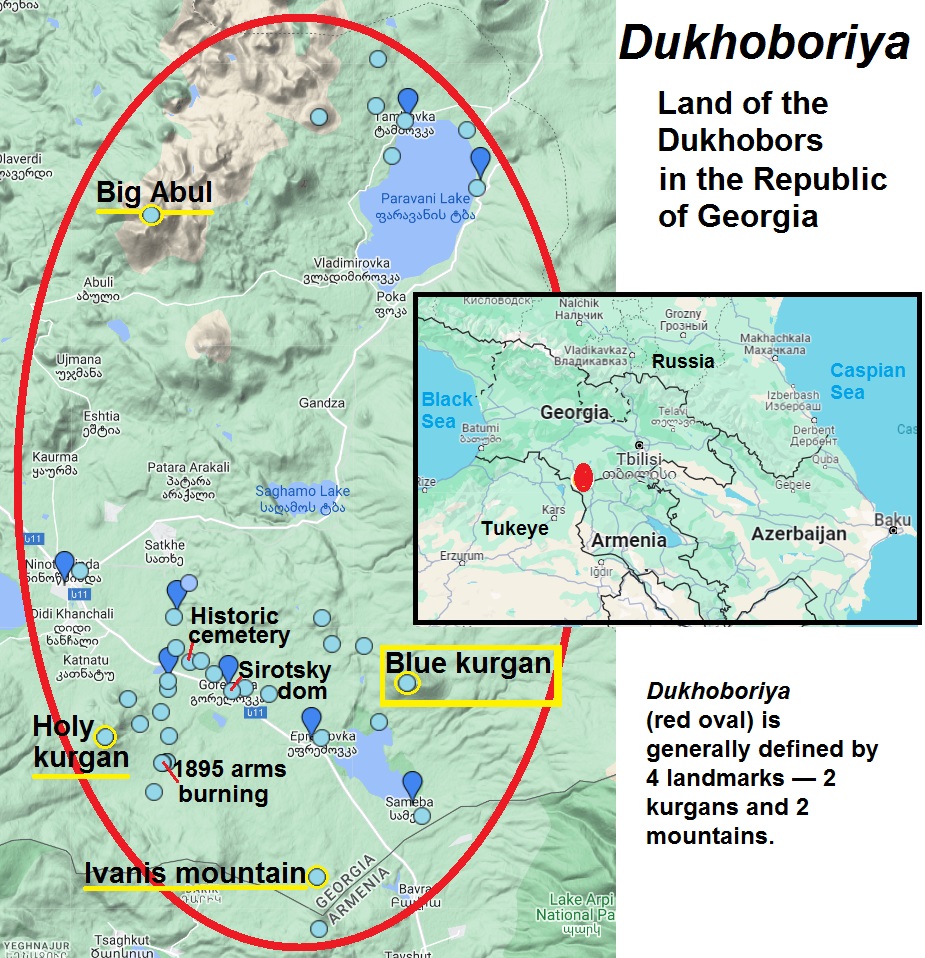
After 170 years in the region (having moved in exile from the Milky Waters area of the Crimea in the mid-1800s), only about 150 Doukhobors remain in Gorelovka here today. The trend is towards out-migration and a loss of identity. Their stone architecture remains a prized possession of neighbours who see an opportunity to get good cheap or free accommodation as locals move out to Russia. Only 57 Doukhobor houses remain in this village.

People interviewed are: Vasily Slastukhin (woodshop), Nikolai Sukharukov (sledge shop class),  Brothers Mikhail and Kuzma (at the cheese factory with sister Tatyana Oslopova, who later sings a song of the 'dear heartland').


Easter service begins at midnight with men on the left (3 men and a boy) and 12 women in beautiful traditional costumes on the right, perform a prayer service where there appears to be no leader yet there is a feeling of unity.

In 'Neighbours' a young fellow admits he came because his Armenian grandfather moved here. The village administrator regrets that so many Russians have moved away.

The remaining Doukhobors survive off their land — selling milk, cheese, and growing gardens. We see one of the women in the home making traditional pirogies.

The short clip of the storks in a nest on top of a pole is beautifully-done. According to legend, say the locals, these birds are a symbol of new birth, kindness and love.

In 'Faith' a woman describes the symbology of her Doukhobor cap. She says some suggest that Doukhobors 'originated in Byzantia,' a predominantly Greek-speaking continuation of the Roman Empire.

The last segment, 'Sacred Place,' is a tribute to the past at the Burial site of the leaders, a 3 kilometer drive west east of their village, where they join Doukhobors from neighboring Orlovka village.

The philosophy of the Doukhbors is clearly articulated with the words 'behaviour is the measure of ones life.' Vasily points out that Doukhobors don't believe in baptism. They see no need for churches which they consider to be 'idolatry.' Their God of love is within. 'Giving to the poor' and helping your neighbour is sufficient. White-bearded Nikolai states that Doukhobors 'live by their word' so that their actions speak louder than words.

Although this could be a depressive story of a people losing their property and their identity, the presentation remains upbeat, portraying the inevitable change that has occurred because of recent geo-political and economic circumstances. In the end, morality wins.

I was surprised that the caves and the 1895 Arms Burning site were missed. Despite these major omissions, this video story is well worth viewing because it really gives the viewer an impression of what life is like there in 100s of scenes and thoughtful dialog.

Tuesday, 28 May 2013

New Doukhobor Song Book, with CDs

Traditional Selections compiled by The Calgary Doukhobor Cultural Society (CDCS), with 36 songs on 2 CDs. 2013. 84 pp. (letter-size pages) $25 + $10 postage. E-mail: tradselect@gmail.com, or phone Don Cheveldayoff at 403-288-0058. 160 published, 30 available as of today. Wire bound.

Though an admirable effort, the first edition reviewed is an amateur work-in-progress, with many flaws. The project appears to have been rushed for this year's Union of Youth Festival held in B.C. in May.

I know well from the projects that I rushed, that flaws are bound to appear. Future buyers should wait for an updated edition.

In 2011, a small group of active Doukhobors in Calgary, Alberta, Canada, decided to publish a songbook with traditional hymns, psalms, peace songs and folk songs. They explain their reason on page 2 in Introductions and Acknowledgments.

The CDCS felt that a songbook needed to be developed that would function primarily as a teaching tool to accommodate the diversity of our group in terms of language — Russian/English and other cultural considerations. We concluded that a songbook with Russian, English, transliterations and accompanying CDs would serve such a need as well as be a legacy to future generations — our children, grand-children and great-grand-children.

Hopefully, our effort to present accurate and clear lyrics, translations and comments has been fulfilled. We apologize if any errors or omission are identified.

The CDCS team selected 36 previously recorded songs and hymns on themes of peace, love and goodwill which were copied on to 2 CDs. The book is well planned and organized to explain each song to those who do not read Russian, and may not know the significance of these selections. Each song is presented on two facing pages in 4 columns — (1) Comments, (2) English translation, (3) Russian lyrics, and (4) an inconsistent transliteration or a somewhat phonetic pronunciation guide.

The book cover shows a rough sketch of downtown Calgary overlaid with the Canadian Doukhobor symbols for peace (dove), and the staff of life (khleb-sol : bread, salt, water). The cover shows an archaic spelling of 'Doukhobour', not the standard 'Doukhobor' now universally used today, but was spelled correctly inside the book. Several photographs of choirs and a map provide some useful context to the reader.

Sample pages 35 and 36
The Comments column explains the song context. For example, several of the songs were performed by Doukhobors and Friends of Peace at the World Peace Forum held in Vancouver, British Columbia in June 2006. With a little more research, the compilers could have added an important historical fact — the Forum continued to Victoria, BC and led to the creation of the Canadian Department of Peace Initiative (CDPI) in which Canadian Doukhobors are active today.

The selection of psalms and songs were good. I especially appreciated these 4 of the 36:
  • Pages 43-44 — Bставайте, Силы Новые (Arise Ye Youth, the Time Has Come), performed by the Blaine Lake Doukhobor Choir in the 1960s, is a nice Prygun hymn calling on the youth for a spiritual awakening.
  • Pages 73-74 — Однозучно Звенит Колокольчик (Monotonously Rings the Bell) is Peter Voykin's exceptional solo, with accompaniment, on the traditional Russian folksong about a lonely coachman.
  • Pages 63-64 — В Честь Победы (In Honour of Peace and Freedom) is an excellent performance of the traditional Doukhobor hymn by the Friends for Peace Choir at the World Peace Forum in 2006.
  • Pages 71-72 — 'Last Night I Had the Strangest Dream' is a classic Canadian folksong, written after World War II, about universal peace, sung by Tom Hawken in 1999 in Vancouver. This is one of a several non-Doukhobor numbers included.
Two glaring assumptions of the meaning of the Doukhobor Movement appear, as if they are fact, without question, comment or discussion.
  • Pages 31-32 — Do Doukhobors believe in Jesus Christ as portrayed in Biblical stories? Such as 'how Christ lifts us and leads us in our times of darkness and need', 'of Christ suffering on the cross', and the story of heaven above. (See: Myth No. 5, in my Spirit Wrestlers: Doukhobor Pioneers' Strategies for Living (pp. 380-381)
  • Page 59 — Are Doukhobors Christians, as assumed in many of the hymns? Or are they universalists, of the Tolstoyan and Unitarian type? Ron Kalmakoff, singer, elegantly answers this on page 59 — 'The Kingdom of heaven is within'. That is, 'heaven' in not out there in space; it is here within us, reflected in our conscience and in our good behaviours.
The English translation is essential for the majority for whom this project was intended — descendants of Calgary Doukhobors who grew up hearing some of these songs, but no longer have much contact with their heritage community. Translation aids wider understanding.

The Russian lyrics are what my generation sung and memorized, but my main problem is with the inconsistent transliteration of the Russian. Using the sample pages 36-37 (shown above), compare a popular standard transliteration of Russian to that published.

US Library of Congress        As Published
Spite orly boevye,
Spite s pokoinoi dushoi;
Vy zasluzhili rodnye,
Pamiat' i vechnyi pokoi.
Speete arli boeviye,
Speete s pokoynoy dooshoy;
Ve zasloozheelee rodniye,
Pamyat ee vechniy pokoy.

Just in this one song there are 3 sounds shown for 'o' and 2 sounds for each of 4 other Russian letters. Russians can vary the sound of the vowel 'o' depending on its location in a word, and the regional dialect of Russian they speak. These varying phonetic sounds depend on the 'ear' of the person writing them.

The published book transliteration only uses a Southern Russian dialect 'h' sound for the Russian letter г (g).

It is noteworthy to look at the foremost Doukhobor linguist Dr. Alex P. Harshenin (1930-1977) and his work on 'English loanwords in the Doukhobor dialect'. In a letter to the editor of Iskra (January 4, 1974: 17-19), the UBC professor wrote: '.... In fact, Doukhoborism cannot be bound to any particular language, although everyone is aware that there is one language in which it finds its richest expression even to the present day, and that is in the broadcast sense "Russian." And it is the learning of Russian that will preserve the better aspects of the dialect, and consequently, of the entire culture as well.'

More recommendations:
  • Again, the most glaring is the phonetic transliteration. I found dozens of errors and stopped counting. The correct transliteration of Russian г is g (not h). Мир is Mir (not Meer). Though many Doukhobors may consider such transliteration as a display of their colloquial dialect, in my opinion it shows poor scholarship and undermines the seriousness of this volume. The compilers failed to consult a standard professional transliteration system as used by scholars throughout the world.
  • Redo the Bibliography (p. 84) with correct precision and accuracy, e.g. No. 6: 'Plakun Trava.' 1982. Koozma Tarasoff. p.26. Redo it as: Tarasoff, Koozma J. Plakun Trava: The Doukhobors. 1982. p. 26. e.g. No. 10. 'Spirit Wrestlers'. 2002. Koozma Tarasoff. p. 109. Redo it as: Tarasoff, Koozma J. Spirit Wrestlers: Doukhobor Pioneers' Strategies for Living. 2002. p. 109. Use one style for all the references.
  • Recall all of the books sold (but let them keep the CDs), and send the customer a new corrected version.
In sum, the package of 36 selections for the CDs and accompanying volume is admirable. The format could be used for many more songs. However, this text is highly flawed and should be replaced as soon as possible with corrections and notations. Our children and the public deserve better.

Friday, 24 May 2013

Privatization Threatens Canadian Medicare

Raging Grannies
The Ontario Health Coalition held an emergency summit in Ottawa on hospital cuts and privatization on May 22, 2013. Its gravity was expressed as follows as some 70 people watched and listened:

'Ottawa is Ground Zero for hospital privatization in Ontario. The Ottawa Hospital is facing among the harshest heath service cuts of anywhere in the province. Thousands of surgeries and hospital procedures are being offloaded, cut and privatized to for-profit clinics (day hospitals). The privatization of clinical hospital care is unprecedented. It threatens the start of for-profit hospitals. It must be stopped.'

Speaker Maude Barlow of The Council of Canadians pointed out that every person has the human right for health care. She urged Canadians to fight privatization. In closing, she paid tribute to Tommy Douglas (1904-1986), the recognized father of socialized medicine in Canada who also paved the way for bargaining rights for civil servants.


Michael McBane, National Director, Canadian Health Coalition, cited peer-reviewed evidence to show how private for-profit delivery of health services is inferior to public not-for-profit delivery. The ten critical items are as follows:
  1. Higher costs.
  2. Higher death rates.
  3. More serious deficiencies in staffing and resources.
  4. Marketing of inappropriate services.
  5. Conflict of financial interest.
  6. Longer wait times for those who can't afford to queue jump.
  7. Cherry-picking to shift cost, risk and liability to public system.
  8. Opportunities for fraud.
  9. Breaking the law against extra-billing and queue-jumping.
  10. Opening up health care to international trade agreements.
  11. For-profit health care is an attack on democracy. (Added by member in the audience) 
The last speaker, Natalie Mehra, Director, Ontario Health Coalition, explained how the proposed 2-tiered system as advocated by the provincial and federal governments is having a negative effect on many aspects of health care, such as seniors. She ended by saying: 'These are human decisions that can be changed, as Noam Chomsky used to say.'

The Ottawa Raging Grannies were on hand at the entrance to the meeting hall with singing and a sign. One of their three numbers ended with: 'Get sick, you'll make somebody richer. It's for-profit health care now!'

Another song was a challenge to the politicians

Politicians, give back our Medicare
It's time the best thing Canadians get to share!!
Just tackle the two-tier question,
It gives us indigestion.
You want our vote — just take this note:
Give back our Medicare.

Tuesday, 14 May 2013

Q56: Help For Struggling Artist?

Doukhobor Artist in U.S. Wants to Study in Canada

Michael J. Koftinow, Manteca CA asks:

.. I am an artist born and raised in California but whose origins are Doukhobor. My family moved from Russia, to Canada to Manteca, CA and settled there in the early 20th century.

I am interested in the history of the Doukhobors (especially their philosophies on life) and would like to personally learn more about it all.

My artwork relates to the Doukhobor ideals (and I've been doing this for years without even knowing it, I guess the spirit thrives in me) but I was wondering if there are any outlets for a poor artist like myself to visit Canada and learn more about my cultural heritage while making artwork about the Doukhobors philosophies on life, government, and the spirit in us all (like artist residencies/ research grants/ways to get to Canada and learn more about the group).

I know its somewhat of an open ended question, but I am fascinated by the culture and would like to learn more about them. Although the Internet is good for reading about the Doukhobors, I haven't found much in grants or artist residencies for our illustrious culture. If you have any thoughts, I would love to find out.

Update May 24: My motivation for creating art is to investigate the accountability and legitimacy of global policy barons. Therefore, my art objects are about society and sustainability. I combine a variety of media such as: drawing, painting, print, sculpture and installation to create imagery that have a topical narrative to it. The imagery chosen and the way the works are presented is a discussion on contemporary life and current affairs. Topics such as water, environment, economy, waste and abuses of power fluctuate with a cast of characters that range from popes and presidents to peasants and paupers.

Too Big to Fail
In the past, my imagery has focused on challenging authority, corruption, hypocrisy and the big bank rollers who finance it all. However, lately, I am increasingly interested in exploring specific sides of these issues. In concepts that are more focused on the, who, what, when, why and how we can fix it. Nonetheless, my ultimate aspiration is to offer imagery that creates a dialogue with the viewer without jeopardizing personal or artistic integrity.

My work can be considered satirical, topical or political but I think of it as cultural commentary. It is looking at leaders and society with an inquisitive point of view. It is the way I understand the world and I illustrate it with a pop-journalistic point of view.


Answer by Koozma

Michael Koftinow's request is genuine. In my experience, most aspiring artists in North America have difficulties in making a living in a free market environment which tends to favour profitability over serious creativity. I applaud Mike's intent to learn more about the philosophy, culture, and inner spirit of the Doukhobor Movement.

There are a number of Doukhobor artists (professional and striving) who are scattered mostly in Western Canada. Perhaps they or their friends can provide a place to stay for this California artist as he further explores his roots and 'the illustrious culture' as he stated. You may respond to him by contacting me at kjtarasoff@gmail.com.

Another opportunity is to attend the 66th Annual Doukhobor Youth Festival at the Brilliant Cultural Centre, Castlegar, British Columbia, May 18-20, 2013. The sponsoring group (the Union of Youth, USCC) will no doubt invite visitors on stage to say a few words of greetings. Here, then, is an opportunity for Michael Koftinow to make his intent known.

Michael is a graduate with distinction from Sonoma State University with BA's in Painting, Art History, and Art Studio.  His Senior Honors Thesis was on 'Jacques-Louis David in Exile'. While working as an educator and  art instructor at the Charles M. Schulz Museum and Research Center in San Rosa, California, Michael was known for his skills in learning new concepts quickly and thinking outside the box. He has also worked as an assistant creative director of a nonprofit group Artstart, helping children to achieve their artistic goals.

Homework:
  1. Read Koozma J. Tarasoff's Spirit Wrestlers: Doukhobor Pioneers' Strategies for Living (2002). Find articles about many Doukhobor artists.
  2. Write to the editor of Iskra, 1876 Brilliant Rd, Castlegar, British Columbia, Canada V1N 4K2, email at info@iskra.ca, Phone: (250) 365-3613 ext 27 or (250) 442-8252. Iskra needs helpers.
  3. Many articles are online on my website Spirit-Wrestlers.com, and links and stories at Jon Kalmakoff's website Doukhobor.org, like The Manteca Russian Colony. Also search for the names of the few Doukhobor artists I named above. Check Larry Ewashen's website for other stories on the Movement.

Friday, 3 May 2013

Book Review-Editorial: The End of War

John Horgan. The End of War. San Francisco, California: McSweeney's Books, 2012. ISBN: 9078-1-936365-36-4. 228 pp.

The End of War is close to my heart and mind as a Doukhobor. I cannot review this book without also adding my own editorial comments. So this is a review-editorial about abolishing war.

Horgan argues that there is no future for this diabolic institution. War will vanish like cannibalism and slavery. He believes as I do, that we can abolish war if we make our minds to do it and set up the structures to make it happen.

Using the collective wisdom of many scholars, Horgan urges us to stop using mines, bombs and other weapons that kill indiscriminately. This includes drones that US President Obama's administration has deployed to carry out assassinations in Iraq, Afghanistan, Pakistan, Yemen and elsewhere. Canada's Prime Minister Stephen Harper is planning to order combat drones — a backward step in world civilization. We Canadians ought to rise up and speak up against this dangerous policy. As well, we need to stop selling weapons to other nations, and to their adversaries.

Much of the arguments on ending wars can be summed up in a meeting in Seville, Spain in 1986, when scientists under the auspices of the United Nations, drafted a statement that begins with five propositions:

It is scientifically incorrect to say that ..
  1. we have inherited a tendency to make war from our animal ancestors.
  2. war or any other violent behavior is genetically programmed into our human nature.
  3. in the course of human evolution there has been a selection for aggressive behavior more than for other kinds of behavior.
  4. humans have a 'violent brain'.
  5. war is caused by 'instinct' or any single motivation.
The statement concludes 'that biology does not condemn humanity to war, and that humanity can be freed from the bondage of biological pessimism. ... The same species who invented war is capable of inventing peace. The responsibility lies with each of us.' UNESCO, the United Nations Educational, Scientific and Cultural Organization, approved the Seville Statement in 1989 and has circulated it around the world and many professional organizations have endorsed it.

I appreciated the many quotes from prominent world scientists, philosophers, neurophysiologists, anthropologists and activists, as well as military figures in support of his thesis, such as Mahatma Gandhi, Martin Luther King, Jr., Lev N. Tolstoy, Margaret Mead, Gene Sharp, John Mueller, David Grossman, and others.
  • There is 'powerful human resistance toward killing one's own species' (p.60). That is why almost 30 percent of veterans of Iraq and Afghanistan suffer from Post Traumatic Stress Disorder. 98 percent of World War II veterans who endured sixty days of combat suffered a psychiatric breakdown (p. 63).
  • As Grossman notes, 'training and propaganda can overcome men's sympathy for the aversion to harming others' (p.66). Also 'violent media, and especially extremely realistic "first-person shooter" games, condition users to overcome their natural aversion to killing"' (p.120).
  • There is 'no clear-cut correlation between resource scarcity and warfare' (p.86).
  • Not all societies wage war. War has never been observed among a Himalayan people called the Lepchas or among the Eskimos (p.101). Margaret Mead's most powerful account of war is her 1940 essay Warfare is Only an Invention — Not a Biological Necessity (p. 101). Mead believes that for the invention of peace to work, 'the first requirement [is] to believe that such an invention is possible' (p.122). Another way to say this is: 'Where there is a will, there is a way' (p.124).
  • 'Docility and bounded nationality — or stupidity, to put it bluntly — help explain why young men throughout history have embraced the terrible lie of the Roman propagandist Horace: ..."It is sweet and honorable to die for one's country"' (110).
  • In any society, there are 'bad apples' that kill. But 'war is the ultimate bad barrel' (114). The institution of war is the main culprit. Abolishing war should be our first priority.
  • Costa Rica, a small county in central America, abolished its army in 1949. In the World Database of Happiness, Costa Rica has received the highest score, while the United States ranked at the bottom. Horgan writes: 'Instead of spending on arms, over the past half century, Costa Rica's government invested in education, as well as healthcare, environmental conservation, and tourism, all of which helped make the country more prosperous, healthy, and happy. There is no single way to peace, but peace is the way to solve many other problems' (p.148).
Politicians, take note. Be brave and make ending war a priority. By ending the war and even the threat of war will transform the world in many creative ways. Your contribution to this process will make you one of the pioneers in getting rid of this diabolical institution.

As an interim step, the creation of Departments of Peace in each country, at the cabinet level, could be a great stimulus to peace-making instead of empty rhetoric. Canadians need to support Bill C-373, an initiative to establish a Canadian Department of Peace. Also we need to look at the new support in this long road to peace called Center for Global Nonkilling. I am surprised that John Horgan missed these two very important references in his learned volume on war.

Readers, please read this book. It has wings. Dream a little and imagine a better future in a world without wars. This one is for you, your children and your grandchildren.

Find more about this book.

Wednesday, 24 April 2013

Raging Grannies Protest Muzzling

In front of Library and Archives Canada, 20 Raging Grannies protested the ‘muzzling’ of federal scientists, librarians, and civil servants from speaking freely in a democracy. Several came from Montreal to join their local colleagues in this rage-fest. See 83 photos of the Raging Grannies protest.

The Prime Minister gags a scientist.
The Grannies staged a street theater. A masked actor playing Stephen Harper, Prime Minister of Canada, gagged a scientist, a librarian and a backbench MP with red and green tape.

‘When you shut down inquiry,’ said Granny Bessa Whitmore of Ottawa, ‘you don't have democracy. We know what happened in the 1930s in Germany, and we don't want that to happen here.’

Bessa lived through the McCarthy era of the Cold War and wants to ensure that this period is not repeated. She spoke for all the Grannies when she said: ‘We must take action now. We cannot be silenced.’

Their signs reinforced their message: ‘Don't be Muzzled. Make Noise!’ ‘Take Action Against Muzzling!’ These words from the song of the Raging Grannies say it plainly: ‘We're demanding free expression. This is unbearable oppression. Harper, you need to learn your lesson. Just let them speak out loud!’


According to the Ottawa Raging Grannies website, the first group to call themselves 'Raging Grannies’ arose in the winter of 1986-87 in Victoria, British Columbia. Several peace activists who were doing street theater began to strategically dress up in outrageous hats and sang satirical songs of protest.

They protested against nuclear submarines, uranium mining, nuclear power, militarism, racism, clear-cut logging, and corporate greed. They were sometimes arrested but never taken to court.

The Raging Grannies franchise spread across Canada and into the United States. Each group changes the words of familiar tunes to suit their particular circumstances.

Ottawa co-organizer Granny Jo Wood says that the present Stephen Harper's Conservative government, elected since 2006, routinely requires political approval before scientists, and civil servants can speak to the media about their scientific findings. ‘Muzzling is being used to shutting down dissent. The press is uninformed. Citizens are uninformed. We have to rise up against it.’ (‘Muzzling’ of federal scientists called a threat to democracy, by Margaret Munro, Postmedia News, February 20, 2013.)

Fisheries and Oceans Canada, Natural Resources Canada, Environment Canada, and Parks Canada have been warned about speaking to the public on identified issues such as climate change, the protection of the polar bear and caribou, and the pipeline. Not all scientists are muzzled, only those whose findings are unwelcome.

In 2012, Margrit Eichler of Science for Peace, pointed out, for instance, the Canada Science and Technology Museum was pressured by the Imperial Oil Foundation, which contributed $600,000, to change their exhibit about the oil sands. ‘They found the language too negative, were uncomfortable with the links between wars and oil, and objected that the exhibit showed changes in the landscape caused by oil mining.’

Dr. Eichler revealed that ‘Canada was a leader in government openness — now we occupy rank 51, behind Angola, Columbia and Niger, in terms of freedom of information.’

The best known example of interfering with scientific integrity of data collection is the abolition of the long census of Statistics Canada, and its replacement with a voluntary survey. With a voluntary survey, it is widely known that the information will deteriorate, especially for poorer groups such as Aboriginal people and disabled people.

Canada's first Parliamentary Budget Officer, Kevin Page, was relentless in his pursuit of government transparency. He was relieved of his post on March 22, 2013 (which he held since 2008) because of his persistence to provide independent analysis of government spending to parliamentarians.

A notorious area of secrecy and muzzling by the Conservatives is the military. The Harper government has blindly supported the 2003 invasion of Iraq, has crackdowns on government dissenters and liberal university professors, has wasted almost $1 billion in three days for security and other costs during the 2010 G20 Summit in Toronto, has allegedly been involved in mysterious robocalls, and has blatantly lied about the 65 F-35 fighter jets expected to cost tens of billions of dollars more than the official projections.

The Deptartment of Defence needs to began an urgent conversation with Canadians on what is the role of the military today in Canada. It needs to look at private member's Bill C373 to see how feasible it is today to create a Canadian Department of Peace in Canada. Only then can one ask what planes and ships are needed.

As Ottawa turns its attention to a handful of retired civil servants that are returning to the public service as well-paid instructors at a federal government management school, it is time to scrutinize an exponentially larger group of ‘double-dipping’ taxpayer-funded young retirees. It is very common for members of the military, for example, to retire in their 40s, often with 6-figure salaries, and to return as soon as the following week as a consultant or salaried civilian. Ex-military members then enjoy a decade or two of a generous pension topped up by a secondary salary or consulting fees, all fully funded by taxpayers. It is a long-standing practice but given its massive scale and our current climate of restraint, it is time for it too to be scrutinized and scaled back.

With the Raging Grannies, let's be inspired by their action against muzzling. Let's work for more openness and integrity in government and develop a new era of enlightened  and responsible leadership. Write letters to your Members of Parliament. No postage required. Join an on line campaign:
See 83 photos of the Raging Grannies protest.

Friday, 12 April 2013

Q55: Were Doukhobors serfs?

Charlie Chernoff, Sugar Land, Texas, USA, asks:

There is one aspect of the Doukhobor history that has puzzled me. So far I have not found a historical summary about how the Doukhobors escaped being serfs. History reports that Serfdom was abolished in Russia in 1861. But it seems that the Doukhobors lived in communities as free families long before that. A short answer if you can.


Answer by Jonathan Kalmakoff, Doukhobor Genealogy Website

In short, the overwhelming majority of 'our' Doukhobor forebears were 'free' peasants in Russia and not members of, the serf class. In other regions of Russia, many Doukhobors were serfs.

Most of 'our' Doukhobors (those belonging to the major grouping of Doukhobors who settled on the Molochnaya in the early 19th century and the Caucasus in the latter 19th century) descended from free peasant classes — odnodvortsy (smallholders), and Cossacks, state peasants and meschane (the townspeople), in the late 18th century.

As the classes were free to travel, they were more apt to proselytize among their Orthodox neighbours, thus 'infecting' them with their heresy. They were severely persecuted for doing so, but that did not stop them, and the Doukhobor faith 'spread across the steppes like a wildfire' during this period. The cruel punishments were replaced by a more 'humane' policy of resettlement, isolation and toleration (i.e., exile). These Doukhobors were quarantined in frontier regions of the Russian Empire where they would not infect the Orthodox, and in doing so, they helped colonize these regions.

That is not to say that there were no serfs at all among the Doukhobors on the Molochnaya and in the Caucasus, however, in most cases, they would have been escaped serfs from their landowers' estates, army deserters or exiles; in any case, serfs comprised no more than 1% to 3% of this major grouping of Doukhobors.

Elsewhere, across the Russian Empire, the Doukhobor faith appeared among the serf class, however, there is little documentary evidence about them. Doukhobor serfs were not permitted to join co-regligionists along the Molochnaya at the beginning of the 19th century. As a result, the majority were doomed to remain in servitude on their masters' estates in northern and central Russia, or else were conscripted into the army (considered the equivalent of a death sentence) or exiled to penal servitude in Siberia, until Emancipation in 1861. Following Emancipation, it is known that some communities of Doukhobors and other Spiritual Christians formed in the Russian Far East, including the Amur region, were comprised of emancipated serfs.

For more details, read historical articles on my Doukhobor Genealogy Website, and Dr. Breyfogle's 1998 thesis and 2005 book.

Sunday, 7 April 2013

Learn to Make Videos

For years I wanted to present my stories in video. Now I am doing it at age 81. My first short project is about my wife Kristina, then about Doukhobors.

I saw an ad for 'script-to-screen video production training for documentary makers and communication professionals.' The course offered 'hands-on' experience in making documentaries. Just what I needed. I enrolled in the first Doc-School held in Ottawa in March — Video Storytelling 101 — a flexible 10-day course.

Peter Biesterfeld
The founder of Doc-School and our teacher, Peter Biesterfeld was born in Soest, Germany. He has 35 years of experience in documentary film-making at Algonquin College, Carleton University, CBC, CTV, and in private business. He recently moved to Toronto where he is working on his current documentary: 'Anarchists and Activists'. I want to learn to do that.

I was pleased to meet three interesting classmates. We all have Eastern European roots. Ken Bilsky Billings began video in 1982; his father's ancestors came from the Crimea, Ukraine. Diana Watt is Manager of Special Programs in Education at the Ottawa University; she was born in Mission, British Columbia where she got to know the Doukhobor speaker/author John Kootnekoff ('Koots') who is a close friend of her father William Ordog (Hungarian). Patricia Palulis (Lithuanian) is Associate Professor of Education on sabbatical from the University of Ottawa.

Left to right: Diane Watt, Peter Biesterfeld (teacher), Koozma J. Tarasoff,
Kristina Kristova (in my video), Ken Billings, and Patricia Palulis
Our first lesson was to study documentaries online. I was most impressed by John Pilger, an independent journalist who speaks about complicity and compliance, censorship and citizen journalism, and the Iraq holocaust. See his Media and the War — Challenging The Consensus as well as the history of 'embedded' and independent reporting in The War You Don't See (2010).

We make videos as a team, and each must produce and edit their own 5-minute project. Ken was already writing and editing 'The Story', a profile promo of an Indian residential school survivor and writer. Diane is making 'WAM — Women, Action and the Media'. Patricia is working on 'Cinema Academica' and its interesting origins at Ottawa University. My project is 'Kristina — A Bulgarian Star in Canada'.

To stage and shoot my segments, everyone came to our residence. We shot Kristina showing how to cook banitsa, a classic Bulgarian pastry dish, and my interview with her. It took us eight hours of team work. Everyone had a chance to use professional cameras and rotate jobs.

We ended the night with home-cooked Russian Doukhobor borshch, Bulgarian banitsa and other dishes, lavished with Slavic hospitality (photo above).

Because this was the first of a series of DocSchools that Peter Biesterfeld plans to organize across Canada, I volunteered to make many photos for publicity. I support this low-cost effort to train citizen documentary filmmakers like us. See my photo album about the 10-day DocSchool Spring 2013.

DocSchool hopes graduates will form a collaborative community of serious documentary video producers. Arrange classes for yourself or a group via the website doc-school.ca. Master Peter can help you 'change the world' by creating effective documentaries that speak to the condition of the day. With professional coaching, you can learn much on your own.

Here are some of my insights from the 10-day course:
  1. Most important: What story do you want to tell? What is your compelling reason?
  2. Do your research, go to your passion and find your focus.
  3. You cannot tell it all. Choose items that provide an interesting consistent select story with impact. The story should be a very fresh journey with highlights and low points along the way. This visual and auditory canvas should be a unique experience in our lives.
  4. Your documentary is like a feature film. Think big, select effectively, edit ruthlessly and get the quality right.
  5. Your documentary film is a point of view with a purpose — not a consensus. The focus helps the audience open a window to the world. However, with the powerful editing tools that we have today (such as Final Cut Pro X), there is real potential for manipulating the story to some ends. This is because as editors we become kind of master puppeteers doing the job of controlling the action and reaction. As film-makers we want to reveal human emotions and present a mood (instead of just describing an action), yet at the same time we have a responsibility to be fair and honest and tell the truth.
  6. My impression is that governments do not want to tell the whole truth to the public because the truth will stop wars. Serious journalists and documentary makers believe that if they had done their jobs properly, and challenged the military about its charge that Saddam Hussein had weapons of mass destruction, we would not have gone to war in Iraq and Afghanistan. Propaganda and public relations people sell war by manufacturing fear of a created enemy threatening our democracy. Expose this fear!
  7. Curiosity ought to be our trusted friend. When necessary, challenge the official story, especially if it comes from positions of power. Who benefits? Why don't we seek an alternative to the war solution, for example?
  8. There is no one way to do a documentary. Michael Moore uses the ambush in-your-face approach. John Pilger asks hard questions with lots of visuals and archival footage. Jennifer Baichival employs the character approach. All are valid styles.
  9. I learned that the basics of visual story telling includes some or all of the following: the cutaway, using variety of shots such as medium, close-up and extreme close-ups; holding the shot until the action is complete; doing 10 to 15 seconds on each shot; shooting at eye level because this connects us to the audience; using more 'nose room' in front; focusing on the eyes, before moving out; asking at least four questions for our Focus Statement; getting an Establishing Shot at the beginning to give context; Actuality provides the real power to a story; with Continuity, we need to build, build and build. Finally, give the last word to the main character.
  10. Always try to tell a story through the eyes of a character — someone doing things for some compelling reason.
  11. In a meeting, ask permission at the beginning: 'Do you mind if I shoot it?'
  12. Think outside the box. The main character could be a place.
  13. Transcribe tapes before editing and creating a Shot Log with Time Codes. Use a yellow marker to indicate items you want to use. Every edit cut requires a motivated reason.
In summary, the 10-day course highlighted the need for dedicated citizen videographers to inform others and to ensure that out society survives as a just, clean, caring, friendly and beautiful entity.

For me, the course provided the preliminary skills and confidence to pursue the video projects that Kristina and I began 20 years ago — with my Doukhobors and her Bulgarians. Thank you Peter!

Useful Resources
  1. RSAnimate is a professionally clean animated video for explaining a complicated message.
  2. Storify is a Social network service that lets the user create stories or timelines using social media such as Twitter, Facebook and Instagram.
  3. Highrise in the World is an Emmy-winning, multi-media, collaborate documentary experiment by the National Film Board of Canada that explores vertical living around the world.
  4. Out My Window is an interactive NFB interactive documentary, open-source film, unlike any you have seen before. Katherine Cizek, the director, put it together over the course of years. You choose where and when you want the stories (49 in total) to begin and end.
  5. Transcend Media Service is a valuable free subscription service from the Johan Galtung group in Norway with weekly stories from around the world. Select videos are listed every week.
  6. Videomaker Magazine is a monthly magazine which covers the use of camcorders, desktop video, editing, lighting, and audio production for novice and expert videographers.
  7. Welcome to Pine Point is an interactive web documentation for the NFB Interactive about a northern town that closed in 1988, and was subsequently demolished.
  8. Adobe AuthorWare7 is an interactive training course for e-learning.
  9. Thoughtmaybe website is an excellent online repository of films covering topics challenging modern society, industrialized civilization and globalized culture.
  10. i-Docs is an exceptional online site for people interested in interactive documentaries, where you can learn, reflect and expand your understanding of the field.
  11. Peter Biesterfeld's Doc-School has helpful links to a number of interactive sites for documentary filmmakers: NFB, HotDogs Library, The Documentary Organization of Canada, Mastering documentary interviews, Chronology of Documentary History, and BBC New Technology on changing how a documentary ends.
See my photo album about the first 10-day DocSchool.

Friday, 29 March 2013

War — The Slavery of Our Times

In his 1900 essay, The Slavery of Our Times, Lev N. Tolstoy argued that killing people is murder and therefore war is contrary to Christian teachings (and one can add, to any warring religion).

He explained how: "Laws are rules, made by people who govern by means of organised violence,..." The army is an instrument of murder which kings, emperors, presidents and prime ministers have institutionalized.

He concluded that war is as useless, brutish, murder and harmful madness to society as slavery. The alternative is  love, non-killing, and a fair economy for all.

It has been over a century since Tolstoy penned that profound essay (below), yet we daily hear the drums of war with the propaganda of 'neutralizing' the enemy, the development of robot planes (drones) to better kill, and for surveillance and control of human populations.

Our 'military industrial complex' (which the late President Dwight Eisenhower in 1961 called as the greatest threat to our society) continues to devour the daily bread of ordinary citizens around the world, as it seeks to develop more and more weapons of mass destruction.

Surely guns kill whether they are rifles or atomic bombs!  Let's stop murdering people for some spurious patriot cause or more precisely for some economic gain.  Shame on us! War is certainly not healthy for children and other living things.
  • Where is our concern for humanity?
  • For the beautiful environment?
  • For creating a better United Nations?
  • For developing Departments of Peace in our respective countries?
Where is our sanity?
Have we gone mad as a human race?

Brothers and Sisters around the world, let's outlaw war just as we have earlier done with human slavery. The time is now! This is a time for cooperation, a time for using science for human goodness and beauty, a time for common sense. Let's get on with it, my friends! Let's turn to a new path of sanity, justice and respect for all. Are we not members of one human family?

I invite you to read Tolstoy's The Slavery of Our Times

Saturday, 2 March 2013

Artist Bill Perehudoff (1919 - 2013)

Sketch of Bill Perehudoff
by Russian artist Vladimir Gubanov
William (Bill) Perehudoff was a farmer, designer and artist whom I have known since the 1950s. He died in Saskatoon, Saskatchewan on February 26th at the ripe age of 94.

The Saskatoon Doukhobor choir will sing at the funeral at Saskatoon Funeral Home at 10:30 a.m., Monday, March 4. Burial at Bogdanovka (Cee-Pee) Cemetery, 6 miles west of Langham.

For me, Bill was a Doukhobor legend. He illustrated several of my books. In 2002, I wrote:

'One prominent artist in a family of five is an honour. But when the wife [Dorothy Knowles] is also a prominent artist and the children [Rebecca, Catherine, and Carol] are equally promising, that is something outstanding. All were born in Saskatchewan where the landscape and the spirit of the Canadian prairies had affect. William (Bill) Perehudoff (1919- ), the head of the family, comes from a Doukhobor background and has been painting for over fifty years. His passion for form and colours have led him to experiment in his farm studio on the North Saskatchewan River. His perseverance and tenacity appear to stem deeply from his Russian roots.' (Spirit Wrestlers: Doukhobor Pioneers' Strategies for Living (2002), pp.117-119.)

Little is published about Bill's opposition to militarism and war. During World War II, he was one of 92 Doukhobor absolutist conscientious objectors who chose to go to jail for four months in Prince Albert, Saskatchwan. While many of his contemporaries in the 'English' (other Canadians) world were avid patriots, Bill in his true Doukhobor spirit of plakun trava (meaning, flowing against the current) bravely went against the prevailing military propaganda of the day.

In Saskatoon in 1948, Bill was first known for murals he painted in the Intercontinental Packers Limited cafeteria. In 1952, he began a 25 year career as art director at Modern Press, a company owned by the Saskatchewan Wheat Pool, and publisher of the weekly Western Producer.

I began to know Bill in 1955 when he contributed Mother and Child, the first of his 5 abstract covers for The Inquirer, the first Doukhobor publication in the English language, which I edited. The original was soon purchased by the Saskatchewan Arts Board (page 10). By 1958, we published four articles about Bill's art career.

Pen and ink work by Bill Perehudoff
of the Arms Burning by Russian Doukhobors in 1895

For my first book, Pictorial History of the Doukhobors, published in 1969, Bill laid out the text and did 16 pen and ink drawings of arms burnings and other historic views. I worked closely with Bill as he greatly enhanced this first pictorial book about the Doukhobors. His images filled in a missing visual texture of our Russian Doukhobor heritage. Coming from a Russian Doukhobor background, Bill had a creative feel for his Slavic roots, and admired the Doukhobor movement.

I vividly remember seeing the book for the first time at the Doukhobor Historical Village Museum in Verigin, Saskatchewan. It was July 6, 1969, the celebration of the 70th anniversary of Canadians of Russian descent. Bill arrived in his station wagon filled full of books and 16 framed pen and ink drawings. We stacked the books for sale on a table at the meeting site. I sat for hours selling and autographing copies, talking and watching people admire the new pictorial volume. I also bought all his drawings, some of which have been on display in my living room for decades.

For a while this book become a rare collector's item which sold for up to $700 a copy. Now you can find lower prices online.

In 1977 Bill retired from Modern Press, but continued to paint until 2001 when poor health resticted his work.

When I was co-curating the exhibit The Doukhobors: 'Spirit-Wrestlers' at the Canadian Museum of Civlization in 1995-1997, Bill generously donated a large abstract painting of a Doukhobor sash, acrylic on canvas (Tarasoff, 2002: 118) to the Museum. He also donated a painting to the Doukhobor Museum in Castlegar, BC. To the National Doukhobor Village Museum in Verigin, Saskatchewan, he donated an artistic depiction in colour of the 1895 arms burning which was then used in the Centennial quilt design (ibid.).

At the end of the 1990s the CBC videotaped A Conversation with Bill Perehudoff on resistence to abstract art at his rural home and studio overlooking the North Saskatchewan River. This video was aired again by CBC on February 8, 2013. Bill asserts the need to simplify confusion to allow art to last and 'let colour come alive'.

I feel that Bill Perehudoff is not fully recognized as an abstract modern artist, nor is his Doukhobor heritage well known. A Google search for the name Perehudoff finds 100s of pages about Bill's art career, and images of him and his paintings, even a Wikipedia page.

In sum, Bill Perehudoff's legacy will carry on not just as a creative artist who experimented with the abstract form as a way to discover something new so as to attract public attention, but also his deep roots in the prairie soil, and in the Russian Tolstoyan Doukhobor tradition of the Spirit Within, including its important nonkilling universal ethic.

We will miss you, Bill, but we will remember the beauty that you have given to the world, as well as the wisdom to work towards a world without wars.

Bravo, my dear friend. Bravo!

Tuesday, 19 February 2013

Ode to Kristina

My wife was awarded the Bulgarian Medal and Certificate of Honour!

On February 16, 2013, Kristina Kristova was officially recognised by the Bulgarian Government — the Agency for Bulgarians Abroad — with the national Paisii Hilendarski Memorable Medal and Certificate of Honour. The Certificate states: 'for her significant contribution to the preservation and promotion of the Bulgarian culture and traditions in Canada, for her dedicated work as the founder and leader of the Bulgarian Society in the Capital Region Ottawa-Gatineau, and to celebrate her 70th year jubilee'.  See 70 event photos.

Medal inscription: 'Bulgarians, know your roots and language.'

In 2000, the Bulgarian Government decreed to issue an annual state award to creators and performers whose works are connected with Bulgarian culture, history and traditions. The award was named for monk Saint Paisii Hilendarski (1722-1773), a national historic spiritual leader, peoples' revivalist and confessor, and founder of the Bulgarian Renaissance. While in monastery (1760-1762) he created the Slav-Bulgarian History — Istoriya Slavyanobolgarskaya — which stimulated the formation of Bulgarian national consciousness.


80 attended, with some from Montreal. Kristina's daughter Milena Krassi was honoured to be the event master of ceremonies at the Bulgarian Embassy, Ottawa, where the celebration took place. During the evening program of speeches, slide shows, and poetry, I added my poem (below). Delicious Bulgarian food was prepared by local volunteers. The first president of the Ottawa Bulgarian Community, Vasil Gatchev, called me an 'Honourary Bulgarian'. See 70 event photos.

My Ode to Kristina — a World Citizen

As friend, companion, husband of Kristina —
there is much to say about this interesting person.

Her Bulgarian experience as anchor person on
National TV for more than 20 years,
shows through in her personality.
In editing some of my draft writings, her comments are
appreciated for setting the logic straight,
for being concise, and for showing me
how creative words can impact the message on the public stage.
Her genius in grasping a thought, even in English,
often means rewriting what I considered to be a final draft.

As a pioneer in the local Bulgarian Community,
I have seen her selfless energy at work —
phoning, writing on the computer,
calling compatriots to preserve traditional language and culture,
and urging them to bring their best foot forward
in a multicultural Canada.

That same energy I have seen with other activities —
selling watches and jewelry to eBay customers,
working for a high-tech company,
selling designer clothes, and recently
working as Site Administrator of the International Languages Program on Saturdays.

In all of these works, quality has been her goal.
This often means a long day —
working into the early hours of the morning.
I would of course be called to help —
carry this, copy that, deliver this, take photos,
or help edit a letter in English. With her enthusiasm and good intent,
how could I not help?

Shopping for me with Kristina has been most frustrating.
Why? Because our styles differ.
I generally know what I am looking for, and I go for it;
while her approach is to look and look and look
for something ‘perfect’.
But as we all know, perfection is difficult or impossible to achieve.

In our 20-plus years together
I have seen how adaptable Kristina is.
Learning the English language from practically zero
has been a challenging task. And thanks to her she helped me with my Russian.
Unfortunately, I have not yet learned the Bulgarian language, but
have had to rely much on observation, listening, and instinct.
However, I very much appreciate and admire
the friendship of Kristina and members of the Bulgarian community in Ottawa.

Of course, I have noticed Kristina’s nostalgia for Bulgaria and Europe.
For her, Ottawa at times feels like a small village.
Periodically she reminds me that I came from Saskatchewan —
a country boy born on an isolated farm without any modern conveniences,
35 miles away from the nearest large city.

But for Kristina to be born in the centre of Sofia,
it is natural for her to see herself at the front of things.
Achieving great success in folk dancing,
Master of Ceremonies in thousands of concerts,
and as Anchor Person on TV,
this style has become her tempo in life.
Nostalgia for Kristina in an earlier active life style is normal.

Her Medal of Honour from the Bulgarian Government is long overdue.
Like the Order of Canada in this country, she deserves the respect of
her countrymen and women.
She deserves it —
because she has served well in giving generously to her mother land
just as she is contributing generously today to her adopted country.

My ode to Kristina —
a colourful person of our wonderful world community.
Obicham te!   (I love you!)

How we met

Kristina Kristova and I first met 21 years ago on Russian Christmas day in Ottawa, Canada, January 7, 1992 at a social gathering. We spoke in Russian. She was a news anchor for Bulgarian National TV who had come to Canada to sign a contract with the Canadian Broadcasting Corporation (CBC) in Toronto. Kristina was staying in Ottawa, Canada, where her daughter Milena was getting a Bachelor's Degree in Music at the University of Ottawa, and is now a flute and piano teacher.

Kristina was born in Sofia, Bulgaria during the height of World War II. She was folk dancer with the state folklore ensemble founded and led by Fillip Kutev. During the Cold War the group performed around the world; and, in 1963 toured 25 states in the USA, including Carnegie Hall in New York, and two cities in Canada (Montreal and Ottawa).

In 1968, at the age 26, Kristina won a competition out of about 1,000 candidates which led her to a career as the Anchor Person of the Bulgarian National Television. As a representative of Bulgarian TV abroad, she went to dozens of countries, including Greece, North Korea, and Afghanistan for which she received an Order of Bravery for her interviews on the streets of Kabul. Besides news, she was the Master of Ceremonies for over 7,000 concerts and festivals all over Bulgaria. In brief, Kristina was a very busy person in that small, historically rich and beautiful country called Bulgaria.

From 1995 (when the Ottawa Bulgarian organization was registered) to the present, Kristina was a member of the Board of Directors. From 2004 to 2007 and from 2011 to 2013 she has been President of the National Capital Region Bulgarian Community as well as the Ottawa Region Bulgarian Foundation.

More Views of Kristina

Anna Tzvetkova of Montreal, who was Kristina's colleague at the University of Sofia, Bulgaria, submitted this article with 4 photos to the Bulgarian language newspaper Trud [Labour]: Драги зрители, Христина Христова чукна 70! [Dear viewers, Kristina Kristova has reached 70!] (February 23, 2013). Two photos show her at work in Bulgaria.

Cartoonist Alexey Talimonov

In September 1991, I met Alexei Talimonov, an international renowned cartoonist and illustrator. He was in Canada heading a delegation of six men associated with the Museum-estate of Leo Tolstoy "Yasnaya Polyana."
We travelled to Durham, Ontario for a special meeting with the Tolstoy Society of Canada (dissolved in 1994). On September 21, I interpreted for a CBC documentary about the delegation and their view of 'the future of farming' for the program Andrienne Clarkson Presents. In Ottawa we met with the Art Director of the National Gallery of Canada.

I met him again in the fall of 1992, when I traveled to Tula, Russia, where Alexei was director of the publishing and printing company Lev Tolstoy. Alexei reprinted the 1900 edition of Vladimir Tchertkoff's Christian Martyrdom in Russia: Persecution of the Doukhobors. The Preface was written by myself and Larry A. Ewashen and published as a Spirit Wrestlers Associates publication (1993).

Alexei, his wife Nila, and two daughters (Lubov and Nina) migrated to England in 1994 and estblished careers. Daughter Lubov Talimonova (1971-2011) was an exceptionally talented painter, writer and illustrator of childrens books. One of her paintings, 'Space. Aries Constellation', was taken onto the space station MIR, bearing the stamp of the station's astroauts' signatures on the back.

Ukrainian-born Alexei Talimonov is a successful and award-winning cartoonist and illustrator. He is a member of The Cartoonists’ Club of Great Britain and the FECO. Alexey has exhibited his works worldwide. His cartoons have been published in newspapers and magazines since 1978. Five books of his cartoons were published in Russia, Ukraine and UK. Also Alexey has illustrated several books.
The meat grinder

More then 5,000 of his drawings have been published in various newspapers and magazines in the UK, Russia, Ukraine, USA, Canada, Germany, Italy, Iran, China and other countries. Amongst the British periodicals publishing his works are The Lancet, New Statesman, The Oldie, The Spectator, Prospect, Ethical Consumer Magazine, Writers’ Forum, Music Teacher and others.

In Russia Alexei Talimonov’s cartoons have been published in the leading newspapers and magazines of the country, such as Izvestiia, Pravda, Trud, Literaturnaia Gazeta, Krokodil, Zdorov’e, Argumenty i Fakty and others. Alexei Talimonov regularly participates in international exhibitions and contests. He himself is well known for his support of artists in Russia and other countries of the CIS. In 1994 Alexey Talimonov was awarded the International Goncharov Award as "The Patron of Arts".

See more of Alexey Talimonov's extensive collection of cartoons at

Wednesday, 6 February 2013

Artist Donates Paintings for Peace

Click for MORE PHOTOS

Visual artist, teacher and counsellor Jennifer 'Lightwolf' Jones of Manotick, Ontario, donated these two paintings to the Canadian Department of Peace Initiative to be sold by Silent Auction in Ottawa by February 28, 2013.

The paintings were created as group Spiritpaintings during the 2011 and 2012 Annual Ottawa Peace Festivals. Eight workshop participants followed a kind of Rorschach inkblot method in which 'the painter lets go of the outcome while being in a meditative state and focuses on a Prayer of Intention for Healing'. The result is an unfolding mystery or a new adventure.

Click for MORE PHOTOS
Jennifer Jones, visual artist and healer

For an elaboration of instruction, workshops and exhibitions, see Jones website Spiritpainting.com, especially the Podcast of her interview.

I met the artist at her Spiritpainting Show and Sale held in The Green Door Restaurant, Ottawa, on February 4th, 2013. Here I also met Bosnian filmmaker Vinko Totic who presented an 8-minute film on YouTube showing a demonstration of Jennifer Jones at work. See photos I took of the event.

In watching the YouTube, listening to the Podcast, speaking to the artist and viewing the exhibition, I was intrigued by the Spiritpainting technique in art and healing. Using paper or canvas and water-based paint such as acrylic, Jennifer Jones seeks the inner guide or energy spirit of the unconscious (in her case, it is the wolf, a symbol of power and teacher of enlightenment). Then she holds on to her Intention (prayer or request), as she relaxes and lets this mysterious process manifest itself while she places paint on paper, folds and refolds as needed.

'It's about letting go of your control, your thoughts, your ego, and allowing the Spirit to give you guidance,' she said. The emergent image, usually in bright colours, gives you mysterious beauty and even serves a healing function.

'I'm very glad to help the Canadian Department of Peace Initiative,' she said as she responded to Bill Bhaneja (co-chair of the Ottawa Branch CDPI) who publicly thanked Jennifer Jones for her generous gesture. 'I guess it will become an annual event,' said Jennifer.

Jennifer Jones works regularly 40 hours a week as a professional in a treatment centre in Ottawa. But from her home she has also helped heal clients across the country and even in Australia, for example, by speaking to them by phone. After getting proper rapport, she was able to pick up appropriate vibrations which she then used in producing a healing type of painting which she would sent to her clients. That's clairvoyance in action, as I see it.

Monday, 4 February 2013

'Tolstoy and Doukhobors' Exhibit Online

The 46-page bilingual exhibition Leo Tolstoy and the Doukhobors: Conscientious Objection (2010/2011) was posted on the Gandhi Information Center, Berlin, Germany, webstie on December 22, 2012. The title in German is Leo Tolstoi und die Duchoborzen - Kriegsdienstverweigerung aus Gewissensgründen.


This exhibition, created for the occasion of Leo Tolstoy's death centenary (November 20, 2010), was on display August 28, 2010 to January 29, 2011, at the Anti-War-Museum, at 21 Bruesseler Street, Berlin.  It is now archived in the Peace Gallery.

From many sources, the exhibit uses photos, maps, text, quotes, prose, a history timeline and list of Tolstoy's writting's about Doukhobors, to show '... the fundamental importance of activism against military and war as well as a plea for conscientious objection by the late Leo Tolstoy.'