Saturday, 17 March 2012

Celebrating My 80th Birthday

To celebrate my 80th birthday of February 19th, some 37 friends came out to a party on March 3rd at our home in Ottawa. Most guests were from the local Bulgarian community which I have gotten to know since I first met Kristina Kristova in January 1992 shortly after she arrived from Bulgaria to visit her daughter Milena.


Over food and drink there was a program of speeches, gift-giving and music.  Step-daughter Milena Kyurkchiyska prepared the main course dishes for which we are all grateful. What follows below are some of the memorable messages of the day.


My Poem

Good evening my friends — Bulgarians, Russians, English, Irish and Indian.

As I once wrote:

'I am part of you as you are part of me.
We belong to the same human family.'

You are all here today to celebrate a birthday.
Not just any kind of birthday,
but my 80th.

Eighty years ago
on an isolated Saskatchewan farm
I came to be
from my mother's womb —
helped by Babushka Polia as mid-wife.
My brother John was already here
four years earlier.
My Dad was on hand to
give moral support.

I was given the name 'Koozma'
after my Slavic Deda and grand-Deda
who both had the same name.
The roots stem from the Greek word 'cosmos',
meaning the Universe.

Fast forward to Ottawa
where Kristina and I are honoured to welcome you.

My friends —
Thank you for coming to share
your joy, love and gifts of friendship with me —
the ingredients that make life worthwhile.

Most of all —
thank you for remembering me as I am:
a father of two nice children (Lev and Tamara)
and their children Jaspar and Katya, Nic and Elena;
as husband to Kristina — the belle of Bulgaria
(with her two musical children Milena and Orlin);
a friend to all here and many others around the world.

An active part of me is that I am an ardent pacifist —
inspired by the wisdom of many:
Russian writer Lev N. Tolstoy who called war
'a slavery of our times';

Mahatma Gandhi, Indian lawyer who was grounded
in the principles of Truth and Nonviolence;
Martin Luther King, Jr. the nonviolent activist who coined the phrase
'I have a dream...';
As well as by the nonkilling tradition pioneered by
Glenn D. Paige of Hawaii.

Throughout my life I have embraced the
Spirit of Love in us —
which says

'It's wrong to kill another person
for then we kill the sacred spirit within each.'
Stemming from my mother's breast comes
my Spirit-Wrestlers/Doukhobor identity
of love, bridge-building, and compassion.

Again, my friends,
Kristina and I thank you for being here
and patiently listening.

At 80 —
I am grateful to share my voice with you
for friendship and joy!
Blagdarim! Thank you!.


From family and friends

Daughter 

For my father on the occasion of your 80th birthday:

A decade by decade reminiscence of your life so far!


As I was thinking about what I would say tonight, on the occasion of your 80th birthday, I decided I would do something that both of us have spent a lot of our lives doing: approach this challenge from a historical perspective. You have spent much of your life focused on other people — documenting their lives and sharing their stories — so I decided that tonight I will turn the historical lens on you!

Obviously, I wasn’t there for much of this, and unfortunately I don’t have access to great archival records to help me with this task. But I did my best to remember what I had been told and make some educated guesses so that I could share highlights of Dad’s of life, decade by decade, so far.

80 years ago (February 19, 1932): you were born on a farm not far from Saskatoon; you were welcomed by your older brother John, and of course you were a delight to your mother Anastasia and your father John Tarasoff; this was the Great Depression, a terrible time for many in Canada, but I have the feeling that your parents were hard-working farmers who made sure they would always be able to fill the tummies of their growing family.

70 years ago: you were a ten-year old living on your family farm; I am sure you were a big help around the farm and you were probably a very good student at your local school. You were bilingual, speaking Russian at home and English at school. I think you were a good athlete as well, and likely enjoyed playing baseball and other sports at Doukhobor picnics and other gatherings. You probably followed your brother around a lot and tried to be just like him, learning as much as possible.

60 years ago: As a strapping handsome 20-year old you had already had many adventures. Your skill as a baseball player had been recognized and you had been invited to a special baseball camp in the Ozark Mountains of the United States. Legendary ball player Ty Cobb noticed your skill and invited you to try out for the Pittsburgh Pirates. You even watched the Academy Awards from a Hollywood mansion when you were waiting for your tryout to take place. I think you were already interested in writing and taking photographs; Elena thinks that you probably spent time just watching your surroundings, observing and recording what you saw both in writing and on film. Soon you would start producing a journal, The Inquirer, to share knowledge about the wider Doukhobor community.

50 years ago: Now you were living in Vancouver, British Columbia. You now had a university degree under your belt — a Bachelors of Arts and Sciences focused on literature, psychology and drama  — you had married Saskatchewan Doukhobor Nadya Konkin and you were awaiting the arrival of your first child. You were finishing your Masters’ Degree in Anthropology and would soon juggle the demands of fatherhood, studies and then looking for a job.

40 years ago: Well, by now I was on the scene! 40 years ago, in 1972, I was 7 — almost 8 — years old so finally I can tell you a few things that I can remember first-hand! Just two years earlier you had been relocated from Winnipeg to Ottawa to follow your job with the Department of Regional Economic Expansion. In fact you lived right here, at 882 Walkley Road! You chose this house so that my brother Lev and I could walk to an innovative school, Fielding Drive Public School. A good education was always important to you! Even though we lived here in Ottawa, our ties to the West were important, and every summer we would drive or fly to Saskatchewan to visit my babas, my dyeda and other relatives. Later in this year you and Mom would take Lev and me on one of our first amazing travel adventures — to Moscow, Leningrad and Kiev for the Winter Festival of the Arts! Many more great trips would follow in years to come.

30 years ago: You had a 17-year-old daughter and a 19-year-old son. Lucky you! Two teenagers! Both of us were at university so you had some peace and quiet during the school year, but you certainly saw me during summers! As a result of all the travelling we had done as a family, I too had the travel bug and was looking forward to a year abroad. And thanks to all the photography I was exposed to I too had a camera in my hand, saw much of the world through a viewfinder and spent many hours in a darkroom developing film and printing photos. As a result of an earlier reorganization you were no longer employed by the federal government; but you were devoting your energies to research, writing and photography. Nadya, my Mom, had made the decision to live a separate life so you were learning to live a rich and fulfilling life on your own.

20 years ago: Much love was in the air at this time. You would soon meet a beautiful Bulgarian woman named Kristina Kristova. She would bring much joy and excitement into your life! You had attended my wedding to John Pinkerton two years earlier, and you were happy to see that Lev was living with the love of his life, Dorothee Bienzle, on an organic farm near Guelph.

10 years ago: It does not seem that long ago that I attended your 70th birthday with two very young children of my own. In 2002 you were the proud dyeda to 4 grandchildren: Jaspar (who was 6), Nicholas (who was 4), Katya (who was 3) and Elena who had just turned 1. Kristina and you lived a full life and you continued your research, writing and photography while she worked at JDS Uniphase. You enjoyed visits up to our place in the country, north of Wakefield, Quebec, and continued interesting research projects including working on an exhibit for the Canadian Museum of Civilization.

Today: So that brings us to today! 80 years — what a full and rich life you have lived so far. And you show no signs of slowing down! You continue your many activities — and even add some — as you adapt to our ever-changing digital world. You continue to correspond with your many friends and you continue to share your ideas — but now you use email, and web site and a blog rather than the typewriter and Gestetner-printed journal of your past. Your grandchildren are now all teenagers — or nearly there — and you delight in seeing them grow and make their own paths. Today they are students and athletes with many interests and talents. Tomorrow — who knows? They may be clothing designers, engineers, mechanics, lawyers, teachers.... But no matter what path they choose they will always know they are half-Doukhobor: they will know what borshch is (and how it tastes!), where the Doukhobors came from, and how important our pacifist roots are to our family — and to the future of the world. You can take great pride in knowing that this knowledge is in large part thanks to you! What a legacy!

So what does tomorrow hold? Who knows? But if these last 80 years are any indication of things to come, you will continue to have many adventures and happy events ahead.

So — happy birthday Dad! I invite all of you here to please join me in toasting the past — 80 years of a life well-lived — the present — a healthy, vibrant person surrounded by loving friends and family — and the future, with so much to look forward to!

With love,
Tamara


Grandson Jaspar, Guelph, Ontario

Happy Birthday!

Dear Koozma it's your birthday,
Oh what a special day!
Haven't seen you for awhile,
So I'll use this e-mail to say:

Your age brings plenty of experience,
A great deal of wisdom too.
And it's great when you share that knowledge
To help others become smart like you.

This day is meant to celebrate
Make sure you do something fun!
Because you've got a whole other year
Until you turn 81!


Tatiana and Misha Raytchev family, Ottawa

A happy man is a man of honesty and sharp intelligence.
There is no need to count years; we need to count deeds.

So let's celebrate the deeds of our dear Koozma as a professional, spiritual, and family man!

Love from the Raytchev family.


Glenn D. Paige, Founder and President of the Center for Global Nonkilling, Hawaii, as read by guest Bill Bhaneja, co-chairman of the Ottawa Chapter, Canadian Department of Peace Initiative:

To Koozma, dear Friend and Toiler for Nonkilling Peace —

Not by chance are you celebrating your 80th Birthday at home in community with family and profoundly respectful peace-worker friends. For it exemplifies the Doukhobor Spirit that we are not alone but toil in community to achieve everywhere the Peaceful Life objectives of the Burning of Weapons in 1895.

Your Spirit-Wrestlers's website is a global treasure for Nonviolence Education. Your Blog educates with elegant prose. Your photographs artfully open our eyes. Your patriotic actions toward demilitarizing Canada provide examples for nations of the world. Your generous caring for others appears in everything you do.

May your 80th Birthday celebration be an occasion to remind us all of Tolstoy's advice:

'Radоvatsya! (Be joyful!). Radоvatsya! (Be joyful!)

'The point of life, its purpose is joy. Rejoice at the sun, the stars, the grass, the trees, animals, people. And beware that nothing impairs this joy. If this joy is impaired, it means that you [we] have made a mistake somewhere — look for that mistake and correct it.'
    — Lev Tolstoy and Yasnaya Polyana: A Photographic and Literary Essay by E. Kassin, V. Yankov and G. Rastorguyev (Moscow: Progress Publishers, 1984), page 121.

May the Blessings of Good Health and Happiness be with you and Kristina Kristova for many years to come!

Love and Nonkilling Peace,
Glenn and Glenda


Bill and Marie Bhaneja, Ottawa, Ontario

To: Dear Friend and Peace Colleague Koozma

Warmest wishes on your special Birthday! We are grateful for you having inspired us all these years through your fine intellect, wisdom, kindness and commitment to build a world in which Nonkilling peace can be possible.

We salute you for the peace building you have accomplished.

Wishing you many more years of good health and happiness with Kristina and family.

Love, Bill & Marie


Jim Deacove, Family Pastimes, Perth, Ontario

Well, well. 80 years old. You have to tell us your secret of longevity. Not only do you feel good, but you also look good....I once heard someone say that the secret of longevity is deep breathing -- so long as you can keep it up for eighty or ninety years.


Svetlana A. Inikova, Moscow, Russia

From the innermost of our hearts, Oleg and I greet you on your 80th birthday. We wish you many more years to remain young in spirit, active, with a full life. Good health to you and good luck! Koozma, I thank you very much for all that you have done for me. You have become my teacher in the area of photo gatherng, you taught me to pay attention around you and not lose track of my camera.... (Trans. from Russian).


Local Bulgarians: Neli and Boria Poliakov, Malvina and Nedko Panayotov, Lidia and Vassil Gatchev, Kalinka Georgevova and Aram Nalchadjian, Rositsa and Evelyn Anastasov, and Anton and Svetlana Pelchesky (and daughter Rya).

Dear Koozma. With great satisfaction, as your Bulgarian friends, we congratulate you on your birthday and wish you good health for many years to come, so that you will again bring joy to us with your presence of wisdom — along with your wife Kristina and her concerns and help. We respect and love you!  From the Bulgarian community in Ottawa.  (Trans. from Russian).


Ivaylo and Elsa Grouev, Penka Grueva, and Maria Groueva, Ottawa

Our deepest wish to you for many years of good health, luck and success. Enjoy fully your golden age — an age of joy, serenity and wisdom … Always love and live light. May there always be sunshine, may there always be sky… With love and inspiration!


Lidia and Vassil Gatchev and Anka, Ottawa

It's not just on your  birthday that we stop and think of you. But that's the perfect day for us to tell you that we do!


Solveig and Stoyan Penev (Niagara Falls, Ontario) and Robert and Spartak Penev (Ottawa)

We wish you a very happy 80th birthday, and with much love, we wish you only health and happiness for the next 80 years.


Vania and Evgeni Stoychev, Bulgarian Ambassador to Canada, Ottawa

From our heart we wish you and Kristina good health, the celebrations of many more anniversaries, and to always be happy with good nature.  With admiration and love. (Trans. from Bulgarian.)


Jordanka and Avram Ignatov, Ottawa

Happy Birthday! We wish you health, happiness and to take interesting snapshots and gorgeous pictures.


Tsveta Panayotova, Ottawa

Congratulations to you on your Jubilee! I wish you good health, youthfulness and love.


Nadya Tarasoff/Lambert, Baysville, Ontario

Warmest wishes for a joyous celebration of your 80th birthday, a milestone our fathers never achieved.


Canadian House of Commons

Thursday, 8 March 2012

International Women's Day
       Deserves More Attention

International Woman's Day began in the early 1900s as International Working Women’s Day to recognize women's value in all aspects of society.

julie maas ~ nightslantern.ca

Today over 100 countries around the world celebrate this event on March 8th, many as a national holiday. Canada is one of those countries that has recognized its importance after 1977 when the United Nations General Assembly invited member states to proclaim March 8th as the UN Day for Women's Rights and International Peace — but Canada has not as yet created a holiday for it.

The struggle for gender equality and autonomy is far from over, and everyone of us (men and women) need to address discrimination in the workplace and reduce the salary gap with male counterparts. Today, in Canada, women have more rights in 2012 than they did a century ago, but more needs to be done.
Each year around the world during International Women's Day (IWD), thousands of events occur not just on this day but throughout the month of March marking the economic, political and social achievements of women.

The theme this year is 'Connecting girls, inspiring futures'. The idea is to develop the power and potential of young girls to be change agents for a better world. Would it not be great if this opportunity led to the creation of a nonkilling world without wars? That would be the fulfilment of the ultimate human right.

Girls and women, let's join with boys and men around the globe to make a real difference in our world. If we work together with a firm resolve to make everyday International Women's Day, surely we will overcome much of the violence, wars, corruption, and inequality that presently plagues our world.

Sunday, 26 February 2012

Activists Protest 'Conference of Defence Associations'

Over 100 concerned citizens in Ottawa marched to the Chateau Laurier Hotel on February 23rd to protest the hosting of the 'Conference of Defence Associations' in the Canadian capital. The march was organised by the Ottawa Peace Assembly who say that the military gathering is part of the planning phase for an attack on Iran.


The meeting in Ottawa of war profiteers, the Harper Government, and top military commanders from Canada, the UK and the US indeed appears rather ominous, resulting in a response from the activists. Their poster reads: 'Don't attack Iran. They lied in Iraq. They're lying about Iran. Don't let them do it again. Stop the war of 2012. Protest the war machine.'

As I walked with the marchers, I heard the following wisdom in the chanting:
     'Stop the killing. Stop the hate. We don't want your racist war.'
     'What do we want?' 'Peace.' 'When do we want it?' 'Now!'
     'Health care. Child care. Anything, but Warfare!
     'We need peace and prosperity, not war and austerity.'

A flyer stated: 'The Harper government is beating the drums of war against Iran, while spending millions on massive celebrations of the War of 1812, and $490 billion on militarism, all while attacking our cherished public services and falsely claiming there's not enough money.'

To emphasize the human tragedy of wars, the activists staged mock deaths outside the doors of the conference. (See a video clip from Press TV).

As a concerned Canadian, I support the move to Stop the war of 2012! (In fact, it is time to make war a crime against humanity.) As citizens, we ought to cease this drum beating and instead develop an architecture that prevents violence and wars. The creation of a cabinet level Department of Peace in Canada would be a good step in this direction. See Private Member's Bill C-373. Within its mandate would be the establishment of a Civilian Peace Service responsible for training peace professionals to work at home and abroad.

Parliamentarians, listen to reason. What are you waiting for?

The meeting sponsors, the Conference of Defence Associations (CDA) founded in 1932, is the oldest and most influential advocacy group in Canada's defence community and plays a leading role in setting the country's military and security strategy.  It receives funding through a grant from the Department of Defence. Since 1987 the CDA has created an outreach arm called the CDA Institute to 'research, to inform, to educate, and to promote informed debate, awareness and understanding of security, national defence and development issues.' For this purpose, the Institute conducts conferences, seminars, roundtables, meetings; promotes research activities, sponsors awards such as the Vimy Award; and publishes a range of magazines, papers, and educational/informative documents.

The USA, Israel, Britain, Canada and some of their Western allies accuse Iran of pursuing a military nuclear program of mass destruction. However, as a signatory to the nuclear non-proliferation treaty, Iran maintains that its nuclear program is for peaceful purposes. This unclear situation has resulted in much of Western media demonizing Iran which has become very similar to the lead up to the Iraq War.

Wednesday, 1 February 2012

Confusing Doukhobors And Nudists

Dear Editor:

I am responding to correct the  reference to the Doukhobors in Meghan Murphy's article 'The Naked Protestor (or How to get the Media to Pay Attention to Women)' (rabble.ca, January 21, 2012).

Nudity was first used at the beginning of the 1900s in Canada as a form of protest against injustice or perceived injustice. When the public was shocked, nudity became a quick and easy tool of embarrassing the 'guilty one'. The nudist soon learned that the quick way to get public attention, especially through the media, was to strategically strip naked at moments of disadvantage.

It was the extremist zealots or Sons of Freedom, so named in the early part of the 1900s who earliler split from Doukhobors to form a different group, used nudity as a form of protest along with destruction (fire, dynamite). The press and Ms. Murphy continue to mislabel the extremist Sons of Freedom as Doukhobors, though they are not the same.

Please understand that nudity was NOT a genetic part of the Doukhobor social movement. Nudity was used by a relatively few people, whom I have called 'zealots'. In quick time, these zealots (men and women) quickly got addicted to this tool and in a real sense hijacked the mainstream Doukhobor Movement. The media also followed suit as did many scholars who failed to distinguish zealotry from the main group.

See my book Spirit Wrestlers: Doukhobor Pioneers' Strategy for Living (2002) for many insights into the Doukhobors. Also read my website Spirit-Wrestlers.com.

Yesterday I was reminded by a psychology professor from California that 'culture must be handled with great delicacy and sensitivity' because it is easy to make an offense. Let's use this reminder when dealing with Doukhobors or any other group.

Sunday, 22 January 2012

How The Media Manipulates Us Into War

Generally, people assume that the media has the responsibility of presenting the truth and nothing but the truth in its journalistic reports about peace and war. It is agreed that an informed public is less likely to go to war.


The Transcend Media Service of the pioneering Johan Galtung nonviolence Transcend group in Norway, has presented a 'video of the week' from Global Research TV revealing some startling facts about mainstream media. The 14-minute video online 'Faking It: How the Media Manipulates the World into War' is worth watching. Summary:

'As the US and Iranian governments escalate tensions in the already volatile Straits of Hormuz, and China and Russia begin openly questioning Washington’s interference in their internal politics, the world remains on a knife-edge of military tension. Far from being a dispassionate observer of these developments, however, the media has in fact been central to increasing those tensions and preparing the public to expect a military confrontation. But as the online media rises to displace the traditional forms by which the public forms its understanding of the world, many are now beginning to see firsthand how the media lies the public into war.'

To help journalists make a correct picture of the world, Transcend offers a Solutions-Oriented Peace Journalism service to the public. Jake Lynch, Associate Professor and Director of the Centre for Peace and Conflict Studies at the University of Sydney presents a feature article: What is Peace Journalism?

In his opening remarks, Professor Lynch states: 'Peace journalism is when editors and reporters make choices  — about what to report, and how to report it  — that create opportunities for society at large to consider and to value non-violent responses to conflict.'

While the conventions of war journalism usually assumes a zero-sum game, leaving only further violence as a possible response, peace journalism, as a remedial strategy, chooses to supplement the news conventions by giving peace a chance. Here are five characteristics of peace journalism offered by Professor Lynch:
  1. Explores the backgrounds and contexts of conflict formation, presenting causes and options on every side (not just "both sides");
  2. Gives voice to the views of all rival parties, from all levels;
  3. Offers creative ideas for conflict resolution, development, peacemaking and peacekeeping;
  4. Exposes lies, cover-up attempts and culprits on all sides, and reveals excesses committed by, and suffering inflicted on, peoples of all parties;
  5. Pays attention to peace stories and post-war developments.
Of course, peace journalism is in favour of truth, as any must be. However, as a legitimate strategy in reporting especially on war and peace, it opens up multiple opportunities to inspect propaganda and other self-serving representations. As alternative media journalists, let us try to use as many of the five characteristics as listed above, while also avoiding demonizing language, labeling and so forth. By so doing, we will serve the public better and hopefully we will help give peace a chance.

Friday, 20 January 2012

Why Glorify War?

Logo: 'Another Mother for Peace'
This year marks the 200th anniversary of the War of 1812, a war that many consider Canada's war of independence, not from Great Britain, but from the USA.

Canada's Conservative government has embraced the bicentennial as a chance to inspire and inform, calling it 'the Battle for Canada', and devoting $28 million (3 years of funding, ending March 31, 2014) to commemorations, re-enactments and education. See the official website : 1812.gc.ca 

Why do we have to keep glorifying war, disguised as education to promote tourism? What about celebrating our pioneer farming history and the history of people who used their hands and efforts here in Canada to make our country what it is? We could learn some real lessons from that kind of history. We don't learn too much that is useful from glorifying war.

Here are 2 recent articles which annoy me:
Fanning the primordial emotions of people to become patriotic soldiers trained to kill another human being considered to be an 'enemy' is an outdated notion waiting to be dropped such as happened with slavery more than a century ago.

More and more concerned people of the world are speaking out for the creation of a new way of thinking. The January 19th, 2012 the United Nations DPI/ NGO Briefing: Culture of Peace: Amplifying the Unseen and Unheard Voices of Peace (2 hour video) examined the role of the culture of peace in today's interconnected world as a vehicle for human development and for ultimately realising the 8 Millennium Development Goals.

As defined by the UN, the culture of peace is 'a set of values, attitudes, modes of behavior and ways of life that reject violence and prevent conflicts by tackling their root causes to solve problems through dialogue and negotiations among individuals, groups, and nations.' That concept encompasses tolerance, disarmament, sustainable economic and social development, democratic participation, gender equality, freedom of expression, and respect for human rights.

The transition from a culture of war to a culture of peace requires the transformation of individual modes of behavior and institutional practises. Learning to live with peace and harmony is a long-term process which begins with inner peace and nurturing of attitudes and practises that promote the expansion of peaceful principles. Education plays a key role in this process.

In looking at Canada's role in this transformation, here are some things that our leaders and ourselves could do to create a safer peaceful world:
  • Cease the warrior mentality such as the development of $15 billion F-35 stealth fighter-bombers, and instead concentrate on building capabilities for rescue work, fighting fires and crime.
  • Urge world leaders to stop the development of intercontinental missiles, atomic and other weapons of mass destruction including land mines and soldier-robots.
  • Create a cabinet-level Department of Peace for Canada, with full support for training peace professionals.
  • Develop a generously-funded program in schools, universities and libraries honouring the real heroes of the country esp. in agriculture, settlement history, education, medicine, science, industry, literature, culture, humanities, sports, and politics.
  • Stop buying violent toys for children. Consider purchasing co-operative games where everyone works together to win.
  • Ultimately, declare that war is a crime against humanity. The new mantra ought to be the creation of a nonkilling society. Peace is the way of the future — for our children and our children's children.

Do U.S. Bases Threaten World Peace?

Who really threatens world peace today? Spokesmen for the most powerful military nation in the world, the U.S.A., state that rogue states and terrorists threaten the stability of our world; and that it intends 'to control space in order to protect U.S. interests and investments.'

With over 1,000 U.S. military bases around the world, at a cost of a trillion dollars a year, I am surprised that very few people (including the mainstream media) seriously raise the question of who really threatens the world order.

Stars show U.S. military bases in the middle-east.
From map posted by Lew Rockwell (12/6/2011).

In his December 12, 2011 article: Remembering His-Story - Iran Attack Next?, author Bruce K Gagnon addresses this serious question. Mr. Gagnon is Coordinator of the Global Network Against Weapons and Nuclear Power in Space. The map in his article summarises the situation. Each star represents a U.S. military base. In the middle, in blue, is Iran. Iran has no military bases outside its borders. Just north of Iran is Georgia that has essentially become a U.S. / NATO base. Turkey belongs to NATO. Iran has been checkmated. North of Georgia is Russia. Can there be any wonder why Russia is so alarmed about an attack on Iran?

Let's suppose that a foreign power set up a base just outside of the U.S.A — the government would probably go ballistic. So why can't the citizens see that their own nation is threatening other countries around the world with its colonial-type 'manifest destiny' approach? In our one-world community, we should follow the wisdom of classical cross-cultural anthropologists in respecting strangers.

From my anthropological training, I have learnt that 'stepping into the shoes of the other' is a good way to learn about the stranger. This wisdom encompasses the same attitude that is found in the Russian proverb 'When entering a church, do not bring with you your own charter.' Another proverb says the same in another way: 'Do not measure others by your own arshin (Russian: yardstick, measure).'  Effective cross-cultural workers and international negotiators certainly know these skills and use them in achieving their various ends.

Americans and other powerful nations, wake up! Let's remember that each country has its own interest. Collectively, the best interest of the world is global peace.  Let us therefore, follow the Golden Rule: 'Do unto others what others wish us to do unto you!

Monday, 12 December 2011

Book Review:
A Troubled Personality Revealed

Nerys Parry, Man & Other Natural Disasters (Winnipeg, Manitoba: Enfield and Wizenty, an imprint of Great Plains Publications, 2011), 214 pp. ISBN 9878-1-926531-12-0. $29.95.

Updated 15 May 2022. 

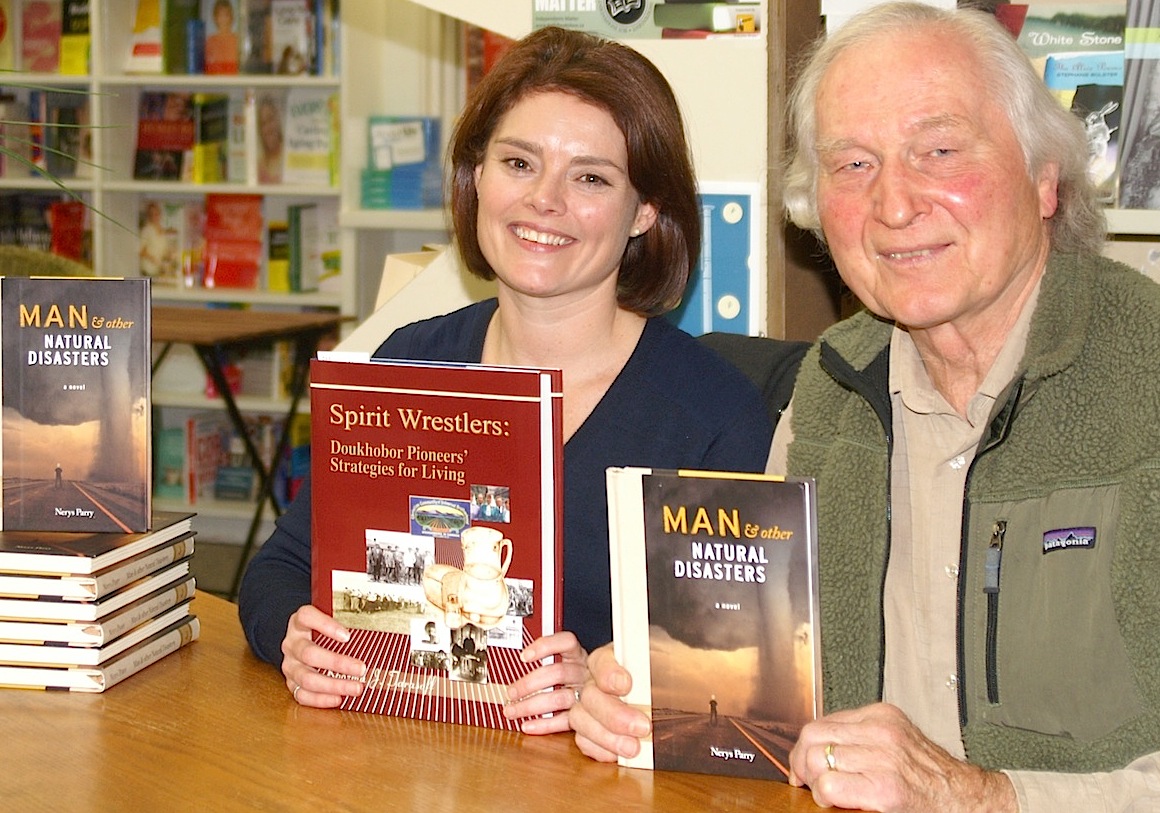
On November 10, I became alarmed after reading a local news item (now offline) announcing that Doukhobors were mentioned in a new book. Was another award-winning author slandering the Doukhobors? Here's what I read about the book signing event. 

'Man and Other Natural Disasters delves into turbulent acts in Canada's past. The Sons of Freedom, an offshoot of the Doukhobors protested against government interference with mass nudity, arson and explosives. That past terrorism is analogous to what's happening now in many parts of the world. Nerys spent many hours reading the actual diaries of the Sons of Freedom. She was surprised how closely the situation happening in Bountiful B.C. mirrors what happened decades ago.

'Man and Other Natural Disasters is a thoughtful and frightening novel on what happens when extremism takes over a religion or belief system.

'Nerys was a finalist for the 2011 Colophon Prize and tied for seventh out of more than 130 books in the Giller Prize Reader's Choir Award contest....'

I bought the book and read it before the bookstore signing event. 

Reviewer Koozma J. Tarasoff (right) exchanged books with author Nerys Parry (left)

I had to read the book and meet Nerys Parry to discuss why I thought the news announcement was misleading, in two ways:
  1. Those Sons of Freedom who burnt, bombed and went naked distanced themselves from the main Doukhobor Movement, and therefore they excluded themselves from it. The word 'Doukhobor' does not belong here and therefore should not be used in association with the zealots. When used, it is a case of exploitation and slander against a peaceful group.

  2. The Fundamentalist Church of Jesus Christ of Latter Day Saints (FLDS Church) — polygamist Mormons in Bountiful, BC — have no connection to the Sons of Freedom nor to the Doukhobors. Why make reference to Bountiful here which is currently in the news — unless its purpose is to draw on some kind of sensationalism to sell books. Publicists should stop the crass capitalistic practise of maligning and exploiting another group with the intent of selling a product and gaining a financial interest.
Upon meeting the author and further studying her book, my worries passed. She led me to further research in which I found that mental illness played a major role in sabotaging Doukhobor history.

The fictitious main character, Simon Peters, is presented as a creative bookbinder in the basement of the Calgary Public Library. The story involves the tragedy of his family from natural and man-made causes.Towards the end it turns out that Simon is really Seymon, an extreme zealot from the interior of British Columbia whose family was involved in a series of disasters in the form of terrorism. The Seymon character was largely inspired by diaries that the author found in the Library and Archives Canada for Fred N. Davidoff 1944-1970 (MG 31 H26) (MIKAN 102610). Davidoff was born 1924 in the Cowley area of Alberta.

Around the year 2000, the author Nerys Parry first developed the Simon character, but the manuscript lay dormant for some time. In 2005-2006, Nerys and a colleague worked on a story about the effects of chemical, biological and radiological experiments in the Canadian Forces Base at Suffield, Alberta on the veterans who were used as human testers during the World War II period. When blacked out materials from RCMP records hindered the full development of the Suffield story, Nerys discovered an adjacent Davidoff File in the Archives as being a wonderful fit for Simon. The Simon story was further developed and the publisher preferred the new version. Perhaps Canada going into Afghanistan had something to do with the decision, even though the last veterans of Suffield were quickly dying out? 

I examined all 3 boxes of Fred N. Davidoff 's archives (fonds) and learned that Davidoff was worse than I had previously known. I knew that Simma Holt's Terror in the Name of God: the Story of the Sons of Freedom Doukhobors (1964) was based on information that Fred Davidoff had given to this Vancouver Sun reporter. He is mentioned 20 times in her book and featured in the chapter: 'Autobiography of a Fanatic' (page 217+). Within several years, Davidoff flip-flopped his fabricated views in order to gain parole from nine years in jail.

The result of all of this was that the Doukhobors as a whole were blackballed by Simma Holt and by her main informant Fred Davidoff with the false claim of nudity, bombings and burnings. These acts were real, but they were perpetrated by individuals who closely sided with zealotry and a few with terrorism. These acts were contrary to Doukhobor beliefs, and were not performed by independent nor community Doukhobors.

From his archived diaries, letters, and accounts by others, I learned that Fred N. Davidoff's behaviour was that of a classic psychopath, mostly ignored in Holt's book. He was an extreme fanatic, a con artist who fabricated much of what he said about the Doukhobor name and thereby misled Canadian reporters. He was mentally unstable, was an informant to the police, was one who could not be trusted, and people feared him. He was a person with a vivid imagination of himself. Most damning of all was that he had a habit of slandering many innocent Doukhobor people with terrorism.

In my response to seeking justice and truth, it has taken me and several of my friends some fifty years to try to correct the misinformed damage that has been done by the team Simma and Fred. In a real sense, both Holt and Davidoff hijacked the Doukhobor identity.

In the conclusion of her book Man and Other Natural Disasters, Nerys Parry states: 'I would like to clarify that Simon/Seymon and his family are fictional characters, and any similarity with living or dead persons is coincidental....'

Whenever possible, Nerys stuck to some of the known facts that occurred during the turmoil in the 1950s and 1960 — such as the Polatka (tents) affair in the Kootenays in 1953, the New Denver institution for kids of zealots from 1953 to 1959 (surrounded by a high chain-link fence), the RCMP infamous Special D. (Doukhobor) Squad, and the death of Harry Kootnikoff in 1962 while making a pocket watch bomb. All this Nerys admits in her Notes and Acknowledgements.

Obviously Nerys enjoys straddling the divide between science and fiction. This is real talent — and she is very good at it. In fact, the large part of the book on Simon Peters was so congruent that I believed him to be a bookbinder in Calgary, Alberta and that his parents were ranchers. When Simon has a complete mental breakdown and becomes Seymon in the office of a British Columbia psychiatrist, this is sudden transformation. At the end, when this split personality goes back to Calgary, as the reader, I am not sure who this real character is. Is he from Alberta or from British Columbia? Is he a passionate bookbinder or an unpredictable person? Is he a gentle pacifist or a dangerous terrorist?

To her credit as a skilled writer, Nerys Parry has minimised stereotyping the Doukhobors by avoiding the use of the name. (I found only two times the word was used in 214 pages, and one was in the title of a book.) Instead, Nerys has carefully used terms such as Sons of Freedom, Svobodniki, and Freedomites. Not Doukhobors. Yet, with much negative association with the past, when zealots and authors (such as Simma Holt) have hijacked the Doukhobors identity, it becomes difficult to dissociate one from the other. It is similar to the stigma that Muslims today receive from terrorists (who are not real Muslims).

Separating fact from fiction is a very delicate process even for a sensitive and innovative young writer such as Nerys Parry. She has done very well in this book. She has raised the bar for future writers to be very sensitive when straddling science with fiction. The book is worth a read.
————
Comments: Beginning in 2024, you can only self-enter a Comment below with a 'Google Account' (Gmail.com). This prevents irrelevant anonymous comments (spam and admail).  If you do not have a Google Account, email your Comment to KJTarasoff@gmail.com for posting.

Saturday, 10 December 2011

'Mutual Help Society' Proposed

Hank Hulsbergen
The following letter was submitted by Hank Hulsbergen of The Netherlands. Hank, now 60, recalls his 17-years living in Canada and especially his fond memories of Helen and John Stevenson (Argenta Quakers, British Columbia). As an innovative thinker, he suggests the creation of a Mutual Help Society — a structure inspired by Peter Kropotkin as well as the Mennonite Central Committee. In his most recent letter, Hank Hulsbergen writes: 'At the end of most Unitarian services, people hold hands and sing three times "Carry the flame of Peace and Love until we meet again." Of course reading that Doukhobors aspire to Peace and Love as well fits well with that!'


Dear Koozma:

How are you? I lived in Canada for 17 years of which 10 in British Columbia. Good friends from Argenta, Helen and John Stevenson, advised me in the early 1980's to read Plakun Trava: The Doukhobors and I even received a letter from you telling about the publishing of PT. Maybe due to studies at Simon Fraser University, I decided I'll do that later. Now I'm back in the Netherlands and have recently read a lot about the Doukhobors on the Internet. The title of your book has always stayed with me.

In 1979, when the old hotel was still operating in Grand Forks, BC, I enjoyed some borshch for the first time in my life. Later, in 1998, when living in Vancouver, I helped an elderly lady move to Grand Forks and visited her a few times when on holidays from Europe. Even got to see the Doukhobor Museum [in Castlegar, BC] when it hadn't been that long open yet. From the very first time I came to Grand Forks and the Kootenays, I sensed that that area was the nicest of BC. Since I'm sensitive to "atmosphere", I have undoubtedly picked up the peaceful vibes of the people.

Back at the University of Washington in 1974 I had a Jonah Goldstein as prof for a first year course in Human Relations and Counselling Studies (HRCS) which dealt with alternative communities etc.

This HRCS program was very much inspired by the work of Carl R Rogers. His book On Becoming a Person is still wonderful to read. I find the essence of his ideas back with the lifestyle of the Doukhobors. During my University of Washington years I somehow came across Peter Kropotkin's Mutual Help [Mutual Aid: A Factor of Evolution] when writing an essay. Then I find out he was very much supportive of the Doukhobors.

In the last month and a half all these experiences seem to have come together and I somehow found your email address on the nice Internet site. I would still like to find a way to read Plakun Trava and perhaps other material later. Can I purchase the CD-Rom while paying with credit card? Am not totally clear on the process.

While my religious background has been with the Dutch Reformed Church, while my parents always allowed me to draw my own conclusions and have my own thoughts, in Canada I was active in various Unitarian fellowships.

In a wild moment, I thought it would be neat if Doukhobors, Unitarians, Mennonites, Hutterites and maybe others would work together to have a common "Mutual Help" society, not so different from the Mennonite Central Committee, which encourages and supports young people to do a year of voluntary service for communities and people nationally and internationally.

Having focused my study in Communication on Psychotherapy, Doukhobor communities may be best suited to help "lost" children and teenagers find their bearings again. Much like the Friendship school in Argenta saw students live with local families.

In short, reading about the Doukhobors and their lifestyle etc inspires me a great deal. If and when I come to Canada next summer I hope to spend a bit of time in the Kootenays again too.

I'm currently 60 years young and am kind of open to a change and some new things. My reason for emigration to Canada was to make myself free from the military draft at the time. This too I found to have in common with the Doukhobors. I'm working on the vegetarian bit! :)

     Hope this finds you well and happy.
     Kindest regards
     Hank Hulsbergen

Thursday, 1 December 2011

Atamanenko Tables Dept. of Peace Bill

Ottawa, ON – Alex Atamanenko, MP (BC Southern Interior), was joined at a press conference today [November 30, 2011] by fellow peace advocates, along with Elizabeth May of the Green Party and Liberal Jim Karygiannis to herald the introduction later in the day of his Private Members Bill to create a federal Department of Peace. May and Karygiannis are co-seconding the Bill. [C-373]

Left to right: Koozma J. Tarasoff, Jim Karygiannis, Alex Atamanenko,
Theresa Dunn,  Elizabeth May and Bill Bhaneja. Photo by Kristina Kristova.

Atamanenko’s bill is a slightly amended version of retired NDP MP, Bill Siksay’s bill from the last parliament, notable for the non-partisan support it had gathered.

Karygiannis says this is one issue where party politics should not get in the way. “It is time for Canada to serve the global constituency by committing to the creation of a Department of Peace.”

Elizabeth May stressed her party's continued support of this initiative. "Peace is more than the absence of war. Non-violent solutions, 'waging peace,' requires a focused investment and shift in consciousness. Even talking about a Department of Peace helps in that shift," she said.

Representatives for Canadian Department of Peace Initiative (CDPI) at the press conference described the bill as exemplifying a global movement in 30 countries promoting infrastructures of non-violent peace within governments, with Peace Ministries and Departments in three countries, most recently Costa Rica. “The bill illustrates the need to prepare for peace in the same way as we prepare for war – with adequate resources and expertise,” stated CDPI Co-Founder,
Bill Bhaneja.

“This is an opportunity to unify the millions of voices expressing a will to follow a new path where our road markers are not fear, anger and vengeful killing but rather prevention, empathy and justice for all of humanity,” declared Theresa Dunn, co-Chair for CDPI.

Doukhobor writer and historian Koozma J. Tarasoff said the need for the architecture for peace is urgent at a time when nuclear and robotic weapons are posing a threat to the world community. “As Canadians, let’s regain our status not only as a peacekeeping and peace-building nation, but also as a nonkilling one.”

“The notion that there can be peace in the world may be a utopian ideal but each generation owes it to the next to make a dedicated attempt to get as close to it as humanly possible.” concluded Atamanenko.

Bill Bhaneja's Note:

Bill Bhaneja (Co-Chair of the Ottawa Chapter, Canadian Dept. of Peace Initiative) wrote the following summary of this historic event:

'....Theresa and I were invited to attend the press conference at 1:30 pm. where Alex Atamanenko spoke about the Bill followed by Elizabeth May and Jim Karygiannis....Theresa, Koozma and I were also given our moments of fame to say a few words at the event. Overall the messages sent were solid and complementary and should have good resonance with the wide ranging peace communities....

'In the House we had a substantive representation from the Ottawa chapter of about 15 people who got to meet Alex after his introduction of the Bill and thank him for his initiative. An official transcript of the Bill will be on line in two languages soon with a designated Bill number assigned to it [C-373]. The new Bill covers all the aspects we wanted to see in it, with minor fine tuning of certain sections e.g. education responsibilities, focus on conflict prevention in R2P, and UN 1325 etc provided by us and others. Alex said  that he will need some time to focus on strategy of how to follow up on this in the Parliament, most likely after Christmas recess. In the meantime, he thought we could go ahead in using the Bill to get the message out in the public as well as to our local politicians for co-seconding the Bill. Our main task right now is to spread the message and energize the civil society and others through this Bill that the idea of DoP and Peace is feasible. Also the Bill can be helpful in fund raising with organizational endorsers. And I am not forgetting the 10,000 target petition signing.'

Koozma's Note:

This historic event impressed me in three ways:
  1. The professional and friendly manner of Alex Atamanenko and his office in getting this Bill tabled in the House. Peace is a trans-party issue. 
  2. The Liberals and the Green Party joined the NDP in this pioneering venture for a new architecture and vision for peace in the world. 
  3. The short talks emphasized the urgency of this Bill, the global nature of it (peace is everyone's business) and the need for a new way of looking at the state of our world civilization.
My own talk was as follows:

'My ancestors the Doukhobors in 1895 destroyed their guns in a mass voice to the world that the slaughter of human beings from the scourge of wars must stop once and for all. Today, modern weapons of mass destruction, esp. that of atomic bombs and robotics, threaten our world civilization with annihilation.

'Like Steve Jobs of Apple, we need to envisage a world in a totally different way so as to invigorate Canada's role as a peacekeeper and peacebuilder. The proposed Canadian Department of Peace provides the architecture for doing this — especially in promoting the transition from a war-based to a peace-based economy.

'With the late Dr. Martin Luther King Jr., we can say, 'We have a dream not to be killed and the responsibility not to kill another human being. We have a dream and a vision to pass along to the future generation our hope to create a nonkilling society. Now, let us support the Bill and make this vision a reality. For where there is no vision, people perish.'

Wednesday, 23 November 2011

Remembering Remembrance Day and the Occupy Movement

Consider Remembrance Day November 11th. I watched with much interest the 2011 ceremony of several thousand people in downtown Ottawa observing this event with the sounds of bugles, words of praise for the fallen soldiers, the laying of wreaths and the red poppies, and the march past by young and old. Even the Governor General was in the spirit — dressed in his military clothes. It was all very patriotic.


It was 11th November, when on the 11th hour of the 11th month of 1918, the armistice ended the war called Great. This was soon followed by the words of John McCrae in his poem: 'In Flanders fields where poppies blow / Between the crosses, row on row.' Then, in propaganda style, the poem which is sung every year at the televised National Remembrance Day service in Ottawa, urges the listeners  to 'take up the quarrel with the foe.'

Why 'take up the quarrel with the foe'? Was not the intent of the old soldiers to end the collective insanity known as war? Today 2011 Remembrance Day seemed so out of step with the real meaning of the commemoration of the past wars. Surely the intent was to create a culture of peace, not a culture or war. Surely, the Day should not be used as a recruiting rhetoric for more soldiers? Yet today in the fields of Afghanistan, Iraq and Libya, we seem to have forgotten this lesson. Recently Canada's Defence Minister Peter McKay is determined to convert Canada from a peacekeeping country to a macho militarized one.

Let's stop and not buy into this madness! Let's cease to produce victims of wars. Or as Russian philosopher Lev N. Tolstoy would have said: 'Let's stop the slavery of our times' — meaning, let's stop war and militarism. This means stopping the criminals who engineer these events. (Lev N. Tolstoy. The Slavery of Our Times. 1900. pages 95, 104)

For example, the Conservative Government in Canada today wants to purchase several dozens of F-35 fighter planes worth billions of dollars — planes that are designed for attack and not for defence purposes. These fighters are useless in the North and cannot be called to rescue people in need. All this is being proposed without thorough debate at a time when the country is going through an economic recession. In fact, the democratic process of debate is bypassed and trampled upon. Is that not a contempt of Parliament?  (Jet fighters a costly mistake for taxpayers, by Tamara Lorincz and Steven Staples, Time-Colonist,  December 10, 2010.)

Now let us look at the Occupy Movement which began in mid-October 2011 in the Wall Street district of New York City — and since then has spread around the world as a popular social movement. Its dissatisfaction is wide-spread. Generally it is aimed at narrowing the gap between the rich and the poor; including protesting corporate greed, corruption and  undue influence of the world's wealthiest over governments. These are all legitimate citizen issues.

I visited the group in Ottawa's Confederation Park where I saw some 50 tents, including a large kitchen tent and a smaller Media one. I  took several pictures of the tent community and spoke to Laura who told me: 'We are an emerging paradigm. The movement is a base for hope.'

What is encouraging is that this Occupy Movement has captured the attention of many bright young activists who have espoused nonviolence and mutual aid. In a sense, they are the vanguard of the oppressed people of the Earth. That is indeed commendable.

Although the protests have broadly been leaderless and nonhierarchical, the movement seems to have gained wide popular support in the short time of one month. In response, municipal officials feel themselves as responsible owners of the property and are now rallying the force of the state to shut them down. What the next move of the activists may be has yet to evolve.

In the meantime, we need to step back a moment and see what we have learned from both the Remembrance Day and from the Occupy Movement? If we do not learn from our mistakes, we are doomed to repeat them. May I suggest the following short list of items is a good Socratic beginning to our quest for wisdom and action in creating a peaceful, just and a more equitable and caring society:
  1. Is anyone listening? Are we listening? Is the media brave enough to critique corporate interests? Moreover, is the media willing to publish both minority and majority opinions? How about looking at Pension reforms and Tax reforms. Let's make sure that our health care programs are intact and available to everyone as a human right. 
  2. Implicit in our quest is a critique of the military industrial complex and its threat to our civilization. What kind of country do we want? I sense that Canadians want to regain their peace-keeping tradition and distance themselves from that of a military conquering power. How about working to establish a Canadian Department of Peace? Let's make nonkilling our mantra for the new world.
  3. We need to continually ask 'How do we make life more just and equal?' The answer requires a critique of extreme capitalism, including banks, stocks, deregulation, tax reform, 'free trade',  the whole works.  More and more thinking people are coming to the conclusion that a better system should be based on the common good and not on individual greed and the desire to control. We need to develop a creative structure of redistribution of wealth and resources. 
  4. How can we use the co-operative movement as an engine in creating a better society? Recall that on October 31, 2011, the United Nations launched the International Year of Cooperatives. Here, then, is a new opportunity to see how co-ops work differently than that of corporations which primarily are designed to make money for shareholders. Co-ops work on the principle  'One person, one vote'.

Friday, 18 November 2011

Peace Festivals in Ottawa, Canada

Talk and Slide Show to the Kiwanis Club of Sage
Ottawa, Ontario, November 16, 2011 

 
Introduction

Kiwanis is a global co-educational service club organization (mostly in North America and Europe) of volunteers dedicated 'to changing the world one child and one community at a time'. The organization was founded in 1915 and today is headquartered in Indianapolis, Indiana, USA. Current membership is 240,000 in 7,700 clubs in 80 nations. The average age is 57, with men making up 74% and women 26%. On November 16th I was invited to speak to the Kiwanis Club of Sage in Ottawa, which is an all-men club with an average age of 80. The Club has 53 members. Its president A. W. ('Tony') Myres welcomed me and my wife Kristina to the meeting and later Hank Lagasse (President Elect) introduced me. The Notes for my talk follow, after which I presented a slide show of some 400 images of the 5th Annual Ottawa Peace Festival held September 21 to October 2nd. A Question period followed.

The Talk

Good morning everybody!

I understand that the Kiwanis founders years back took 'We build' as the original motto of the Club, which today has been translated to 'Serving the Children of the World' through a variety of local programs including nurturing literacy, music festivals, student-led projects, Air Cadets and Remembrance Day services, supporting Salvation Army, and hands-on assistance to those in need.

In a real sense, your motto is similar to the Peace Festival theme. As a well-known sign says 'We are building peace for children and other living things'. For all of us, of course, peace and justice have no boundaries — whether for children or adults. We are all one in this world.

The very interesting annual Ottawa Peace Festivals have taken place in Canada's capital city since 2007, with the 5th one being a 12-day festival earlier this Fall. The dates form book ends of two UN International Days of Peace (Sept. 21) and Nonviolence (October 2nd).

As photographer, writer, and peace activist, I have had the honour of attending the five festivals and have visually recorded them for all to see on links found on my website Spirit-Wrestlers.com, including links for images on Picasa. Before showing you a slide presentation of the latest Festival on my iPhoto Mac program, I would like to briefly give you a flavour of some of the wisdom of this unique citizens'-based cooperative effort which this year hosted 25 events by 19 civil society organizations and participants. So far this was the largest Ottawa Peace Festival.

The key facilitators have been Dr. Bill Bhaneja (retired foreign service officer, political scientist, member of Pugwash Group, Gandhi scholar and Co-Chair of the Canadian Department of Peace Initiative) and Dr. Peter Stockdale (founding chair of the City of Peace Ottawa).

The idea came to Dr. Bhaneja at one of the global summits of DoP when a delegate from the US mentioned that they were thinking of 11 days of peace activities leading to 9/11. 'We wondered', said Dr. Bhaneja, 'if we could do something similar in a Canadian setting using the two universal UN resolutions. The resolutions define the spirit of CDP/DoP mandate of working towards a Culture of Peace and Nonviolent Resolution of Conflicts.'

The effort coincided with the work of a local civil society group, the City of Peace Ottawa, whose mission statement was: 'To develop Ottawa as a model city of peace, and be a model for other peaceful cities, promoting social harmony and inclusiveness.' And so the Ottawa Peace Festival was born around the theme of 'Peace, Unity, and Harmony'. (See Dr. Bhaneja's talk of September 17, 2011 on Peace Festivals and Cities of Peace)

Presentation

I would like to briefly share with you some of the wisdom of the past festivals. Click here for the text of my presentation: Peace Festivals in Ottawa, Canada, 2007 - 2011, with links to stories and images of each event. Also see: Ottawa Peace Festivals : Archive & History.

Slide Show

Now to my 383 photos of the 5th Annual Ottawa Peace Festival 2011. Enjoy.

Questions Asked

1. 'What is the inner threat to Canada?'
The questioner wanted to know if it was some nation, or what? He suggested that it was 'a clash of religions' between Muslims and Christians. This is an answer that needs to be explored further. What do readers think?

2. 'Should governments be involved in the peace movement?'
Yes. I replied that while individual action and non-government organizations are important in peace making, ultimately we need to involve our government with its huge resources.

3. 'Does the Department of Peace Initiative support the Wall Street movement?'
Yes. As a non-government group, I said, the Initiative supports the protesters around the world in seeking peaceful change towards more equality, justice and a greater voice in our society. DoP members believe that a peace structure in government will go a long ways to promoting the transition of the economy from a war-based one to a peace-based one. This path towards a culture of peace, it is expected, would greatly benefit the economic, social, and psychological status of the 99 percent of the population that the Wall Street movement is working to improve.

4. 'Besides Ottawa, do you have other Chapters across Canada?'

Yes indeed. There are 12 chapters across Canada from coast to coast. The Department of Peace movement is now active in 30 countries. Since 2006, three countries have established Peace Departments: Costa Rica, Nepal and Solomon Islands.

Monday, 7 November 2011

Anna Markova: 'A Doukhobor Martyr'

A Doukhobor Martyr : Anna Markova : 1902-1978 is a chapter in a new book 100 More Canadian Heroines: Famous and Forgotten Faces, by Merna Forster, pages 236-239. This entire 4-page Anna Markova chapter appears on Google Books in 2 file segments — first 3 pages and last 3 pages.

She was passionate about family and faith — and forgiving of those who imprisoned her.

The short 4-page biography, with a photo of a young babushka Markova (above), positions a Doukhobor woman among female scientists, doctors, scholars, educators, pioneers, athletes, business women, politicians, peace activists, artists, actors, an astronaut, detective, soldiers, and other notable women who impacted Canadian history since the 1700s.

'Doukhobor pioneer Anna Markova…' appeared in the announcement: 'Book continues list of Canada's most important women,' Times Colonist (Victoria & Vancouver Island, BC), Oct. 9, 2011.

This book is the second in a series for Forster, who places Markova among the 101th to 200th of her selection of heroines in Canadian history. References used were:
  • George Woodcock and Ivan Avakumovic, The Doukhobors (Toronto: Oxford University Press, 1968).
  • Jim Popoff, "Passing of a Doukhobor Martyr" and "An Interview with Anna Petrovna Markova," Mir No. 17, pages 2-23, May 1979.
  • Koozma J. Tarasoff, 'An Esteemed Babushka Who Weathered the Storm,' Spirit Wrestlers: Doukhobor Pioneers' Strategies for Living, 2002, pages 113-114.

Forster concludes: 'Anna Petrovena Markova [Voykin] … One of the first Canadian Doukhobor social activists, she is still remembered as a visionary. The local newspaper noted, "She was zealous, but not a zealot, and a staunch advocate of enlightenment, family unity, spiritual and moral rebirth."' And she adds that Markova was memorialised in 4 ways:
Forster missed much online:

Thursday, 3 November 2011

Doukhobor Russian Language Research

"Saskatchewan Doukhobor Native Speaking Fluency" is a joint research project at the University of Saskatchewan with the State University of St. Pertersburg, Russia. The Russian government is funding the study and a related Russian website.

The project was launched by Dr. Veronica Makarova, Associate Professor in the Department of Languages and Linguistics and the Interdisciplinary Linguistics Program Chair at the University of Saskatchewan. In 1992 she earned her Ph.D. in Linguistics at the University of St. Petersburg. Her bibliography lists 37 papers published up to 2011.  She is editor of Russian Language Studies in North America : New Perspectives from Theoretical and Applied Linguistics (200 pages) to be published March 2012. In 2012 she moved to the Department of Religion and Culture.

Most Canadian Doukhobors recently learned about this project from newspapers on Saturday Oct. 29, 2011.
  • Linguist to rescue Doukhobor language, The Star Phoenix, Saskatoon
    (copied on Doukhobor Genealogy Message Board)
  • Russian linguist wants to rescue dying Doukhobor language, The Vancouver Sun
  • Researchers try to save language, Edmonton Journal, October 31, 2011

Dr. Makarova published her first paper about Doukhohor Russian in March 2011:
Язык саскачеванских духоборов: введение в анализ The Language of Saskatchewan Doukhobors: Introduction to the Analysis
В.А. Макарова, Э.В. Усенкова, В.В. Евдокимова, К.В. Евграфова. Известия вузов. Серия «Гумани-тарные науки», 2 (2) 146-151. 25-05-2011.  Markarova, V.A, E.V. Usenkova, V.V. Evdokimova, K.V. Evgrafova. News of Higher Schools. Series "Humanities", Vol. 2, Issue 2, 25 March 2011, pages 146-151.
В статье описывается состояния русского языка этнического меньшинства канадских духоборов провинции Саскачеван. Этот уникальный диалект, находящийся на грани исчезновения, никогда ранее не подвергался лингвистическим исследованиям. В статье приводится краткая история духоборов Саскачевана, описываются некоторые характерные черты их речи и показываются причины постепенной утраты ими русского языка. Речь данной группы представляет особый интерес с лингвистической, социолингвистической и антропологической точек зрения. Описание и сохранение образцов этого уникального диалекта, находящегося на грани исчезновения, для последующих поколений является важной задачей. This paper introduces the description of the state of Saskatchewan Doukhobor Russian, the language of an ethnic minority residing in one of Canadian provinces. This unique dialect is on the very brink of extinction, and yet it has never been subjected to any linguistic studies. The speech of this minority group is of particular interest from the linguistic, sociolinguistic and anthropological perspectives. The paper gives a brief survey of Saskatchewan Doukhobor history, describes some characteristic features of Saskatchewan Doukhobor Russian speech and outlines the reasons for the language loss.

Mae Popoff (B.Ed, BA and PDG graduate studies), president of the Doukhobor Cultural Society of Saskatchewan, and editor of the Sheaf, contacted Dr. Makarova and cleared the main question most have asked — about all the Russian-speaking Doukhobors in B.C. Popoff reports:
  • I arranged for her to interview Russian speaking Doukhobors, including myself and my Chernoff relatives. 
  • Professor Evgrafova from St. Petersburg has been in Saskatoon for 10 days and leaves Nov. 6, 2011. 
  • I made Professor Makarova aware of British Columbia Doukhobors but she is concentrating on Saskatchewan for now.
  • I will continue to be in contact with Dr. V. Makarova and the Saskatoon Doukhobor Society

Also see Blog: Q43: Is 'Doukhobor Dialect' Defended? about Dr. Schaarschmidt defending the Doukhobor-Russian language dialect. Malarova's project was news to him, as he writes (11/1/2011):
If she is correct about the fact that there are still about 50 speakers of the language there is hope for the maintenance and revitalization of the language but it will take more than the efforts of a linguist to accomplish this goal or else the language will only be "rescued" as a museum language and not as a form of daily communication. It will take a community effort to be willing to achieve the maintenance and revitalization of Doukhobor Russian in everyday communication. I know that the situation in BC is much better than the one in Saskatchewan but nonetheless I look with concern at the obituaries in Iskra.


UPDATE July 1, 2012:

A chapter about the Canadian Doukhobor Russian dialect is at the end of Dr. Makarova's book published June 1, 2012:

Schaarschmidt, Gunter. "Russian Language History in Canada. Doukhoboor Internal and External Migrations: Effect on language development and structure," (Chapter 10, pages 235-260) in Russian Language Studies in North America: New Perspectives from Theoretical and Applied Linguistics, edited by Veronika Makarova. London: Anthem Press, 2012. ISBN: 9780857287847.

See previews at Google Books, Amazon.com and Anthem Press.

Introduction, page xvii: "... the author illustrates an interplay between the colloquial and ritual functional styles in Doukhobor Russian. The unique features of Doukhobor Russian are explained by its largely oral traditon, relative geological isolation, deliberate resistance to the influence of Canadian English, and the influence of Ukrainian, dating mainly to the first generation of settlers in the province of Saskatchewan. This study is the first major work introducing the language history and structure of Doukhobor Russian."

Tuesday, 1 November 2011

Tamara Tarasoff Awarded for Volunteerism

Introduction

On the evening of October 28th, 2011, I was in Aylmer, Quebec where I attended the West Quebecers 2011 Community Awards. Here my daughter Tamara (b.1964) received their annual Education Community Award for her outstanding volunteer work in the Wakefield area of Quebec.

As a father with Doukhobor pacifist roots growing up in Western Canada, tears came to my eyes when Tamara in her response acknowledged the role of her parents in instilling the spirit of inquiry, activism and responsibility for ones actions. She mentioned the peace marches that she and her brother Lev used to go with us as parents and other members of the concerned public in Saskatchewan, holding signs for peace and universal brotherhood.

Acceptance by Tamara Tarasoff for Education Community Award

What we do as parents does matter. As an example to our children, we affect our gene pool and the future generations. That is Lesson 101 of the celebrated biologist Charles Darwin. That is how the quality of the world is achieved.

As well, individual actions do matter. At the end of her emails, Tamara adds a priceless bit of advice, taken from the wisdom of popular US anthropologist Margaret Mead (1901-1978) whom I as an anthropologist met years ago in Moscow and Montreal:

'Never doubt that a small group of thoughtful, committed citizens can change the world. Indeed, it is the only thing that ever has.'

Tamara has taken that wisdom to heart. I have followed the EcoLaPeche Blog which she has written over the past two years to inform fellow citizens about the poorly planned regional septic sludge plant that her regional government wishes to build along the Gatineau River near Wakefield. Her brave efforts combined with the collective support of concerned community members is a classic case of basic democracy at work. The community has virtually raised the roof and brought to light the actions of seven mayors in the Gatineau area while pushing for a better solution, one that all citizens can live with. The combined efforts of 'thoughtful committed citizens' is having an effect.

As parents we are of course proud of Tamara and her non-paid volunteer work in the Wakefield community of Quebec. As father I would like to add one other attribute that deserves mention.

In our materialistic digital age, Tamara has not forgotten her Russian Doukhobor roots. When the Canadian Museum of Civilization was holding its Spirit Wrestlers Exhibition in the mid-1990s, she did a contract for the Museum in creating modules on the best of Doukhobor traditions and culture. Also she volunteered in demonstrating the art of cooking as well as spinning wool. Moreover, as time permits, she has been working on a Traditional Recipe book largely based on her first-hand lessons and memorable anecdotes from her Saskatchewan grandmothers who were both excellent cooks: Baba Luba Konkin in Kamsack and Baba Anastasia Tarasoff in Saskatoon. We all look forward to a 'best seller'.

At the Awards ceremony we were reminded that 'it takes a whole village to raise a child'. Absolutely!

West Quebecers 2011 Community Award — Education
This award is given to the person who has made the most substantial contribution to the development and enhancement of education.

Tamara (right) with son Nicholas and daughter Elena.

Tamara Tarasoff moved to the Wakefield area with husband John in 1996. Soon after children Nicholas and Elena were born, she was inspired to become part of this community's outstanding volunteer tradition. As a young mom, she first brought her energy and ideas to Wakefield School. She volunteered in the classroom and worked with other parents to establish the Butterfly Garden and organize events and fundraisers. One year, she organized a parent petition asking the Municipality of LaPêche for a grant to complete the school playground; after she made a presentation at a municipal council meeting and received the desired funds.  In recent years she worked with community members to create a plastic bag education program for the school. As a result of this program, students reduced their use of plastic bags and encouraged community members to do likewise.  In 2011, she co-led Life Before Plastics, a follow-up to this program; over several months, Grade 4 and 5 students explored the history of plastics, participated in oral history and photography workshops, took photographs, and conducted oral history interviews with elders in the community who lived before plastic was a common material.

Other areas of Tamara's community involvement include local sports clubs, the Fairbairn Museum, the Harvest Festival and Eco Echo. More recently she has taken a leadership role fighting for a sustainable alternative to the regional septic sludge treatment plant planned for the banks of the Gatineau River; she believes it makes no sense to scar the beautiful rural landscape north of Wakefield with huge open lagoons, truck the septic tank contents from 20,000 households in 7 municipalities to these lagoons and release the effluent into the River.

She is grateful for this award and wants to thank her friends and family for their support and involvement over the years. She also wants everyone to know that, when she grows up, she wants to be a Wakefield Granny. 
—————————

From Wakefield, Quebec, there was another community award winner. It was 70-year-old Neil Faukner, this year's recipient of the Founders Award for Outstanding Leadership from the Regional Association of West Quebecers. He said that we need to depend on partnerships in making our communities work. Our spirit ought to  be similar to the one that President Obama in his election speech said 'Yes, we can!'

Neil Faukner

Signalling his advancing age, Faulkner wants to inspire youth to get involved. 'I want to encourage people to have a bigger vision of the future and what it is that we want here,' he said. 'We are lucky to live in a community where people are not afraid to stand up for what they believe in.'

Final Thoughts

As writer of this article, I would like to add a reminder to all of us as citizens of Canada. If we are not satisfied with the way that the country is going, we need to stand up and be counted not only at the ballot box, but also in our communities as volunteers. This may mean standing up to oppose the militarization of the country (instead of the Pearsonian emphasis on Peace Keeping), the attempted privatization of our basic institutions of public health care, education, the Canadian Broadcasting Corporation, the Canadian Wheat Board, and so forth.

As Tamara, Neil and so many others have shown us: Yes we can!