Showing posts with label Review. Show all posts

Thursday, 14 April 2016

‘Non-Tourist’ Sites in Georgia

Molokane and Dukhobortsy found by journalist.

About March 2016 the Russian newspaper Kosomolskaya Pravda, sent staff journalist Sergey Ponomarev on a ‘special project’ assignment — fly from Moscow to Tbilisi, Georgia, and report about the sites and people that tourists rarely or never see.

He visited 22 mapped places (below) and several side-stops, reported in two parts online with photos and video. 100s of readers commented, and he replied to many.

On his agenda were Molokane and Dukhobortsy (Doukhobors). When he met a Russian woman vendor named Potapova in Tbilisi, he first asked if her family arrived with Molokane or Dukhobory. She replied, no, my grandfather came here in the 1930s from Tambov, followed by all Potapovs from our village. (Русским здесь не доверяют? (Russians are not trusted here?), Part 1. [Video now offline])

Click map to ENLARGE.
His report posted April 5 got 50 comments, though editors dated the story the next day, on April 6, 2016 as : Путешествие по «нетуристической» стране: Расцвела под евросолнцем Грузия моя? [Traveling in ‘non-tourist’ country: Flourish in the European sun, my Georgia?]. The story title is a play on the title of the popular Soviet era song: Расцветай под солнцем Грузия моя (Flourish in the sun, my Georgia).

Ponomarev apparently prepared for his tour, and set an agenda to follow a route which covered most of the country. He rented an apartment in Tbilisi, and carried his video camera around town interviewing in Russian with anyone who spoke Russian. Then he traveled to the eastern edge of the country where he sought Molokane (Part 1 of 2). Along the southern border he found Doukhobors (Part 2 of 2).

Title page. Click to ENLARGE

Ironically unknown to the reporter, in the middle of the panoramic photo of Tbilisi (above) used for the opening page of his report are 2 historic sites for Molokane and Dukhobortsy. The current Rike Park was home to the first large Molokan settlement in Tiflis. This sandy river bank flat was earlier called the peski district (pes.ki' means sandy in Russian; ree'.ke means sandy in Georgian). The adjacent Metekhi jails held all the arrested gun-burning and protesting Doukhobors in the Caucasus in 1895-1896.

Ponomarev, 50, was raised in the Urals, studied journalism at Ural State University. He worked as a newspaper journalist in various parts of the Far East, and in the 1990s was hired by Kosomolskaya Pravda.

The content is useful for the general public, and presents as a valuable authentic ethnographic work, though his reporting is superficial at times and he missed many fascinating out-of-the-way peoples and places. All of his video is with a hand-held camera, image bouncing as he walks, out of focus when the light is dim or the subject is back-lit, and too often strays while he interviews. The sound is often noisy with traffic or wind. The project shows how a print and photo-journalist tries to do video journalism. Fortunate for our readers, he included two groups of Spiritual Christians.

We translated and posted his two stories. Leave comments on this blog, below.

Russian entry page on Kosomolskaya Pravda: Путешествие по «нетуристической» стране: Расцвела под евросолнцем Грузия моя? [Traveling in ‘non-tourist’ country: Flourish in the European sun, my Georgia?].

Thursday, 13 June 2013

New Video About Georgian Doukhobors

Review by Koozma J.Tarasoff of Doukhobors: Community of Faith, a video documentary by Russian TV, June 7, 2013: (28 minutes). Copyright by "RT" and "TV-NOVOSTI" 2013.

Studying Doukhobors from their roof-top.

The opening image is a 1893 sketch of the Doukhobor village Gorelovka, Tiflis province, Russia, by H.F.B. Lynch. Russian Television (RT) sent a Georgian video crew to produce this documentary. The opening sound track is sprinkled with singing and snippet previews of this 'sacred place.'

The 29 minute video is divided into 5 sections titled: People (at minute 2:48); Vasily (3:30); Nikolay (6:38); Mikhail, Kuzma, Tatyana (9:00); Community of Doukhobors; Ads (12:04 for 2 minutes); Faith (14:12); Easter (15:20); Exodus (19:17); Neighbors (20:42); and Sacred Place (25:30) the cemetery.

Roof-top views

Presented mostly in English over Russian dialogue, the introductory printed text along with another text further on explains the context of this film:
  • RT teams up with a couple [video journalists Niko and Magda] from Tbilisi, Georgia, who travel south of the country to explore the community of the Dukhobors — a Christian group that believes God lives inside humans, not in an organized church. See how this group managed to preserve their way of life for centuries.
  • In 2013 a young couple traveled from Georgia's capital, Tbilisi, to the south of the country. This region is home to a breakaway Orthodox group. Known as the Dukhobors, they reject all church rituals and iconography and have managed to preserve their way of life.
This is one of the better films on the Russian Doukhobors for several reasons. It is tightly edited. Their philosophy is clearly articulated. The tone is upbeat, friendly and informative. Unlike previous videos in Georgia which focused on women, here men and children are included. The video quality and color are beautifully done.

The story is quickly paced from the time the crew leaves Tbilisi by car, arrives in Doukhoboria, climbs on top of a heritage earth house with a green grass roof, where they view the world of the few remaining Doukhobors in a village now occupied with Armenians and Adjarians (Muslim Georgians). The journalists ask many questions in voice over, which are eventually answered by the subjects in interviews. They translate most of the Russian in subtitles, and give insightful commentary throughout.

The journalists describe their roof top view as if it was 'from another planet.' The old Doukhobor village has given way to 'a Caucasian ghetto.' There is nostalgia for the old Soviet era when living together was a pleasure, cleanliness was a virtue, education was free, orderliness, culture and a job gave rhythm to life. There was a view of a public school with only several children present; they were reciting Russian, Georgian, and Armenian alphabets.

After 170 years in the region (having moved in exile from the Milky Waters area of the Crimea in the mid-1800s), only about 150 Doukhobors remain in Gorelovka here today. The trend is towards out-migration and a loss of identity. Their stone architecture remains a prized possession of neighbours who see an opportunity to get good cheap or free accommodation as locals move out to Russia. Only 57 Doukhobor houses remain in this village.

People interviewed are: Vasily Slastukhin (woodshop), Nikolai Sukharukov (sledge shop class),  Brothers Mikhail and Kuzma (at the cheese factory with sister Tatyana Oslopova, who later sings a song of the 'dear heartland').


Easter service begins at midnight with men on the left (3 men and a boy) and 12 women in beautiful traditional costumes on the right, perform a prayer service where there appears to be no leader yet there is a feeling of unity.

In 'Neighbours' a young fellow admits he came because his Armenian grandfather moved here. The village administrator regrets that so many Russians have moved away.

The remaining Doukhobors survive off their land — selling milk, cheese, and growing gardens. We see one of the women in the home making traditional pirogies.

The short clip of the storks in a nest on top of a pole is beautifully-done. According to legend, say the locals, these birds are a symbol of new birth, kindness and love.

In 'Faith' a woman describes the symbology of her Doukhobor cap. She says some suggest that Doukhobors 'originated in Byzantia,' a predominantly Greek-speaking continuation of the Roman Empire.

The last segment, 'Sacred Place,' is a tribute to the past at the Burial site of the leaders, a 3 kilometer drive west east of their village, where they join Doukhobors from neighboring Orlovka village.

The philosophy of the Doukhbors is clearly articulated with the words 'behaviour is the measure of ones life.' Vasily points out that Doukhobors don't believe in baptism. They see no need for churches which they consider to be 'idolatry.' Their God of love is within. 'Giving to the poor' and helping your neighbour is sufficient. White-bearded Nikolai states that Doukhobors 'live by their word' so that their actions speak louder than words.

Although this could be a depressive story of a people losing their property and their identity, the presentation remains upbeat, portraying the inevitable change that has occurred because of recent geo-political and economic circumstances. In the end, morality wins.

I was surprised that the caves and the 1895 Arms Burning site were missed. Despite these major omissions, this video story is well worth viewing because it really gives the viewer an impression of what life is like there in 100s of scenes and thoughtful dialog.

Monday, 12 December 2011

Book Review:
A Troubled Personality Revealed

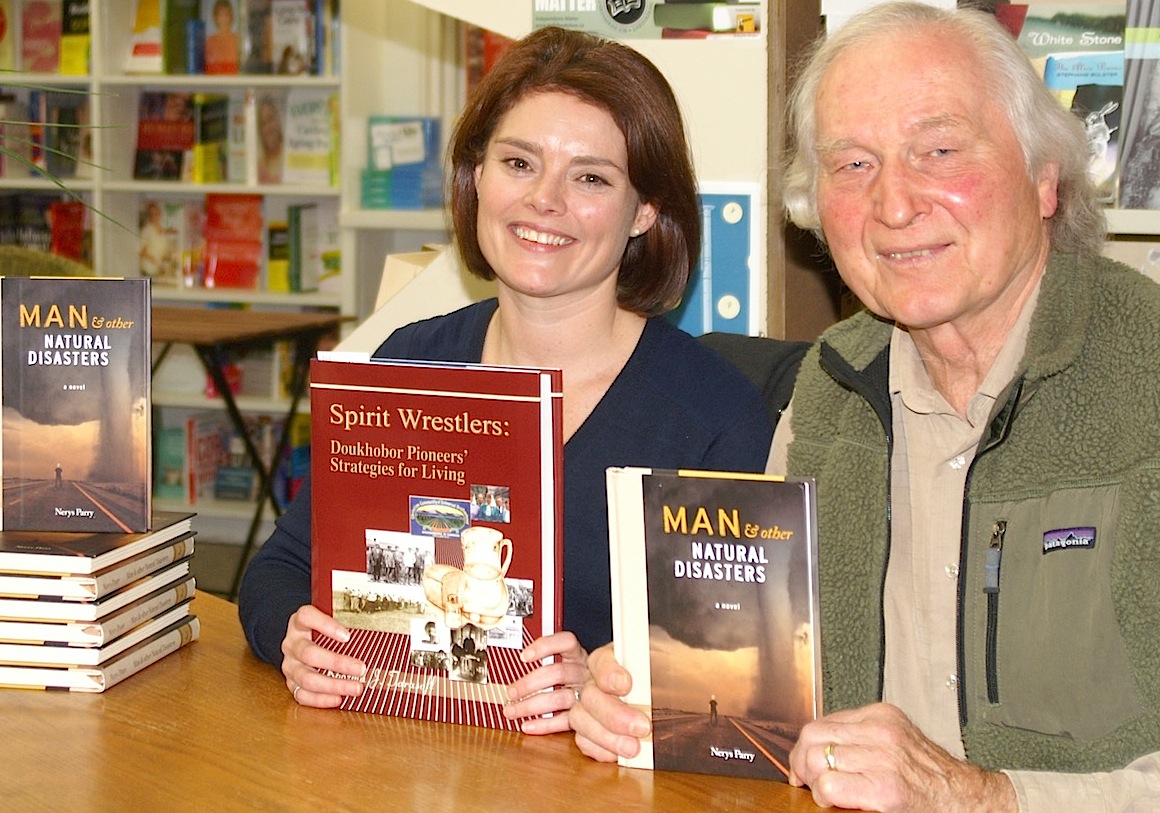
Nerys Parry, Man & Other Natural Disasters (Winnipeg, Manitoba: Enfield and Wizenty, an imprint of Great Plains Publications, 2011), 214 pp. ISBN 9878-1-926531-12-0. $29.95.

Updated 15 May 2022. 

On November 10, I became alarmed after reading a local news item (now offline) announcing that Doukhobors were mentioned in a new book. Was another award-winning author slandering the Doukhobors? Here's what I read about the book signing event. 

'Man and Other Natural Disasters delves into turbulent acts in Canada's past. The Sons of Freedom, an offshoot of the Doukhobors protested against government interference with mass nudity, arson and explosives. That past terrorism is analogous to what's happening now in many parts of the world. Nerys spent many hours reading the actual diaries of the Sons of Freedom. She was surprised how closely the situation happening in Bountiful B.C. mirrors what happened decades ago.

'Man and Other Natural Disasters is a thoughtful and frightening novel on what happens when extremism takes over a religion or belief system.

'Nerys was a finalist for the 2011 Colophon Prize and tied for seventh out of more than 130 books in the Giller Prize Reader's Choir Award contest....'

I bought the book and read it before the bookstore signing event. 

Reviewer Koozma J. Tarasoff (right) exchanged books with author Nerys Parry (left)

I had to read the book and meet Nerys Parry to discuss why I thought the news announcement was misleading, in two ways:
  1. Those Sons of Freedom who burnt, bombed and went naked distanced themselves from the main Doukhobor Movement, and therefore they excluded themselves from it. The word 'Doukhobor' does not belong here and therefore should not be used in association with the zealots. When used, it is a case of exploitation and slander against a peaceful group.

  2. The Fundamentalist Church of Jesus Christ of Latter Day Saints (FLDS Church) — polygamist Mormons in Bountiful, BC — have no connection to the Sons of Freedom nor to the Doukhobors. Why make reference to Bountiful here which is currently in the news — unless its purpose is to draw on some kind of sensationalism to sell books. Publicists should stop the crass capitalistic practise of maligning and exploiting another group with the intent of selling a product and gaining a financial interest.
Upon meeting the author and further studying her book, my worries passed. She led me to further research in which I found that mental illness played a major role in sabotaging Doukhobor history.

The fictitious main character, Simon Peters, is presented as a creative bookbinder in the basement of the Calgary Public Library. The story involves the tragedy of his family from natural and man-made causes.Towards the end it turns out that Simon is really Seymon, an extreme zealot from the interior of British Columbia whose family was involved in a series of disasters in the form of terrorism. The Seymon character was largely inspired by diaries that the author found in the Library and Archives Canada for Fred N. Davidoff 1944-1970 (MG 31 H26) (MIKAN 102610). Davidoff was born 1924 in the Cowley area of Alberta.

Around the year 2000, the author Nerys Parry first developed the Simon character, but the manuscript lay dormant for some time. In 2005-2006, Nerys and a colleague worked on a story about the effects of chemical, biological and radiological experiments in the Canadian Forces Base at Suffield, Alberta on the veterans who were used as human testers during the World War II period. When blacked out materials from RCMP records hindered the full development of the Suffield story, Nerys discovered an adjacent Davidoff File in the Archives as being a wonderful fit for Simon. The Simon story was further developed and the publisher preferred the new version. Perhaps Canada going into Afghanistan had something to do with the decision, even though the last veterans of Suffield were quickly dying out? 

I examined all 3 boxes of Fred N. Davidoff 's archives (fonds) and learned that Davidoff was worse than I had previously known. I knew that Simma Holt's Terror in the Name of God: the Story of the Sons of Freedom Doukhobors (1964) was based on information that Fred Davidoff had given to this Vancouver Sun reporter. He is mentioned 20 times in her book and featured in the chapter: 'Autobiography of a Fanatic' (page 217+). Within several years, Davidoff flip-flopped his fabricated views in order to gain parole from nine years in jail.

The result of all of this was that the Doukhobors as a whole were blackballed by Simma Holt and by her main informant Fred Davidoff with the false claim of nudity, bombings and burnings. These acts were real, but they were perpetrated by individuals who closely sided with zealotry and a few with terrorism. These acts were contrary to Doukhobor beliefs, and were not performed by independent nor community Doukhobors.

From his archived diaries, letters, and accounts by others, I learned that Fred N. Davidoff's behaviour was that of a classic psychopath, mostly ignored in Holt's book. He was an extreme fanatic, a con artist who fabricated much of what he said about the Doukhobor name and thereby misled Canadian reporters. He was mentally unstable, was an informant to the police, was one who could not be trusted, and people feared him. He was a person with a vivid imagination of himself. Most damning of all was that he had a habit of slandering many innocent Doukhobor people with terrorism.

In my response to seeking justice and truth, it has taken me and several of my friends some fifty years to try to correct the misinformed damage that has been done by the team Simma and Fred. In a real sense, both Holt and Davidoff hijacked the Doukhobor identity.

In the conclusion of her book Man and Other Natural Disasters, Nerys Parry states: 'I would like to clarify that Simon/Seymon and his family are fictional characters, and any similarity with living or dead persons is coincidental....'

Whenever possible, Nerys stuck to some of the known facts that occurred during the turmoil in the 1950s and 1960 — such as the Polatka (tents) affair in the Kootenays in 1953, the New Denver institution for kids of zealots from 1953 to 1959 (surrounded by a high chain-link fence), the RCMP infamous Special D. (Doukhobor) Squad, and the death of Harry Kootnikoff in 1962 while making a pocket watch bomb. All this Nerys admits in her Notes and Acknowledgements.

Obviously Nerys enjoys straddling the divide between science and fiction. This is real talent — and she is very good at it. In fact, the large part of the book on Simon Peters was so congruent that I believed him to be a bookbinder in Calgary, Alberta and that his parents were ranchers. When Simon has a complete mental breakdown and becomes Seymon in the office of a British Columbia psychiatrist, this is sudden transformation. At the end, when this split personality goes back to Calgary, as the reader, I am not sure who this real character is. Is he from Alberta or from British Columbia? Is he a passionate bookbinder or an unpredictable person? Is he a gentle pacifist or a dangerous terrorist?

To her credit as a skilled writer, Nerys Parry has minimised stereotyping the Doukhobors by avoiding the use of the name. (I found only two times the word was used in 214 pages, and one was in the title of a book.) Instead, Nerys has carefully used terms such as Sons of Freedom, Svobodniki, and Freedomites. Not Doukhobors. Yet, with much negative association with the past, when zealots and authors (such as Simma Holt) have hijacked the Doukhobors identity, it becomes difficult to dissociate one from the other. It is similar to the stigma that Muslims today receive from terrorists (who are not real Muslims).

Separating fact from fiction is a very delicate process even for a sensitive and innovative young writer such as Nerys Parry. She has done very well in this book. She has raised the bar for future writers to be very sensitive when straddling science with fiction. The book is worth a read.

Sunday, 18 September 2011

Anastasia's Amber —
          a love story in a troubled world

Review of a novel by Annie B. Barnes, Anastasia's Amber (self-published 2011), 223 pp. $17. Order from Annie B. Barnes, Box 40, Site 120, RR3, Sundre, Alberta TOM 1XO. Email: barnesun@telusplanet.net.


Annie B. Barnes of Sundre, Alberta, is no stranger to the Doukhobor movement. She wrote a play about her Doukhobor grandmother who came to Canada on S.S. Lake Huron ship in 1899 which premiered at the Canadian Learned Societies Meeting in Calgary in 1994. Then she researched an article on 'Doukhobor women in the twentieth century' in which she presented the inner voices of the Doukhobor women who until then did not have a chance to reveal their societal worth as homemakers and career people (Tarasoff, ed., Spirit Wrestlers' Voices, 1998: 13-35).

In this first novel, Barnes continues the trend of Doukhobor women coming of age and speaking out and having a feeling of belonging to the group as well as to this world. Her experiences in coming from a blended family, with intermarriage, moving from Saskatchewan to British Columbia, and identity crisis is all paralleled in this novel. It begins and ends in Tula, Russia near the home of Lev N. Tolstoy the most famous Russian philosopher and writer who assisted the Doukhobor migration to Canada.

The book's title with its unifying thread is a ring made of amber — a yellowish translucent fossilized resin derived from extinct trees and used in jewellery. The story is about two teens in the Caucasus during the late 1800s who fell in love, but could not marry because their parents belonged to different ideological camps — the Big Party under the leadership of Peter V. Verigin, and the Small Party lead by the Gubanovs (direct relatives of the leader Anastasia Gubanova who died in 1886 in Goreloe village).

The heroes are Gregory Gubanov who presents an amber ring (with three missing diamonds) to his sweetheart Anastasia Glukov just before she left for Canada in 1899, as an act of secret engagement. He never saw Anastasia again, but would tell his father that the time would come when the Doukhobors would reunite in Goreloe village. So he hoped Anastasia would return to him then.

This reunion of love would never occur. However, the twists and turns of four generations of Doukhobor life in Canada brought out the sorrows and joys of family life including family break ups, with a new set of names: Palagea (Polly), Mikhailo Popov, Sam Negraev, Marusia, Alex (non-Doukhobor), Alexandra, Barbara Ellen, Grandfather Sam, Sofia and Stanley (Jewish owners of apartment in Vancouver), Sofia and Emma in Odessa, Tatiana and Sergei of St. Petersburg, Ivan Grigorovich Gubanov, Alexei Ivanovich Gubanov and son Victor in Tula.

Inter-group and intra-group conflicts were at play. When Palagea and her husband Sam (Independent Doukhobors who did not believe in spiritual leadership) moved from Saskatchewan to British Columbia, Palagea said:

'I wanted to go back to Saskatchewan. We don't belong here. The English don't want us because we're Doukhobors and the Doukhobors don't want us because we're Independent, not Community Doukhobors....' (p. 59).

There was also the nostalgia factor: how much should we look back to our communal Russian roots and how much should we adopt western values of private enterprise with emphasis on profit? A similar struggle has played out in the present Russian Republic with the collapse of the Soviet Union in 1989 under an encouraged and supported Western rapid shock strategy.

The range of characters is international. The love story is only revealed at the end. The beautiful ring, mostly hidden for over a century in the hem of a women's woolen skirt had gone through a metamorphosis of fear and healing. It was a long journey, but love finally triumphed, as Marusia and Alexei Ivanovich exchanged rings of love. Doukhobor-Russian roots were finally validated as the identity crisis came to an end.

Author Annie Barnes used her imagination to include scribblers (of her mother's diary) and letters as part of her way to reveal this broad human landscape of sorrow, death, love and joy, in a kind of modern-day Shakespearean drama.

Transliteration of Russian words into English was frequently used as a folkloric device to provide a sense of place and time. Yet in another sense, it was used to bridge the realities of East and West, of Russia and Canada, of distance and strangers. Below is an example of these words transliterated appropriately (thanks to the author's careful research including consultation with Doukhobor scholars and books). Proper transliteration is important for the standardization of certain words, thereby making it accessible to the wider world.
  • babushka — grandmother
  • borshch — traditional cabbage soup
  • chemodanchik — small suitcase
  • chekhol — cotton cover
  • kasha — porridge
  • lapsha — broad noodles
  • lekharka — healer
  • nedostatok —flaw
  • Novyi God — New Year
  • poka — 'till we meet again, later
  • Pescheri — caves
  • pesni — folk songs
  • plakun trava — the grass that flows against, not with, the river current
  • platok — shawl for head
  • plov — rice dish
  • proshchanie — farewell
  • psalmy — prayers, Psalms
  • skazka — a fairy tale
  • spokoinoi notche — peaceful night, goodnight
  • Sirotskii Dom — Orphan's Home / administrative centre in 1800s
  • stikhi — hymns
  • sukhari — dried bread
  • vareniki — boiled dumplings
  • vecharushki — evening parties
  • rabota — labour, work
  • Vechnaya Pamyat — everlasting memory
  • zapoi — the engagement

Well done, Annie! Poka!

Tuesday, 30 August 2011

Film review: Krishnamurti's Search for Truth

The Challenge of Change: The Biographical Film of J. Krishnamurti is a 75 minute DVD in English, produced by Evelyne Blau from 1984 through 2004. Krishnamurti's messages share much with the Doukhobor movement.

CLICK to SEE VIDEO
Subtiltes in 12 languages.

I was invited to view this video biography of Jiddu Krishnamurti (1895 - 1986) by Jim Deacove whose firm Cooperative Family Pastimes hosted 'Films from Heart and Soul' at their monthly 'Spiritual Cinema Circle' presented in Perth, Ontario at the Myriad Cinema.

The film includes a series of statements Krishnamurti makes into the camera specifically for the documentary. It includes a wealth of excerpts from various talks and dialogues as well as a biographical sketch of his early life. Jim and his wife Ruth have met this Indian philosopher on several occasions and have been impressed by his revolutionary zeal to inspire people in discovering the truth within themselves. Jim is a volunteer librarian for the Krishnamurti Foundations.

The core of Krishnamurti's teaching is contained in the statement he made in 1929:
'Truth is a pathless land.' ... Man cannot come to it through any organization, through any creed, through any dogma, priest or ritual nor through any philosophical knowledge or psychological technique. He has to find it through the mirror of relationship, through the understanding of the contents of his own mind, through observation, and not through intellectual analysis or introspective dissection. Man has built in himself images as a sense of security — religious, political, personal. These manifest as symbols, ideas, beliefs. The burden of these dominates man's thinking, relationships and his daily life. These are the causes of our problems for they divide man from man in every relationship.'

This 'pathless land' proposal may scare or threaten people's habitual beliefs. It may seem even anarchistic and rudderless. But wait, have patience. There is wisdom to this exercise.

In the tradition of Socrates, Krishnamurti provokes us to search for truth above and beyond our ready-made solutions as found in established institutions, patterns, and habits. He urges us to cease sectarian thinking, and put away Shankara, Buddha, Christ and God so that our mind is alone, clear, and no longer influenced, controlled or compelled to serve a set dogma. Spiritual leaders, gurus, and things we've read about need to be set aside. The search for the inner truth must take preference; it is an inner journey that seeks a common denominator to the notion of humanity. It is what makes us human.

As reviewer, I have never met Krishnamurti, but have been impressed by his simple, yet difficult formula in truth seeking.

A contemporary of Krishnamurti was the Russian author and philosopher Lev N. Tolstoy who used a similar approach to seeking the truth. Tolstoy criticized sectarian thinking including a critique of his close followers who tended to set up a Tolstoyan society. Tolstoy criticized this society and urged the people to look at the issues at hand (and not to make an icon of him).

A recent example comes from Canada.  As leader of the New Democratic Party in Canada for the past eight years, the late Jack Layton (1950 - 2011) periodically reminded his members that they ought not make an idol of him, but focus on the universal issues of health care, social justice, public pensions and make sure that no one is left behind. This was his way of rejecting the cult of personality, as one of his mentors Tommy Douglas had done many years earlier. Each of us can think of examples in our own lives that require us to transcend economic, political, ethnic, racial and religious boundaries — so as to help us go directly to the core of our humanity, and therefore to the truth of things.

Seeking the truth demands effort, vigour, transparency and discipline. Anthropologists remind us that society requires both continuity and change, so that we need to seek a balance in both. Here we need to be careful not to throw out the baby with the bathwater. While seeking the truth, we need to preserve a sense of integrity for our existence as worthy and caring human beings on planet earth.

Friends, be brave and watch your ecology carefully as you enter the path of discovery from day to day, from moment to moment and become liberated in a new level of truth. Find much more on his official website J. Krishnamurti online.

Monday, 22 August 2011

Review: 'The Trouble With Tolstoy'

Soviet commemorative stamp
The Trouble with Tolstoy: Soldier, Seducer, Saint and Sinner is a sensitive two-hour BBC television production that captures some of the essence of why Lev N. Tolstoy was such a huge literary and moral figure in Tsarist Russia. Truly, he was the voice of moral authority that even went beyond the borders of Russia.

The Narrator Alan Yentob of St. Petersburg raises the question of Tolstoy’s greatness. During the film, he tries to answer the question with archival historical footage and images, with readings from his novels, and with comments from various historians and commentators on this writer.

Lev Tolstoy’s 82 years of turbulent life included:
  • his mother who died when he was 2
  • father died when he was 8
  • as a student he faced extremisms of gambling, drinking and sexual promiscuity
  • as a soldier he was shocked by the utter horror of war
  • he survived a loving, but rocky marriage of 46 years
  • as a writer of gold standard, he experienced a mid-life crisis which led him to question what is good in society and what is bad.

The Russian Orthodox Church excommunicated him; while the Tsarist Government feared his influence ‘as a trouble-maker’ might lead to a revolution. That would disturb the balance between the rich and the poor. The Imperial state dared not arrest him because he was a man of the people. He was a man that the peasants saw as their savour; a man who could stand up and support them.

When Tolstoy learned that a Russian dissident group burnt their guns in 1895 as a protest against militarism and wars, he completed his book Resurrection and used its funds to help the migration of 7,500 of the group to Canada (including my grandparents). Towards the end of Part 2, the Narrator interviews Doukhobor descendant Elaine Popoff Podovinikoff in front of a large house that her family built near Yasnaya Polyana. This was a fitting tribute of the relationship of Tolstoy to the Doukhobors.

Tolstoy was Socratic in approach. He always said exactly what he saw. He was a critic of social justice and continually raised the question of what is moral. In seeking happiness in life, he discovered that love was a central ingredient here.

The concluding statement of the Narrator captured the essence of the times: The real trouble with Tolstoy is ‘his uncomfortability’ which is ‘unavoidably true’. It is this timelessness that is applicable to society after his death in 1910 right up to the present. Here are a few individuals who like Lev Tolstoy dared to speak out on issues that can lead to a just society with happiness as its core message:

  • Mahatma Gandhi, influenced by Tolstoy’s nonviolence paradigm, devoted his life to political struggle for India’s independence from British rule. In and out of prisons, he used his unique civil disobedience of Satyagraha grounded in the principles of Truth and Nonviolence. Independence came in1947.
  • In 1935 U.S. Marine Major General Smedley Butler published a book War is a Racket in which he showed how business interests have commercially benefited from warfare. This message applies to our times (such as the CANSEC arms show event in Ottawa, in May 2009).
  • In the 1960s, Martin Luther King Jr. acted nonviolently as he courageously spoke out against social racial inequality in US society. His efforts led to desegregation of buses and washrooms in America. In 1969, King called to conscience in a stance against the war in Vietnam. King, like Tolstoy, challenged the whole architecture of war now.
  • Filmmaker Michael Moore and Linguist and Philosopher Noam Chomsky have questioned privatization; they revealed that free market economy while  being good for the wealthy,  often is a disaster for the population. These people dared to question orthodoxy in their American society.
  • In Canada, Order of Canada recipient Murray T. Thomson, has publicly campaigned to close down NATO. He urged the Doukhobors, Quakers, and Mennonites to support him in this effort.
  • In Hawaii, Dr. Glenn D. Paige, founder and director of the Center for Global Nonviolence, had the wisdom to challenge the prevailing dogma of wars and violence. He discovered that a nonkilling global society is possible. He observed that despite lethal capability most humans are not and have not been killers. Love and compassion is the way.

Like Lev N. Tolstoy of the past century, these wisdom people had the courage to raise some of the Big questions of our time. The film reminds us that we must be vigilant in each generation to ensure that happiness and love remains as our practical beacon for the present and the future.

More: Video Excerpt: 'The Trouble with Tolstoy' showing the Doukhobors.

Saturday, 30 April 2011

Literary Award for Chernovs' Toil and Peace

In April 2010, Vancouver authors Rifet Bahtijaragic (right) and Bill Hoopes published a book about Doukhobors : Chernovs In the Storm of Time, which I reviewed in August 2010.

A year later the book was republished under a new title, Chernovs' Toil and Peace, and honoured as finalist for the 2011 Ethel Wilson Fiction Prize by the British Columbia Book Prize Committee. Below is their award certificate.

In a tribute to the authors, Dr. Glenn D. Paige, founder and President of the Center for Global Nonkilling wrote: 'What a surprise and inspiration to receive your novel Chernovs' Toil and Peace ... You are a pioneer in the nonkilling arts of the 21st century .... A combination of artistic genius of early Tolstoy informed by the spiritual genius of the later Tolstoy could do it. Your work is a harbinger....'