Showing posts with label Georgia. Show all posts

Monday, 1 July 2019

Peace Trek from India to Switzerland

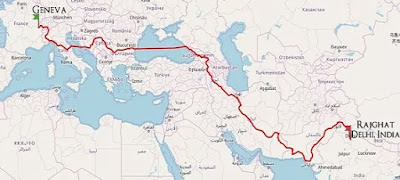
A year-long trek for 'Justice and Peace' begins October 2, 2019, in New Delhi, India. Participants will march about 6,214 miles for 370 Days, crossing 16 countries, to Geneva, Switzerland, arriving on the 22nd of September, 2020. A part of the trek is happening in Canada.
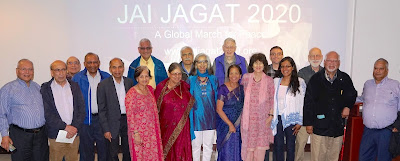
In the Hindi language, Jai Jagat means 'victory to the world', 'victory to the planet', 'victory to all'. It also names a series of grass-root marches — 2007, 2012, and Jai Jagat 2020 — to address poverty, discrimination, climate crisis, and healing conflict and violence — the 17 Sustainable Development Goals.


Details of the Jai Jagat 2020 trek were presented at a slide-lecture hosted by the Mahatma Gandhi Peace Council, held at Carleton University on June 15th. About 30 attended. I took photos.

Trekkers will pass near Doukhobors in the South Caucasus, and board a ship at Batumi, Georgia, the same port where many Doukhobors left Russia beginning in 1898, eventually arriving in Canada. Most Canadian Doukhobors still use the pre-1920 Russian name Batum for Batum Oblast (province) and city. The original plan was to walk around the Black Sea through Russia and Ukraine, but Russian officials are 'not interested' in allowing this march through their territory.

Dr. Jill Carr-Harris is Canadian with Ph.D. studies from the University of Toronto, who lived for 30+ years in India. She teaches peace and Gandhian nonviolence, and is married to a like-minded Indian peace activist who is the leader of Jai Jagat 2020. She came to Canada to promote the events, raise funds, and meet with family and friends before she begins the year-long walk.

Dr. Jill Carr-Harris
Dr. Carr-Harris opened her 1-hour lecture exclaiming Jai Jaget!, a greeting used in India 'to recognize each person as a member of the universal family' — 'an act of peace'. In her first lecture slide, she labeled the trek 'A Global March for Peace'.

In 2017 she introduced the Jai Jagat 'campaign' in Ottawa, and has returned to 'update' the news and 'get some people engaged' — 'grassroots ... action'.

In 2014, I met her husband Rajagopal P. V. in Ottawa, Canada when he and Jill came to introduce their early plans for these treks.

Both husband and wife view human behaviour as basically good, but we need to support ways to assure global survival for all living things — ‘not just making money’ for ourselves. In our most difficult moments, nonviolence training teaches us to be compassionate, must be used to 'organize society', and be integrated into all the higher academic fields (sciences and humanities). 'A Gandhian perspective ... educating young people ... to get them to think about peace and nonviolence'.

Jill Carr-Harris stated that the late Murray Thomson and UN Ambassador Doug Roche are the 'grandfathers of peace' in Canada. Roche 'said we are moving from a culture of violence, a culture of war, ... into to a culture of peace ... but, there are small ups and downs'.

Her slides are not shown on the web except in this video, and are included here.

      4 Phases of the Jai Jagat Campaign
  • PHASE 1: Nonviolent training, local action and youth engagement.
  • PHASE 2: Global Peace March: from Raj Ghat, New Deli India to Geneva Switzerland with Peace Conferences along the way.
  • PHASE 3: GENEVA Action Forum & Dialogue with UN & Financial Institutions.
  • PHASE 4: Follow up Advocacy County/Local Level Action and Advocacy.

Dr. Carr-Harris reported that 50 people have committed to walk the entire 10,000 kilometers. Everyone is welcome to join and leave at any place and time. Many peace groups along the route are organizing partial marches, joining the permanent marchers for a few kilometers. Many not on the main route from India are planning local marches. some to join the movement in Geneva. European countries are accommodating marchers with special visas. Peace organizations around the world can recognize and join in the global effort. First Nations are now marching from New Brunswick to Maine, USA, before winter.

There are social media campaigns in 4 countries, including Canada. In addition to Dr. Carr-Harris, the Canadian event advisor is Dr. Anne Pearson, Shastri Indo-Canadian Institute (Alberta), Global Peace Centre Canada (Ontario).

     What Can People In Canada Do?
  • Working to Galvanize:
    • Social Media Unit in Atlantic Canada
    • Communication Group in Southern Ontario
    • Teachers Group in Western Canada
  • Connecting with Mahatma Gandhi Foundations in Edmonton, Hamilton and Ottawa to Raise Jai Jagat in 2nd October Program
  • Small Fundraising Efforts (For marchers)
  • Working on Marches in Canada
  • Join the March (Either the Long March of Other European Marches)
  • Sending Journalist Students to Join Marches.

Her final announcement was that a 'Peace and Non-Violence Department' is being planned in Rajasthan, India. It precedes our Canadian Peace Initiative for a similar government department.


Thursday, 14 April 2016

‘Non-Tourist’ Sites in Georgia

Molokane and Dukhobortsy found by journalist.

About March 2016 the Russian newspaper Kosomolskaya Pravda, sent staff journalist Sergey Ponomarev on a ‘special project’ assignment — fly from Moscow to Tbilisi, Georgia, and report about the sites and people that tourists rarely or never see.

He visited 22 mapped places (below) and several side-stops, reported in two parts online with photos and video. 100s of readers commented, and he replied to many.

On his agenda were Molokane and Dukhobortsy (Doukhobors). When he met a Russian woman vendor named Potapova in Tbilisi, he first asked if her family arrived with Molokane or Dukhobory. She replied, no, my grandfather came here in the 1930s from Tambov, followed by all Potapovs from our village. (Русским здесь не доверяют? (Russians are not trusted here?), Part 1. [Video now offline])

Click map to ENLARGE.
His report posted April 5 got 50 comments, though editors dated the story the next day, on April 6, 2016 as : Путешествие по «нетуристической» стране: Расцвела под евросолнцем Грузия моя? [Traveling in ‘non-tourist’ country: Flourish in the European sun, my Georgia?]. The story title is a play on the title of the popular Soviet era song: Расцветай под солнцем Грузия моя (Flourish in the sun, my Georgia).

Ponomarev apparently prepared for his tour, and set an agenda to follow a route which covered most of the country. He rented an apartment in Tbilisi, and carried his video camera around town interviewing in Russian with anyone who spoke Russian. Then he traveled to the eastern edge of the country where he sought Molokane (Part 1 of 2). Along the southern border he found Doukhobors (Part 2 of 2).

Title page. Click to ENLARGE

Ironically unknown to the reporter, in the middle of the panoramic photo of Tbilisi (above) used for the opening page of his report are 2 historic sites for Molokane and Dukhobortsy. The current Rike Park was home to the first large Molokan settlement in Tiflis. This sandy river bank flat was earlier called the peski district (pes.ki' means sandy in Russian; ree'.ke means sandy in Georgian). The adjacent Metekhi jails held all the arrested gun-burning and protesting Doukhobors in the Caucasus in 1895-1896.

Ponomarev, 50, was raised in the Urals, studied journalism at Ural State University. He worked as a newspaper journalist in various parts of the Far East, and in the 1990s was hired by Kosomolskaya Pravda.

The content is useful for the general public, and presents as a valuable authentic ethnographic work, though his reporting is superficial at times and he missed many fascinating out-of-the-way peoples and places. All of his video is with a hand-held camera, image bouncing as he walks, out of focus when the light is dim or the subject is back-lit, and too often strays while he interviews. The sound is often noisy with traffic or wind. The project shows how a print and photo-journalist tries to do video journalism. Fortunate for our readers, he included two groups of Spiritual Christians.

We translated and posted his two stories. Leave comments on this blog, below.

Russian entry page on Kosomolskaya Pravda: Путешествие по «нетуристической» стране: Расцвела под евросолнцем Грузия моя? [Traveling in ‘non-tourist’ country: Flourish in the European sun, my Georgia?].

Tuesday, 1 September 2015

It is criminal how the West is maligning Russia and Putin

By Alex Ewashen. August 4, 2015

Alex Ewashen
On June 27th on the Doukhobor Heritage Tour 2015 to Turkey, Georgia, Azerbaijan and Russia, to seek out our forefather’s ancestral roots, Brian and I set out on an experience of a lifetime, we returned on July 20th. These countries mentioned were all a part of Russia when our ancestors migrated to Canada in 1899. The heritage tour is a wondrous story, but that will come at a later day.

It is another world out there which our media tells us nothing about, but to strike right at the bone, it is criminal how the West is maligning Russia and Putin. In our travels through villages, towns, country sides and the streets of cities we found that Putin was well respected and admired, and that Moscow was the centre of that part of the universe. Besides being a very popular tourist destination, (one of the most expensive cities in the world) people from Turkey, Georgia, Azerbaijan and of course Russia go to Moscow to work, they work 20 days there and come home for 10.

There are huge cranes everywhere, from the Kremlin to the outskirts of the city, and streets are being dug up to up grade the infrastructure. In our travels we came into Moscow from two different directions and there are new four and six lane highways leading into the city. The streets of Moscow are clogged with BMW's, Audi's, Mercedes, Volvo's, Cadillacs, and every other American and Japanese cars. Men in silk suits and shinny brief cases hurry by on the streets, too preoccupied, or on iPhones, to give you a glance or a smile. I could have spent my entire time sitting on the street photographing the different ladies foot ware, toenails painted to match their shoes and handbags.

And what about the West’s embargo and sanctions? Well, it seems as far as technology and big business, like KFC, Burger King, and McDonald’s, and the car industry are exempt. It is business as usual. The ordinary man in Russia welcomes the embargo. People were getting upset about the many imports, and Russia has geared up very fast to becoming self sufficient developing their own industries. A young couple we stayed with in a village were into making cheeses and selling cream, butter and milk. Their produce had gone up in price by 60 to 75% since the embargo. A lady running a souvenir kiosk, said: 'Look at my stock, it is all made in Russia now'.

On the other hand while visiting in Georgia, which is under US dominance, the general populace is very upset about the embargo. Georgia has a centuries old wine industry, because they are forced to take part in the embargo, they cannot sell their wine to Russia, who was their biggest customer. Georgia grows tons of watermelon which they used to sell to Russia, this market is no more, so the agricultural producers are really hurting.

Saudi Arabia, the US’s foremost ally in that part of the world, is investing 10 billion US in the next five years, largely in the Russian economy, targeting infrastructure, agriculture, medicine, and logistics. Putin’s goal is to make Russia 100% self-sufficient in it’s food industry within the next 10 years.

The biggest thing happening to demonstrate the futility of Western efforts to isolate Russia is a summit underway between Brazil, Russia, India, China and South Africa to establish a new development bank, BRICS, and emergency currency reserve pool, each to be armed with $100 Billion, to rival the World Bank and International Monetary Fund (IMF) .

Russians are very conscious about their diet. A bill has been submitted to restrict advertising of food high in sugar, salt, fat and saturated fat. If passed, the bill would ban fast-food advertisements aimed at Russian youth and would require that any advertising of these products be accompanied by a health warning. The law would also prohibit fast food advertisements within 100 metres of gyms, medical clinics, military buildings, cultural venues libraries and schools.

Our trip was an experience of a lifetime, and a real eye opener….


More
  1. Alex Ewashen. Rags To Riches…My Way. July 8, 2015. Book Review by Koozma.J. Tarasoff.
  2. Natylie Baldwin and Kermit Heartsong. Ukraine: Zbig's Grand Chessboard & How the West Was Checkmated. Next Revelation Press, San Francisco and Montreal, 2015.
  3. Corinne Seminoff. 'Back to the Motherlnd - Remaking Russian Farms in Times of Crisis.'
  4. Ekaterina Blinova. From 1945 - 49 the US and UK Planned to Bomb Russia into the Stone Age.  Russia Insider, September 4, 2015. 

Tuesday, 27 August 2013

Georgia Funds Doukhobor Project

The Deportation of the Tavrian Doukhobors to Georgia and Their Identity is the title of a one-year research project begun in July 2013 in the Republic of Georgia, funded by the President.

The project is being researched and produced by 3 advocates in the southern Samtskhe-Javakheti region: Gulo Koxodze, a human rights journalist; Nino Narimanishvili, editor of the Samkhretis Karibche newspaper; and, Nino Zumbadze, a member of the regional Tolerance Association.

Kuxodze (Kukhodze), who works with the Human Rights Center, proposed the multimedia project. They will produce a website, short video documentaries, and print publications dedicated to the life histories, traditions, and culture of the Doukhobors. The project began 1 July 2013, is funded for one year, and will be in Georgian and Russian languages.

Kuxodze has been in contact with 20 local Doukhobor families. She reported about them in the past, and feels an in-depth study of traditions and culture is needed now because many are very old. Though a lot of information is on the Internet, little is in the Georgian language and few have Internet access. Some reports will also be published in Armenian because their newspaper readership is primarily refugees from Armenia, many who invaded Dukhoborya — land of the Doukhobors.

This project will bring more facts to the attention of the National Agency for Cultural Heritage Preservation of Georgia regarding Doukhobor historical sites. In 2012 the proposed granting of cultural heritage status to the Sirotski Dom (Orphan's Home), Gorelovka village, was unresolved. The Tolerance Center, Public Defender of Georgia, reported: "The process should be speeded up and the object granted a status of a museum and allocated two personnel to protect it."

A local Doukhobor said the Sirotski Dom should serve its original purpose, as a home for elderly orphans (widows, widowers). The elders could look after one another with professional help, and preserve their roots.

The historical and cultural value of the 1895 Burning of Arms site, peschery (grotto) and old cemetery are little known among Georgians. All sites should be submitted for the UNESCO World Heritage List for Georgia.

More about Doukhobors in Georgia.

Funded by Presidential Decree

On 17 December 2012, American educated President Mikheil Saakashvili issued a decree to allocate GEL 1 million (Georgian lari / CAN$ 631,165) from the President’s Fund for the development of the Civil Sector and enhancement of the role of free media. Funds were awarded to non-profit/ non-government (NGO) entities.

The Journalistic Development Fund, named "Zaza Daraselia," received GEL 200,000 (CAN $126,450). Zaza Daraselia is Executive Director of the Fair Elections Foundation and was an administrator of Didube-Chughureti region, Tblisi.

The Daraseli Fund fortunately got their grant due to other organizations not submitting and/or not understanding the goals of the President. The Fund awarded cultural projects — performances, attractions, exhibition space, or multimedia projects. The Doukhobor project, submitted in April 2013, satisfied conditions of the Fund as a multimedia cultural project.

The Doukhobor project will bring much needed funds to the young SK newspaper with a staff of eight. The newspaper was launched in 2003 to serve the poor south Georgian Armenian villages with many articles in the Armenian language. It nearly closed in 2012 due to no grant in 2011.

Sources by date
  1. Gulo Koxodze, Facebook.
  2. Everyday Life and Problems of Dukhabors (Part 1), by Gulo Kokhodze, Human Rights in Georgia, 25 May 2007
  3. Everyday Life and Problems of Dukhabors (The End) : Village of Old People, by Gulo Kokhodze, Human Rights in Georgia, 25 May 2007
  4. Here Women Have No Rights and They Are Blind…,” by Gulo Kokhodze, Human Rights in Georgia, 30 May 2007.
  5. Deteriorated House Will Be Restored, Tbilisi.gov.ge, 20 May 2008.
  6. Nostalgia or Unbearable Living Conditions - Dukhobors Abandon Villages in Ninotsminda District, by Gulo Kokhodze, Human Rights in Georgia, 23 January 2008.
  7. შაშკინის გადაწყვეტილე (Probate decision), video netgazeti.ge, 27 January 2010.
  8. Monitoring results of implementation of the National Concept and Action Plan on Tolerance and Civil Integration, Council of National Minorities, Tolerance Center, Public Defender, Republic of Georgia, 2010-2011. In English, Russian, and Georgian languages. (ISBN 978-9941-0-5067-1), pages 132-133, 137-138, 145.
  9. President of Georgia to Fund NGO Sector and Media, media.ge, Trend News Agency, 18 December 2012.
  10. President to Fund Two Organizations for Development of Civil Sector and Free Media, media.ge, 8 January 2013.
  11. Former education minister’s organisation receives presidential grant in Georgia, 9 January 2013.
  12. "Zaza Daraseli Fund" to Start Issuing Grants in the Near Future, Civil Society Institute - CSO Georgia, 16 January 2013.
  13. Civil Sector and Free Media Development Organizations Funded by President’s Fund, media.ge, 7 June 2013.
  14. ვის და რატომ გაახსენდნენ დუხობორები? (Who are and why should Doukhobors be remembered?), Samkhretis Karibche (Southern Gate) news, 26 June 2013.
  15. ვის და რატომ გაახსენდნენ დუხობორები? (Who are and why should Doukhobors be remembered?), Ambebe.ge, 26 June 2013.
  16. Projects Funded by Zaza Daraselia’s Foundation, media.ge, 17 July 2013.
  17. Involuntary Vacation of the Samkhretis Karibche, media.ge, 3 February 2012.
  18. Ethnic Map of Georgia, August 2012, European Centre for Minority Issues — based on ECMI assessments from 2006 to 2008.

Thursday, 13 June 2013

New Video About Georgian Doukhobors

Review by Koozma J.Tarasoff of Doukhobors: Community of Faith, a video documentary by Russian TV, June 7, 2013: (28 minutes). Copyright by "RT" and "TV-NOVOSTI" 2013.

Studying Doukhobors from their roof-top.

The opening image is a 1893 sketch of the Doukhobor village Gorelovka, Tiflis province, Russia, by H.F.B. Lynch. Russian Television (RT) sent a Georgian video crew to produce this documentary. The opening sound track is sprinkled with singing and snippet previews of this 'sacred place.'

The 29 minute video is divided into 5 sections titled: People (at minute 2:48); Vasily (3:30); Nikolay (6:38); Mikhail, Kuzma, Tatyana (9:00); Community of Doukhobors; Ads (12:04 for 2 minutes); Faith (14:12); Easter (15:20); Exodus (19:17); Neighbors (20:42); and Sacred Place (25:30) the cemetery.

Roof-top views

Presented mostly in English over Russian dialogue, the introductory printed text along with another text further on explains the context of this film:
  • RT teams up with a couple [video journalists Niko and Magda] from Tbilisi, Georgia, who travel south of the country to explore the community of the Dukhobors — a Christian group that believes God lives inside humans, not in an organized church. See how this group managed to preserve their way of life for centuries.
  • In 2013 a young couple traveled from Georgia's capital, Tbilisi, to the south of the country. This region is home to a breakaway Orthodox group. Known as the Dukhobors, they reject all church rituals and iconography and have managed to preserve their way of life.
This is one of the better films on the Russian Doukhobors for several reasons. It is tightly edited. Their philosophy is clearly articulated. The tone is upbeat, friendly and informative. Unlike previous videos in Georgia which focused on women, here men and children are included. The video quality and color are beautifully done.

The story is quickly paced from the time the crew leaves Tbilisi by car, arrives in Doukhoboria, climbs on top of a heritage earth house with a green grass roof, where they view the world of the few remaining Doukhobors in a village now occupied with Armenians and Adjarians (Muslim Georgians). The journalists ask many questions in voice over, which are eventually answered by the subjects in interviews. They translate most of the Russian in subtitles, and give insightful commentary throughout.

The journalists describe their roof top view as if it was 'from another planet.' The old Doukhobor village has given way to 'a Caucasian ghetto.' There is nostalgia for the old Soviet era when living together was a pleasure, cleanliness was a virtue, education was free, orderliness, culture and a job gave rhythm to life. There was a view of a public school with only several children present; they were reciting Russian, Georgian, and Armenian alphabets.

After 170 years in the region (having moved in exile from the Milky Waters area of the Crimea in the mid-1800s), only about 150 Doukhobors remain in Gorelovka here today. The trend is towards out-migration and a loss of identity. Their stone architecture remains a prized possession of neighbours who see an opportunity to get good cheap or free accommodation as locals move out to Russia. Only 57 Doukhobor houses remain in this village.

People interviewed are: Vasily Slastukhin (woodshop), Nikolai Sukharukov (sledge shop class),  Brothers Mikhail and Kuzma (at the cheese factory with sister Tatyana Oslopova, who later sings a song of the 'dear heartland').


Easter service begins at midnight with men on the left (3 men and a boy) and 12 women in beautiful traditional costumes on the right, perform a prayer service where there appears to be no leader yet there is a feeling of unity.

In 'Neighbours' a young fellow admits he came because his Armenian grandfather moved here. The village administrator regrets that so many Russians have moved away.

The remaining Doukhobors survive off their land — selling milk, cheese, and growing gardens. We see one of the women in the home making traditional pirogies.

The short clip of the storks in a nest on top of a pole is beautifully-done. According to legend, say the locals, these birds are a symbol of new birth, kindness and love.

In 'Faith' a woman describes the symbology of her Doukhobor cap. She says some suggest that Doukhobors 'originated in Byzantia,' a predominantly Greek-speaking continuation of the Roman Empire.

The last segment, 'Sacred Place,' is a tribute to the past at the Burial site of the leaders, a 3 kilometer drive west east of their village, where they join Doukhobors from neighboring Orlovka village.

The philosophy of the Doukhbors is clearly articulated with the words 'behaviour is the measure of ones life.' Vasily points out that Doukhobors don't believe in baptism. They see no need for churches which they consider to be 'idolatry.' Their God of love is within. 'Giving to the poor' and helping your neighbour is sufficient. White-bearded Nikolai states that Doukhobors 'live by their word' so that their actions speak louder than words.

Although this could be a depressive story of a people losing their property and their identity, the presentation remains upbeat, portraying the inevitable change that has occurred because of recent geo-political and economic circumstances. In the end, morality wins.

I was surprised that the caves and the 1895 Arms Burning site were missed. Despite these major omissions, this video story is well worth viewing because it really gives the viewer an impression of what life is like there in 100s of scenes and thoughtful dialog.

Wednesday, 15 August 2012

Doukhobors in Georgia: to stay or move?

Духоборы в Грузии: остаться или уехать?

The BBC Russian office posted a 3.5 minute TV Russian news video on 14 August 2012, summarising the current situation of the few remaining Doukhobors in Transcaucasia. Translation of introduction:

In southern Georgia near the border with Armenia and Turkey, many Doukhobors relocated here in the mid-19th century. Here in Ninotsminda, formerly the Bogdanovka District of Georgia, historical monuments are preserved of the difficult history of the Doukhobor movement. Today, nearly two centuries later, most Doukhobors moved to Russia, and many fear that the history of the Doukhobors in Georgia is coming to an end. Correspondent, Nina Akhmeteli, BBC Russian office.

The report is excellent for its stark images, good interviews, very good articulation in the Russian language, and a tone that is neither gloomy nor optimistic. Villagers are shown herding and milking cows, and during a Sunday meeting. The cave and cemetery are toured.


Four residents are interviewed: 

Dressed in traditional Doukhobor clothes, Tatiana Oslopova tells how a few elders come to the Sirotskoi Dom (Orphan's Home) on Sunday to 'meet God' and pray together.

Maria Belousova describes how Doukhobors once had a thriving milk economy, but now most the Doukhobors have moved away, including her family. She sold her cow, survives on her garden, and wants her daughters to return to their homeland.

Young Vladim Sukorukov of the village of Gorelovka sees no future for Doukhobors here unless something unexpectedly happens.

Bearded elder Nikolai Sukorukov visits the cave (peshcheriska) near one of three 1895 Arms Burning sites, then the cemetery (mogilitchki) in Orlovka. He came to the area 30+ years from Tbilisi, says he sees hope that the area pulls people back to their homeland.

The reporter concludes that almost two centuries after the Doukhobors were exiled from the Milky Waters area in 1841, many now fear that the Doukhobor history in the Caucasus is rapidly coming to an end.

More about Doukhobors in Georgia.

Sunday, 14 August 2011

Georgia Doukhobor Photos Win 3rd Place at International Competition in Italy


Italian documentary photographer Agnes Montanari has been photographing Doukhobors in Georgia for several years. She entered 5 of her many Doukhobor images as "The doukhobors of Georgia di Agnes Montanari_terza classificata" in immagini dal mondo_classificati 2009, an international "Chatwin Price" photo competition of travel reportage, held November 2009 in Genoa, Italy. "The Doukhobors of Georgia" photos were awarded 3rd place.

Among her many interests are social issues, women, refugees, minorities. Some photos of Doukhobors in Georgia were published in 'The minorities of Georgia', European Centre for Minorities Issues, 2011.

See 36 quality photos with captions by Agnes Montanari displayed online — The Last of the Doukhobors, 9 February 2009.

More about Doukhobors in Georgia

Wednesday, 15 June 2011

Doukhobors in Georgia, a Russian video

This 18-minute Russian language video titled: დუხობორები დმანისმი — 'Doukhobors in Dmanismi' (Bashkicheti) was posted in June 2010 by Baxolia, recorded in 2009-2010. Patience. Video loads slowly. If video stalls, try loading from MyVideo.ge.


The video begins at 5 a.m., showing a typical Doukhobor prayer service at dawn, contrasted with village street scenes. Interviews summarize that only Doukhobors lived here before, now few remain. They are in contact with the neighboring Doukhobor villages. The second half, at minute 8:30, begins as a nostalgic slideshow of older images and songs of the Gorelovka area showng more people and the cemetery service. The video concludes at minute 15:45 with interviews about their future and images of Dmanisi village at 7 p.m. If you can read Georgian, please send in a translation of the video credits, or post in "Comments" below.

More about Doukhobors in Georgia.

Saturday, 4 June 2011

Doukhobors Remaining in Georgia

Fred Makortoff, South Slocan BC, sent this 23 May 2011 news item about the Doukhobor region in Georgia :

Georgia: The Javakheti Region’s Integration Challenges

To ensure political stability and that there is no opportunity for Russia or others to manipulate local politics, Georgia needs to improve integration of its mostly Armenian-populated Javakheti region.

Georgia: The Javakheti Region’s Integration Challenges, the latest briefing from the International Crisis Group, analyses how since the height of tension in the small but sensitive area in 2006, Tbilisi has had some success in addressing grievances by applying a more constructive approach, helping to reduce Armenian and Russian nationalists’ ability to encourage extremism. Although Tbilisi has significantly invested in infrastructure and acquiesced to the use of the Armenian language in schools and public administration, however, Javakheti still faces serious problems.  ... (more)

The full PDF report (Appendix B, page 16) displays an "Ethnic Map of Samtskhe-Javakheti" by the European Centre for Minority Issues (ECMI). This map shows the relative Russian population in the 3 remaining Doukhobor villages — Spassovka, Orlovka, Gorelovka — averaged about half of the total in 2002. Most of the region is Armenian. The Doukhobor portion of that map is enlarged here.


The most detailed report by EMCI of Doukhobors in Georgia was published in 2006, in English and Russian, with a color map: Russian Dukhobor Settlements in Georgia.

Moe about Doukhobors in Georgia.

170th Anniversary of Doukhobors in Georgia — 3 June 2011

The exhibition/meeting "Doukhobors in Georgia" (დუხობორები საქართველოში) will be held at the Conference Hall of the National Parliamentary Library of Georgia (Building III, 7 Gudiashvili Street, Tbilisi 0107, Georgia) on 3 June 2011 at 16:00 (4 PM), to mark the 170th anniversary of the exile of Doukhobors to Georgia.

Alla Bezhentseva, the author of the book Strana Doukhoboriya and the chairperson of the Union of Russian Women of Georgia Yaroslavna will deliver a speech on the Doukhobors’ life in Georgia, their traditions and culture, the present and the future of the school financed by Leo Tolstoy.

Gorelovka, a documentary by Alexander Kviria will be shown at the Conference.

The exhibition will display 20 archival photographs illustrating the Doukhobors’ life in Georgia.

The event is organized by the National Parliamentary Library of Georgia, the Office of the State Minister of Georgia on Reintegration Issues and the Union of Russian Women of Georgia Yaroslavna.

More about Doukhobors in Georgia.

Wednesday, 20 April 2011

Doukhobors Return to Georgia
— Russian TV News

Духоборы в Грузии — Doukhobors in Georgia — is a 3-minute PIC-TV news segment (off-line) about village Gorelovka (Goreloye) broadcast 18 April, 2011. Vladimir I. Tolstoy, his daughter and others are shown visiting the Orphans' Home (Sirotsky dom) and lunching with staff and Doukhobors at the Lev N. Tolstoy Secondary School.

Winter scenes include Sirotsky dom, psalm singing, village scenes, the adjacent Tolstoy school, pictures of Russian writers, ending with stork nests. Near the end (time 2:25), Galina Alekseeva reports that a few educated Doukhobors have surprisingly returned from Russia to this "Georgian Siberia."
 
In the video 3 brief interviews shown, none with V.I. Tolstoy, summarized here:
  • Nikolai Sukhorukov, village elder — Hold your sword without revenge. It's a spiritual sword. Lev Tolstoy has a famous saying: 'Don't oppose evil with violence.' They are identical. A person who walks with the [Holy] Spirit won't get attacked.
  • Vladimir Svetlischev, village resident — We know how to speak Georgian because we live in Georgia. Before we were isolated and there were no Georgians here.
  • Galina Alekseeva, Head of Academic Research at the State Museum-Estate of Leo Tolstoy at Yasnaya Polyana — It's very surprising that many well educated people (Doukhobors) are returning here. They could live in Moscow or Tblisi, but amazingly they are coming back here.
An error occurs at second 22 when the newscaster mistakenly calls Doukhobors Staryvery, Old Believers, a common mistake because few journalists are familiar with the history of Spiritual Christians — Dukhobortsy, Molokane, Pryguny — confusing them with Orthodox "old faiths." The error is repeated in the video segment text: "В ходе Дней Льва Толстого в Грузии участники международной конференции посетили духовный центр староверов - Гореловку." 

The return of a few Doukhobors contrasts with previous news that Doukhobors have nearly abandoned their communal farms in Georgia,

More about Doukhobors in Georgia.
