Showing posts with label Doukhobors. Show all posts

Sunday, 11 September 2022

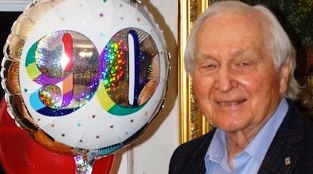
Alex A. Wishlow, 91 (1930-2022), Creston, BC


We gladly send our sincere condolences to the wider Wishlow family in the passing of a memorable personality. Alex was a creative teacher for 37 years, and one of the first Doukhobors to adopt computer technology in his courses. He passionately worked to promote multiculturalism as the way to tolerance and understanding of others.

Alex chaired the Canadian Doukhobor Society (CDS) for many years and persistently reminded its members to be a great example to others. As part of a 65-member 1995 'Voices for Peace Choir' that went international, he actively promoted peace and nonkilling as the way to our future. Alex will be missed. May he rest in peace.

Creston’s Larry Ewashen and Alex Wishlow attend Castlegar unveiling of historic Doukhobor plaquesCreston Valley Advance, October 18, 2012 — Peter V. Verigin was declared a Person of National Historic Significance, and the migration of the Doukhobors from Saskatchewan to British Columbia an event of National Historic Significance.


Read my biography (above) of Alex titled: 'Educator in the Interior of British Columbia' from Koozma J. Tarasoff, Spirit Wrestlers: Doukhobor Pioneers' Strategies for Living (2002): 105-106.

In 2014, Alex addressed a meeting held at the Doukhobor Discovery Centre (photo above)

See his Facebook page with a family photos

Alex's obituary at G.F. Oliver Funeral Chapel is simple: 
Donate to the Doukhobor Discovery Centre in his memory.

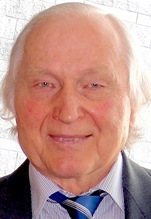
John E. Atamanenko, 91 (1930-2022), Saskatoon, SK

Left: Spirit Wrestlers, 2002, page 310.
Center: Obituary, Dignity Memorial, 2022.
Right: DSS
Christmas Meeting, Saskatoon, 2018.

John and I are close in age and have known each other for many years. I was Best Man at his wedding. We worked together building bridges of understanding between the East and the West, and getting to know the stranger.
  • We promoted cultural tours to the Soviet Union as well as joint business ventures.
  • In 1988, John raised funds for Vakhit V. Sharipov of Kazan, and myself to come to Saskatoon to meet Doukhobor Canadians.
  • There were many times that John generously helped with accommodation and travel related to East-West exchanges. In the 1980s, as van drivers and organizers, John and Koozma escorted a western Canada tour of Soviet poets to Alberta and British Columbia.
  • We promoted the distribution of Russian films and videos to Canadians.
That ancient wisdom is dearly needed today between the Russian Federation and the West. The welfare of the world depends on this understanding so that we can build trust to mutually work towards a peaceful world. Is anyone listening? As a generous man, John will be missed. Sincere condolences to the wider family.

In 1976 he was mentioned in his ag newsletter:
John Atamanenko '54 is now Manager of The Carpet Warehouse in Saskatoon. He has just built a new store and would be glad to have you drop in. (Saskatchewan Agricultural Graduates Association Newsletter, No 145, December 1976, page 4, col. 2)

In 2002, I included this short biography and photo (above) in my big book: Spirit Wrestlers: Doukhobor Pioneers' Strategies for Living (2002), page 310.
John E. Atamanenko, an agronomist by training, has worked variously as an owner of a carpet store, a bingo hall, and as a farmer. An active proponent of EastWest cultural exchanges, he is best known as founder of the Saskatoon Russian Cultural Club. The Club has promoted the use of Russian language, assisted the Russian Pavilion in town, has shown Russian movies, and has arranged for the visit to Canada of Soviet artists, students, professional and business people. His cousin Alex Atamanenko, in Castlegar, BC, is an international Russian-English interpreter, educator, and karate instructor, while Alex's brother George Atamanenko is an agricultural expert in Vancouver.


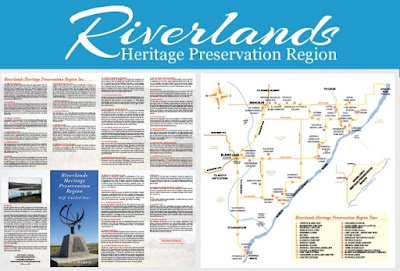
In 2003 John helped launch a project to conserve and promote an area north of Saskatoon near Blaine Lake, where he was raised. They formed the Riverlands Heritage Region project committee, ‘to preserve the historical contributions of Russian peoples who settled on the Canadian prairies over a century ago.’ By 2007 he served as president and treasurer and helped write a progress report about the project: Riverlands Heritage Region Formed in Saskatchewan. In 2015 the tour map (above) was published, titled 'Petrofka to Wingard'. By 2017 the new Riverlands website presented a virtual tour, maps, and video.

More of John’s active biography can be seen in his Obituary in The StarPhoenix, Saskatoon, and at Dignity Memorial Funeral Home.

Plant a tree in his memory.

Friday, 24 June 2022

Doukhobors Celebrate Destruction of Guns in 1895

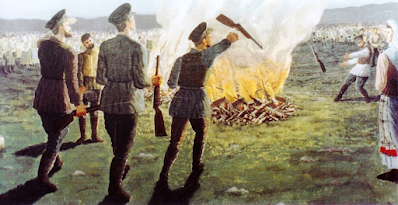
As 'de-Militarization and de-Natizification' is taking place in Ukraine, as the USA is struggling with gun violence, mass shootings and police brutality, and as Canada is proposing to ‘freeze…handguns’ and other safety measures, Canadian Doukhobors will celebrate the 127th anniversary of their ancestors burning their guns in Russia in 1895.

In Russia 127 years ago, pacifist Doukhobors burned all their guns once and for all. No weapons. No killing. For their protest they were severely punished. Many died. In 1898 they were given sanctuary in Canada and military exemption. About 8,300 came.

For over a century, Canadian Doukhobors have commemorated their 1895 burning of guns as a major annual holiday. This year ‘Peace Day’ will be held on Sunday, June 26th.


1895 Burning of Guns. Painting recreated by Michael M. Voykin, 1974.
On display in the Doukhobor Discovery Centre, Castlegar, British Columbia.

‘Peace Day’ gatherings, also known as 'Peter's Day' will take place in community halls in Saskatchewan, Alberta and British Columbia. In Saskatoon, Saskatchewan at the Community Home, 525 Avenue I South, people will gather Sunday June 26th for a prayer service at 11 am, followed by a program and potluck. The Quakers, Tolstoy, the country they left and the country that saved them will be remembered. Facebook.com/DSSaskatoon, or contact elder Mae Popoff (email: maepopoff@sasktel.net). 

Canadian Doukhobors fully support the long overdue new law to ‘freeze’ guns, but recommend banning all weapons of mass destruction. They continue to promote a nonkilling peace as the way to the future of humankind. For them, war is madness. Money spent on wars should be turned into new institutions for the betterment of humanity. Demilitarization is the way for our future survival.

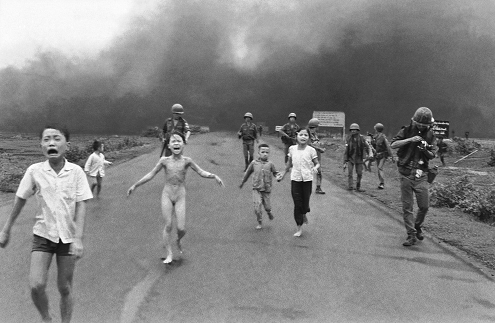
CBC podcast: '50 years after the Napalm Girl photo, what do you see?

"1973 Photo Contest, World Press Photo of the Year". By Nick Ut, Associated Press, 1972.

The madness of war as a criminal act was brought to my attention by the famous Vietnam war photo "The Terror of War", showing Phan Thi Kim Phuc running down a road near Trảng Bàng, Vietnam, after a napalm bomb was dropped on the village of Trảng Bàng by a plane of the Vietnam Air Force. The village was suspected by United States Army forces of being a Viet Cong stronghold. Kim Phúc survived by tearing off her burning clothes and running with her 2 brothers and cousins.

Kim Phuc Phan Thai, now lives in Ajax, Ontario, near Toronto. On June 22, 2022, she was interviewed on the 'Ontario Today CBC podcast: '50 years after the Napalm Girl photo, what do you see?' For me, it was a moving conversation about the power of this photograph on its 50th anniversary.

Napalm that nearly killed Kim was developed in 1942 in the USA as an 'incendiary weapon' to burn buildings, not people. Tears came to my eyes as I listened to Kim, a victim of war, who deserves a Nobel Peace Prize for revealing this horror of inhumanity. She spent 14 months in the hospital to regain her health from the terrible napalm fire she endured.

This 50-year-old image helps to educate us to work for a peaceful world. Kim says: 'Our responsibility is to make people know how horrible war is.’ The truth of the photo is painful, but important to see her today as mother, as grandmother, and as a survivor.

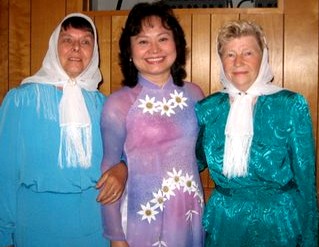
Posing with Kim on her left are Anne Chursinoff, Castlegar, and Lucy Tarasoff, Crescent Valley (right), who performed in the Friends in Unity and Krestova Ladies Kootenay Doukhobor women’s combined choir. Photo from 'Our Way Home Reunion ... Something's Happening Here', Purple Mountain Poetry blog by Linda Lee Crosfield, 10 July 2006.

BC Doukhobors met Kim in July 2006. She was a keynote speaker with Arun Gandhi, grandson of Mahatma Gandhi, at the Our Way Home Peace Event and Reunion held at the Brilliant Culture Centre, Castlegar, British Columbia.

As we commemorate the 127th anniversary of the arms burning in 1895, let’s not forget the pain of countless wars in human history — and the urgent need to stop this mass murder from continuing and threatening our civilization. Wars must stop once and for all. As concerned citizens, we all need to add our energies to this sacred duty of saving ourselves and succeeding generations from the scourge of wars. NATO should cease, as should NORAD!

More

Historic 1895 Burning of Guns: descriptions, selections and translations, by Koozma J. Tarasoff with Andrei Conovaloff, June 24, 2009. Updated 28 April 2022.
—————
Comments: Beginning in 2024, you can only self-enter a Comment below with a 'Google Account' (gmail). This prevents irrelevant anonymous comments (spam and admail).  If you do not have a Google Account, email your Comment to KJTarasoff@gmail.com for posting.

Sunday, 6 March 2022

90 Years of Memories

On February 19, 2022, about 60 people and I celebrated my 90th birthday ONLINE!

My wife and our daughters arranged the event which featured prerecorded video messages, phone calls, and some sent an email or letter. Thank you all.

In early February my daughter Tamara and her husband John, and Kristina with her daughter Milena, decided to arrange a virtual party. They invited many people to submit short video messages at a website, or any way the guests would like. About 60 people participated resulting in a 1.5 hour video and more than a dozen emails, cards and letters.

Kristina wanted to create a photo album of my life, and we selected about 50 photos which became a slide show presentation of my '90 Years of Memories'.

See everything here:

  • Videos submitted (1.5 hours) — Link to be added.
  • Slide show of my life — Link to be added.
  • Emails received

During the planning process, I began to reflect on my 90 years and listed these highlights of my life so far, a short version of my biography and 50 Years of Doukhobor Studies.

  1. Born in 1932 in this farm house to parents and grandparents who came from Russian Doukhobor roots. Believed that hospitality, love and nonkilling are the way to a world without wars.

  2. Met Tyrus R. Cobb world famous baseball pioneer. Invited for tryout in 1953 to Pittsburgh Pirates in California. Did not make it, but exercises that I learned from Lloyd Percival of CBC Sports College of the Air persist today 70 years later.

  3. At the University of Saskatchewan in Saskatoon, where I took my BA in Arts and Sciences in the 1950s, I produced 50 monthly journals of The Inquirer at my grandparent's attic next door, which led me to become a journalist, photographer, scholar, and peace activist.

  4. After attending the World Festival of Youth and Students in 1957 in Moscow, this led me to make 12 additional trips to the Soviet Union and Russia as a bridge-building effort between the East and the West (1957, 1964, 1980, 1991, etc, ). The wisdom of getting to know the stranger persists today as one of key steps to help the people and the planet to survive.

  5. In the early 1960s, at UBC in Vancouver, I was privileged to get my MA in Anthropology and Sociology, with my thesis on 'A Study of Russian Organizations in the Greater Vancouver Area' (PDF, 15 GB). The Cold War, I discovered, was the critical element in what brings people together and what splits them apart.

  6. In 1964, as a Russian and English speaking grad of UBC, I was invited to the International Ethnological Congress in Moscow where I met anthropologists Margaret Mead and Sol Tax.

  7. In 1980, as guest Doukhobor peacemaker and photo journalist, I reported on the Summer Olympics in Moscow as a Slavic representative for North and South America. What an awesome responsibility!

  8. Over the past 60 years I have organized a number of scholarly ethnographic studies and exchanges across North America (including a 1990 3-month North American Ethnographic Expedition with Russian scholar Svetlana Inikova), the Soviet Union and Russia on my ancestors the Doukhobors and East-West understanding. Together with my work in the provincial and federal governments as social scientists, this led me to publish over 25 books and 50 articles; the gifting to the Saskatchewan Archives and BC Archives major collections of textual materials and photographs on Doukhobors, rural development, Native Indians, and ethnography; the creation of a Spirit Wrestlers website and blog with Arizona scholar Andrei Conovaloff.

  9. In November 2007, I presented a paper on 'Tolstoy and the Doukhobors' at the First Leadership Forum in Hawaii where the Center for Global Nonkilling formed; and served as reporter and photographer for 13 Ottawa Peace Festivals.

  10. In 1982 co-organized with Community Doukhobors, the First International Intergroup Symposium of Doukhobors, Molokans, Mennonites and Quakers, held in Castlegar, British Columbia, with many prominent people including the great grandson of Lev N. Tolstoy, a major world writer and proponent of nonkilling. The meeting endorsed a letter to the UN on disarmament and getting rid of wars.

  11. With distinguished Doukhobor lawyer Peter G. Makaroff (the first non-Anglo-Saxon grad in Western Canada with a law degree in 1918), and participating Doukhobor, Quaker and Mennonite reps, in 1964 and 1965, I coordinated and helped organize four major peace manifestations in Western Canada urging the government to cease research and production of chemical and biological weapons of mass destruction, and work towards the survival of our human species.

  12. Between 1996 and 1998, served as guest co-Curator with Dr. Robert Klymasz on 'The Doukhobors: Spirit Wrestlers' exhibit at the Canadian Museum of Civilization, commemorating the centenaries of the  Doukhobor destruction of weapons in 1895 in Russia and the January 1899 arrival of the first Doukhobors to Canada.

  13. We all know that it takes a village to raise members of a family. My grandparents and parents along with my newly acquired families and offspring deserve praise for their support. Son Lev is professor at Memorial University in Newfoundland where he is modeling the last Ice Age and is searching the major parameters of climate change. Daughter Tamara, now retired as a museum professional, recently spent the last three years working in Nunavut as Project Manager, Wrecks HMS Erebus and HMS Terror National Historic Site. Their spouses, Dorothee Bienzle is an accomplished researcher and doctor, and John Pinkerton is a retired international manager for Parks Canada. Their children Jaspar and Katya along with Tamara and John's offspring (Nicholas and Elena) are outstanding students, athletes and outdoors people like their parents. I always marvel at being so lucky to be part of their family circle. 

  14. As well, I marvel at the challenge of keeping alive my 30-year marriage with Kristina Kristova, a pioneering journalist who once served for 24 years as anchor person with the Bulgarian National Television. Her daughter Milena is a music teacher in Ottawa, while son Orlin is in Sofia, Bulgaria, as a professional keyboard composer / musician. Kristina introduced me to her most fascinating Bulgarian community who have given me the title of 'Honourary Member' although I have not learned much Bulgarian language.

  15. In the 90 years of my life, this family along with all the people that I have met around the world (in person, in books and in the media), I consider all of you remarkable and many are friends and wisdom people. Bolshoe spasibo! Thank you very much! You have taught me so much. I wish all of you to live at least to 90 with good health, joy, peace and happiness.

  16. Personally, I look forward to many more years of productive life. In my work, I never got rich in money, but rich in ideas, in friendship, and in the vision of my ancestors for a peaceful world without wars.

Tuesday, 25 January 2022

New Book on Doukhobor Biographies

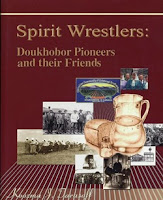
Spirit Wrestlers: Doukhobor Pioneers and Their Friends
has just been published as a text with 459 pages and 340 images, and as a free eBook online. See press release

This 2022 book is a continuation of my 2002 book ― Spirit Wrestlers: Doukhobor Pioneers’ Strategies for Living ―  with 106 long and 93 short biographies

To update the first book 20 years later, I invited more people associated with the Doukhobor Movement to submit their biographies, and many did. A total of 132 biographies have been published.

33 biographies came from around the world ― Canada (24), Russia (5), USA (2), Caribbean West Indies (1), and Australia (1). Four have no direct Doukhobor heritage. 

They are:
  • scholars
  • lawyer
  • ministers
  • educators
  • professors
  • civil servant
  • medical doctor
  • administrators
  • heritage builder
  • Slavic specialist
  • community activist
  • geophysical engineer
  • petroleum consultant
  • wheat pool director
  • singers and musicians
  • museum professional
  • artist, storyteller, dancer
  • communications worker
  • early childhood educator
  • digital technology expert
  • ethnographer and folklorist
  • entrepreneur with a conscience
  • organic candy maker in Australia
  • organic architect in the Caribbean
  • international consular property manager
  • Canadian family in Russia living
    next to the Lev N. Tolstoy estate 
These 33 Doukhobor pioneers and their friends exhibit an extraordinary spirit and talent to create a peaceful and healthy society. Their combined lessons of friendship, love, problem solving, and respect for humanity give us hope for the future of our species on planet earth. 

This large book with 340 images was a voluntary effort. The printing was funded by a very generous donation from geological engineer Michael N. Chernoff of West Vancouver, born in Veregin, Saskatchewan. His big brother Charlie has a biography in the book. 

A limited number of printed copies were distributed to the biographers, to select libraries and archives around the world, to several book reviewers, and to a number of individuals (‘the unsung heroes’). The distribution was made free as an expression of loving dedication to the Doukhobor experience and their hope for a peaceful nonkilling world society. 

The online version will be updated over time. Printed copies can be ordered from Manager Jia Hou, Merriam Print Inc., 252 Laurier Ave. East, Ottawa, Ontario K1N 6P4. Phone Jia at 613-567-5050, or email print252@gmail.com 

About the Editor

Koozma J. Tarasoff was born in 1932 on an isolated Saskatchewan farm 35 miles north-west of Saskatoon. With father John K., mother Anastasia, and brother John J. in the early 1940s, he moved to Saskatoon for public schooling. He got his BA in social sciences at the University of Saskatchewan in 1958. In 1962 enrolled at the University of British Columbia and earned his MA in Anthropology and Sociology in 1964. 

Is first job for three years was for the Province of Saskatchewan doing ethnographic studies of the Native Indians in the Broadview area. Next he joined the Federal Government in Winnipeg and then Ottawa where he worked for Regional Economic Expansion with submarginal rural areas and Natives. In the spring of 1979, the Canadian Council of Rural Development where he was last working was dissolved and he lost his job. That change allowed him to work as an independent ethnographer, photojournalist, and author on the Doukhobors and the peace movement. 

To date, Koozma Tarasoff has written 25 books, including those on native Canadians, rural development, east-west peace making, and major works on his heritage ― the Spirit Wrestlers / Doukhobors. With webmaster Andrei Conovaloff of Arizona, USA, Koozma today hosts the Spirit Wrestlers website and blog ― www.Spirit-Wrestlers.com ― from Canada’s capital Ottawa. 

Update: February 4, 2022

Among the many people who got a copy of this new book was David Swanson, director of World BEYOND War, ‘a global movement to end all wars’. He was inspired by the contents, and on January 28, 2022, posted: ‘Can We Learn Anything From Russian-Canadian Pacifists?’  

Swanson mentioned Tolstoy, Doukhobors, 1895 Burning of Arms, and quoted a paragraph from Dr. Ashleigh Androsoff's biography.

In response to Swanson’s article, Jim Popoff and Dr. Androsoff sent replies to me, which are copied below in the Comments section. Please add your comments and replies on either blog.

Note that the comment posted after Swanson article by Andrei Conovaloff is missing 3 links:
     'For clarification of the first 2 paragraphs, see:
—————
Note: You can enter a Comment below only with a Google Account. If you do not have a Google Account, email your Comment to KJTarasoff@gmail.com   This requirement was the easiest way to prevent irrelevant anonymous comments (spam and admail).

Monday, 25 October 2021

Joan Kazakoff Parker (1934–2021)

 Joan Parker (née Kazakoff) of Mississauga, Ontario, Canada, died June 10, 2021 of stage 4 lung cancer. 

She phoned me a few days earlier saying that she was alive and in good humour. 

Joan was born in the Kamsack area of Saskatchewan to Doukhobor parents.

Her son Jeff was looking after her in the home where he was raised and where her husband George, a professional engineer, died May 5, 2018

Surviving are two children Jeff and Wendy, and Wendy’s son Aaron who is а professional chef in London, England.

Her father George Kazakoff miraculously survived the as-yet-unsolved train explosion near Farron, British Columbia in October 1924 which took the lives of Peter V. Verigin and eight others. 

Joan lived in central California where she attended college. She learned of a cousin, Allan Zolnekoff (1953–), adopted by a Dukh-i-zhiznik family near Los Angeles. His mother was her aunt Dunya "Doe" Samoyloff. And, Allan is an adopted cousin of Koozma's webmaster, Andrei Conovaloff, who shared the same step-grandmother. Small world.

In 1984 she toured the Soviet Union with a group that included my mother Anastasia. Smaller world.

Joan was an interesting personality that I have known for many years by email. Though we never met, I interviewed her and published five stories (below). 

Joan did watercolour and acrylic painting, she made jewelry, and became interested in the culinary arts. At the age of 76, Joan Parker published Joan’s Favourites, a cookbook of 350 recipes from around the world including a section from her Russian Doukhobor heritage. The book is liberally embellished with 28 colourful wisdom proverbs I liked so much that I gathered them into a list posted in 2011.

Items I published about Joan:

Thursday, 1 July 2021

Nonkilling Message at Global Colloquium

On June 28th, 2021, I was one of 13 people honored to address a 3-hour online international conference titled: ‘Creating an affirmative nonkilling world’. This was my presentation text, which you can watch me read on this video at time 2:24:00.

My presentation begins at time 02:24:00

Nonkilling Message at Global Colloqium June 28, 2021

Hello dear colleagues around the world in commemorating the birth anniversary of the Late Professor Glenn D. Paige — one of the wisdom people of the world — a prophet of nonkilling.

It is very appropriate that Dr. Paige’s birthday on June 28th has been designated as International Nonkilling Day. This date always reminds me also about the historical event of my Doukhobor ancestors. It was on midnight of June 28, 1895 that 7,000 of my Russian Spirit Wrestlers / Doukhobor ancestors burnt their guns in the first mass protest in history against militarism and wars. They reasoned that the spark of God and Love resides in everyone, therefore it is wrong to kill another human being.

Russian writer and philosopher Lev N. Tolstoy pioneered this idea in his book The Kingdom of God is Within You (1894); his message of getting rid of wars inspired the Doukhobors to drop their guns and then get rid of them. When persecution followed, Tolstoy, his intellectual friends and Quakers helped with the migration of one-third of the most persecuted (7,500) to Western Canada in 1899. My grandparents were part of this group.

 At the First Global Nonkilling Leadership Forum in Hawaii in 2007, I was honoured to add Tolstoy as one of the pioneers of Nonkilling to that of Mahatma Gandhi, Martin Luther King Jr. and other world leaders and humanists. (Proceedings, page 207) Tolstoy absolutely condemned all wars and looked forward to a new vision of humanity. This vision in modern times came forth from Dr. Glenn D. Paige with the Nonkilling paradigm and hope for a new world order. 

Historically, Tolstoy and the Doukhobors both used the word ‘nonviolence’, but their real meaning, I discovered, was nonkilling. I am honoured that Glenn Paige gifted this insight to me which I have since adopted because nonkilling encompasses the broader notions of love including compassion, universal humanity, and world citizenship.

As a peace activist in many organizations such as the Canadian Peace Initiative and the World Beyond War Inc, I have often used the word ‘Nonkilling’ to describe what I consider to be one of the urgent needs of the day to save us from the scourge of war, terrorism and abuse  and preserve our civilization. Routinely, I end my emails with the words: ‘In search of truth and a nonkilling society.’ Let’s hope the new generation will embrace these important values that Glenn Paige pioneered for the sake of our children, our grandchildren, and the society of human beings.

With the Bulletin of the Atomic Scientists at 100 seconds to midnight, we must urgently work together to stop the slaughter of humanity. Nonkilling is the hope and the way to the future.

Update: Nonkilling Day June 28, 2025, 3 Jul 2025

—————

Note: You can enter a Comment only with a Google Account. If you do not have a Google Account, email your Comment to KJTarasoff@gmail.com

Thursday, 22 April 2021

Review: Our Backs Warmed by the Sun

Book: Vera Maloff. Our Backs Warmed by the Sun: Memories of a Doukhobor Life (Halfmoon Bay, BC: Caitlin Press, 2020), 263 pp. ISBN 9781773860398.

Peter N. Maloff, 1939; and book cover.

The main hero, Peter Nikolaevich Maloff (1900-1971), was a Canadian Independent Doukhobor, a free thinker, an enthralling emotional speaker, a devout vegetarian, and one who was deeply concerned with humanity’s problems of exploitation, militarism and wars. He shared the Doukhobor historic mission of stopping wars and working to create a good society.

The author Vera Maloff (left) of Shoreacres, British Columbia, Canada, is Peter’s granddaughter. After retiring from a career in teaching, Vera began to record family stories passed down from generation to generation. Through Peter’s self-published book, interviews with her mother Elizabeth (daughter of Peter), historic photos, and news clippings, Vera recreates some of the life of her grandfather Peter whom she adores.

Peter Maloff was born in Saskatchewan to parents who witnessed the 1895 Arms Burning event in Tsarist Russia, which marked the Doukhobor community for life as a group that proclaimed to the world that humanity needs to get rid of militarism and wars once and for all.

In 1913, young Peter moved with his parents to establish the communal koloniya svobody (sovereign, or freedom colony) near Peoria, Oregon,* USA for three years. (Kolony svobody,* The Doukhboor Gazetteer). There he entered high school and developed a keen interest in working towards a war-less world where equality reigns, behaviour would be nonviolent, and caring for neighbours would be the Golden Rule that was taught by Jesus Christ and other religious figures in history.

The commune dissolved in 3 years and the Maloff family went to San Francisco, California, for 9 months where they mingled with Molokane and other sectarians from Russia. Peter learned journalism and Russian grammar by assisting Russian publisher Anton P. Cherbak (Щербаков), and meeting many educated Orthodox Russian immigrants in the city.

In 1919 Maloff returned to Canada and settled among like-minded pacifist relatives in the Thrums area of British Columbia along the Kootenay River north of Castlegar. The community was independent in thinking with a few zealot Freedomite families living nearby that did not easily fit into the orthodoxy of the Community Doukhobors, who were known up to 1938 as the Christian Community of Universal Brotherhood (C.C.U.B.).

The book title describes their field work in the hot sun tending to their vegetables and fruit trees. They sold their produce at markets in Nelson and Trail. They also had a horse or two, a cow, a goat and chickens. Most were vegetarians.

In the 1920s Peter became very sympathetic to the zealot cause of striving for equality, in being against private property and some public education. He joined the cause and was arrested in 1929, 1932 and 1937. However, when the zealots began to burn and bomb homes and public property and used nudity as a way to gain public attention, Peter opposed this terrorism. His own home was threatened with arson and some of his books were burnt. By 1940 he abandoned the zealot movement. [Paragraph edited July 27, 2023.]

The biggest impact on Peter’s life as well as on the livelihood of the Doukhobor community was during World War II when Peter spoke out against militarism and wars. He refused to register for the Draft and was arrested, jailed, tortured, and threatened to be sent to a mental asylum and exiled in Canada in the early 1940s to an isolated two-room primitive isolated cottage near Blewett, about 23 km northeast of Thrums. His health was broken and it took several years to regain his strength.

In 1948, Peter published a collection of Russian articles some he wrote, many he collected that he thought would be of interest to Doukhobors. The 600+ page book, often cited in literature about Doukhobors, was never published in English, except for three articles listed below, bottom.

Author Vera wrote about this neglected eyesore in Canadian history through the voice of Peter’s daughter Elizabeth (Vera's mother) who was given the task of periodically visiting her father in exile bringing him essential food for his survival. The book reads well. Vera acknowledges the professional help of editor Anne DeGrace, who generously and skillfully prepared the manuscript for the final publishing form. Teamwork worked!

The book provides a good view of life among a close community group of pacifists with perspectives on values for survival, a passion for truth and justice, peace activism, conscientious objections, upbringing in the family, marriage traditions, land ownership, market gardening, visits to Dr. Bernard Jensen’s ranch in Escondido, California, and more. Vera’s mother Elizabeth (or Leeza) is a centenarian who with probing by Vera reveals the many facets of life of a struggling family showing what it means to be an active Doukhobor in the 20th century and beyond.

I was annoyed by the folksy English spelling of several Russian words, two of which were repeated by book reviewer Ron Verzuh. In my opinion these Russian words should have been properly transliterated according to the Library of Congress, or Oxford University Press standards — borshch (soup : not borsh, or borscht), pirogi (pierogi, filled tarts, turnovers, knish : not peerahee), and lekharka (female healer : not lyeekarka). (See more examples in: New Doukhobor Song Book, with CDs, May 28, 2013.)

Overall, this is a good read on the Doukhobors illustrated by excellent historic images, with special attention to Peter N. Maloff, the brave soul who has suffered for the cause of humanity. His truth was welcomed, but long overlooked by the general public. His granddaughter Vera has done a good turn by giving a voice to a nonkilling hero. Bolshoe spasibo, Vera. Many thanks!

If Peter Maloff was alive today, he would no doubt extend his anti-militarism call to include climate change, universal health care and drug programs for all, as well as urging all of us to make war a crime against humanity. Bolshoe spasibo (A big thank you), Peter! You were a visionary.

Fun fact: Maloff Spring*, Thrums, B.C. was named after Peter N. Malloff who first filed for a permit to use the water in 1956.

* 3 links to the Doukhobor Heritage website by Jonathan Kalmakoff.

More

Tuesday, 20 April 2021

YouTube misspelled "Doukhobor" 68 times

The word Doukhobor was misspelled 35 ways and 68 times in the YouTube closed captions for the USCC Union of Youth video: Peace and Sustainability: How Doukhobor history, culture, and community connects to the Sustainable Development Goals, (22 minutes, March 5, 2021).

NOTE (June 13, 2021) This video was recently taken offline, and is not now listed on the USSC Union of Youth video channel.    

22 other captioned words were also misspelled, and 2 historical mistakes were stated, totaling 92 errors.

For example, in this screenshot from minute 1:30 of the video, Doukhobor is misspelled twice in one sentence.

Correct caption: "I personally identify
as a Doukhobor, and to my knowledge, I'm
a fifth generation Doukhobor Canadian."

Closed captioning “fails” are misspellings of spoken words created by automatic voice-to-text software. These are different errors than the more than 50 ways Doukhobor was misspelled in print by people.

A total of 23 words were misspelled in the online Closed Captioning, and the time-stamped Transcript. The most obvious was how Doukhobor was misspelled 68 times, 35 different ways, never correctly. This means that disabled people probably will not understand the CC text, and anyone searching the closed caption text for the word Doukhobor will not find it.

22 other words also failed to caption correctly. Many are amusing, some phonetically spelled like Dukhoborese. 

To project a serious public image, the captions must be corrected. See links at bottom.

2 Factual Errors Appeared

These corrections were posted in the video Comments, without the links below to the references, because YouTube forbids outside links.

Count 35 different spellings of Doukhobor 68 times in YouTube “Closed Captions”.

Multiple Times (count 49)      Once Each (count 19)
 7  dukabor(s)
 6  duke aboard(s)
 4  dukabours
 4  dukeboard(s)
 4  dukeboro(s)
 3  duke of war(s)
 3  dukeboys
 2  dukabur
 2  duke abroad
 2  duca boys
 2  duke boys
dubois
duca boards
duca boars
ducaborgs
ducavores
duchaboretz     
dukabourg
duke bars
duke boards
duke boars
duke boris
duke of
duke of our
dukeborg
dukeborism
dukelbores
drugs
duplicator
jukeboards

Update: In May 2023 I watched "A Friend at the Door", National Film Board of Canada, 1950, in which Doukhobor was misspelled in Closed Caption as: "dab boards" and "dbo". 

In the 22 minute narration, words were slightly slurred differently, especially Doukhobor. Most of the captions recognized the d, u, k, b, o, r, and s, but scrambled other letters and inserted spaces. As the clarity of voice varied, 6 repeated words (*) were captioned correctly and incorrectly.

22 Other Words
  Spoken   
    alike
    Castlegar*
    Castlegar's
    college*
    Covid-19*
    doms
    Ewashen
    ferries
    Kalmakoff
    Kootenay(s)
    Ktunaxa
    Mir*
    Perehudoff
    Selkirk*
    Sinixt
    spasibo
    Tsar
    Tsilhqot'in (Chilcotin)
    USCC*
    Uteshenaya (Ootischenia)   
Captioned
  a lake
  kasugar
  kassagar's
  call illegal
  kovid 19
  dorms
  awashin
  fairies
  kamikov
  kootenai(s)
  tanaha
  mere
  Pero-hudoff
  soccer
  silks
  spaceba
  sarah
  chiquetmic
  ufcc
  udeshenya
* 6 words spelled correct and incorrect, depending on voice clarity.

The only solution is to edit your own YouTube video captions.

Saturday, 13 February 2021

Remembering William Kanigan. (1931–2021)


William W. (‘Bill’) Kanigan of Saskatoon, Saskatchewan died January 15, 2021. His compassionate heart touched many lives, including mine. Bill was a generous friend who encouraged and financially helped me with my research during the Doukhobor Centennial in 1995.

In 1989 we published an article about him in Spirit-Wrestlers’ Voices. In 2001 he helped Jon Kalmakoff document the Kylemore Doukhobor Colony for Saskatchewan History. In 2017 we published and replied to an essay he composed with his son Kim about two streams of Doukhobors.

Bill is best known as ‘a responsible entrepreneur from the heart’ who for 27 years co-owned and operated the successful Buy Rite Furniture business in Saskatoon, Saskatchewan. He attributed his success to the importance of promoting and practicing co-operation, being gentle, solving problems with thoughtfulness and kindness.


The photo above shows the former Buy-Rite Furniture building (originally the Cockshutt Plow Co. warehouse) at 132 Idylwyld Drive, Midtown Saskatoon. The far end of the building was being demolished. May 17, 1988. Historical Collections, Saskatoon Public Library.

Photo below shows the Kanigan's furniture and appliance store at 220 20th Street West, Saskatoon. August 26, 1965. Local History Collections, Saskatoon Public Library


In 1962, Rnold H. Smith and partners purchased Kanigan Home Furnishings, which Smith operated until 1967. He eventually partnered with Bill Kanigan to establish Buy-Rite Furniture, and was joined by his brother Cecil Kanigan, who died in 2018. Over the years the store grew to a chain of eight province-wide stores. The Buy-Rite Furniture Factory was 2 kilometers north of the showroom at 901 1st Ave N, Saskatoon for railroad access. Smith retired from Buy-Rite in 1985, and died in 2008.

1950s
Bill was brought up in the Community Doukhobor settlement of Kylemore, Saskatchewan by devout parents William George Kanigan and Mary Kanigan (nee Makortoff) who instilled in him the values of compassion, honesty, usefulness, and a belief in nonviolence.

At home, Bill would frequently hear the importance of the Golden Rule, ‘Do unto others as you would do unto you.’ This keystone ethic he applied both at home and at work. He believed that an organization rarely survived for any length of time unless it was ethical and guided by ethical leaders. Although this formula placed a heavy burden on the individual and extracted a heavy price, Bill said that ‘it can be worth the effort’ as reflected in the success of his business.

In his retirement years, Bill, like his parents, was an accomplished singer in traditional Russian. He was a regular member of the Doukhobor Society of Saskatoon and participated in Sunday meetings and the summer outdoor Doukhobor bread baking project at the annual Saskatoon Exhibition. He recently served as an ‘Elder’ in the Society.

Visiting Russian Doukhobor artist Volodia Gubanov (left) shows
his sketch of Bill Kanigan (right), Saskatoon, SK, July 22, 1995.

In early 2001, Bill contributed his family history and 8 vintage photos of his ancestral Kylemore Doukhobor Colony for an article written by Jonathan Kalmakoff, published in the journal Saskatchewan History.

Family was important to Bill, always supportive and encouraging. In the summer of 2001, he and his younger son Ryan went to Moscow, St. Petersburg and other places in Russia, visiting the country of their ancestors. This was one of their highlights in being together.

With Bill's support, his oldest son Kim established a tool and die-making business in Saskatchewan and Nova Scotia. Bill described his son as ‘an entrepreneur with a conscience’ because his son refused to produce several thousand military badges — an action very consistent with the Doukhobor nonkilling legacy. Later, Kim migrated from Canada to the coast of Queensland, Australia, where he used his mechanical skills to refurbish vintage candy machines and founded Stillwater Sweets (Facebook).

In 2016, Bill and Kim communicated by Skype, and often pondered 'what is a Doukhobor based on historical and current facts'? Their dialog evolved into an essay 'The Two Streams of Doukhobor Faith: Apostolic and Inclusivist', published in the Saskatoon Doukhobor journal, The Dove, in 2016.

Bill Kanigan is survived by his wife Doris, children Karen, Kim (Leslie) and Ryan (Nancy Paris), grandson Robin and step-grandchildren Camrin, Megan and Mia. He leaves his sister Natalie Austin, sister-in-law Bernice Kanigan, nieces and nephews. A memorial is planned for a later date. Bill will be missed by a lot of people far and wide.

He was a friend indeed. We enjoyed publishing his essays.


Notes

  1. Three images of Bill, from (left) sketch by visiting Russian Doukhobor artist Volodia Gubanov, July 22, 1995, (center) Koozma J. Tarasoff, published in Spirit Wrestlers: Doukhobor Pioneers' Strategies for Living (2002), page 221; and (right), obituaries online, below.
  2. 'File S-SP-A-25099 - Bill Kanigan' contains 16 Black & White photos of Bill Kanigan created on 12 Feb 1986, The StarPhoenix Collection, City of Saskatoon Archives.
  3. Rnold H. Smith biography in Pederson, Jen. ‘A Seat on Council: The Aldermen, Councillors and Mayors of Saskatoon - 1903-2006’, Edited and Revised by Jeff O’Brien October 15, 2015, The City of Saskatoon Archives, Office of the City Clerk, page 106.
  4. ‘Responsible Entrepreneurship From the Heart’, in Koozma J. Tarasoff. Spirit Wrestlers: Doukhobor Pioneers’ Strategies for Living (2002): pages 219-221. — Much taken from Tarasoff, ‘Responsible Entrepreneurship: an attitude of the mind’, Spirit-Wrestlers’ Voices: Honouring Doukhobors on the Centenary of their Migration to Canada in 1899, 1989, pages 111-115.
  5. Obituaries online for William W. Kanigan, Saskatoon, Saskatchewan (December 24, 1931 - January 15, 2021) — Mourning Glory Funeral ServicesThe Star PhoenixTribute Archive.
  6. Bill Kanigan of Saskatoon, Saskatchewan, and his son Kim Kanigan, Queensland, Australia, posted a paper in The Dove, April 2017, pages 5-15, 'The Two Streams of Doukhobor Faith'. In response, K.J. Tarasoff and A.J. Conovaloff replied with: ‘Q80: Two Streams of Doukhobors?’, Spirit Wrestlers blog, 12 July 2017. — Are there two Streams of Doukhobors? Apostolic and Inclusivist?
  7. Kalmakoff, Jonathan J. 'The Kylemore Doukhobor Colony', 20 November 2010, published in Saskatchewan History (Spring/Summer 2001, Issue, Vol. 63, No. 1) , pages 9-18, references on pages 45-47. — See article in online journal (PDF); and at the Doukhobor Genealogy Website in PDF and HTML.

Tuesday, 6 October 2020

Petrofka Ferry

Saskatchewan boyhood memories by Nick Troubetzkoy
 
Never before published tales of Doukhobor rural life in the 1940s  family farm, banya, baseball field, uncle John's general store and petro station, brick making, folklore, river, water hand pump, electricity, vodka still, cows, fishing, chickens, berries, outhouse, ice skating, ... 

For a kid there was an exciting grab bag of things to see and do along the North Saskatchewan River near Petrofka and on the ferry crossing the river, and on the farm, which was Uncle John's farm.

Orange markers show locations added to map: 'Blaine Lake and Langham, 
SK Doukhobor Settlement, 1899-1932', by Jonathan Kalmakoff.
Green insert map shows location of Petrofka north of Saskatoon, Saskatchewan.

Uncle John had kids, Phil, Donnie and Sonia, and his wife was Mabel. They all lived together in a farmhouse with my grandmother and grandfather on my mom's side (the Gulioffs).

Uncle John, my mom Lucy, Uncle Eli, Uncle Jim and Auntie Fannie, were all brothers and sisters.  There were five of them and they all lived around the great river and near John’s farm at that time. 

The farm was the first place you would hit when you crossed the river on the ferry and reached the shore on the other side.

Just drive a city block along the old dirt road from the ferry landing pad and there you are at a big flat area where Uncle John had put in a baseball field and where people from the entire area would come and play baseball.

Example.
Uncle John sold two types of gas and diesel and K-oil [kerosene] there outside of his local general store just by the ball field, with four grand old mechanical pumps outside. You had to pump fuel into the tall glass cylinders at the top of these pumps by hand and keep them topped up ready for action.

Us kids were given the task of keeping the glass cylinders on top of these tall gas pump housings full, by pushing and pulling the long wooden handles back and forth that were at the bottom of each the pump housing.  Why a hand pump?  Well of course this was because we did not have any electricity anywhere in the region.

When you looked up you would see a small amount of gas squirting and spilling into the tall glass cylinder with every stroke of the pump handle.  

The glass cylinder was really like a giant measuring cup with marks at every gallon, half gallon and quarter gallon.  If you wanted gas you would just pour it into your car’s gas tank with the gas hose and nozzle from the pump.  For example, if you wanted two gallons of gas, you would check to see that the cylinder was full and then you would pour two gallons into your car and you would physically see the gas dropping downward two gallons in the glass cylinder.  Fun to watch, and hypnotic for a kid. 

The gallon level marks in the cylinder were half an inch wide so you could have a good argument about whether you were measuring the gas from the top of the mark or the bottom of the mark. A favourite threat which was shouted at the skinny kid attendants by the burly farmers was 'Hey kid are you sure the gas was at the top of the mark before you started?'  One half an inch of gas in the glass cylinder was a meaningful amount of gas back in those days

The reason there were two gas pumps was not for regular or premium gas, but for regular gas and farm gas.  That’s why the gas in the pumps was of two very distinct colours.  Purple for farm gas and orange for the regular gas. If you were a farmer, you would get your gas tax free which meant at a very considerable savings. But if you weren't a farmer, you would have to pay for gas with the government tax added onto the price.  A big price jump.  Right there you had the purple gas, the orange gas and temptation.

If you put purple farm gas into your car and you weren’t a farmer, you could be heavily fined because if RCMP would stop you, they would take a syringe, plunge it into your gas tank, pull it out and say, 'You sir are a criminal, you have put farm gas in this here car, mister and you are therefore not paying the provincial Saskatchewan Gas Tax which is a serious offence.  Consequently sir, we're going to fine you, or put you in jail, or lock up your car, or take it away from you.  Mister, you are in a big bit of trouble. '

If our family didn't have a car because sometimes we were too poor to have a car, we'd catch a ride with people who were going in the direction of Blaine Lake and the farm.  Then we would be dropped off and stay in Uncle John's housing complex, which was really just a bunch of dirt buildings. The walls of the house and the other buildings were all made from mud.  Made up of a mix of dirt, clay, straw, cow dung, horse dung, and water which was shovelled into wooden forms which were left in the sun to dry and become building bricks.  The bricks were made by mixing this dirt formula in a grave shaped ditch dug in the ground into which you dumped all the forgoing ingredients and added water and women with bare feet to mush everything into a muddy dirt mixture just like kneading bread dough and then dumping the dirt dough into the forms to dry in the sun thereby creating mud bricks for constructing walls.

These architectural wonder houses were very, very primitive, very tiny and with only one wood burning stove in the middle of the house. Separate interior spaces were defined by woven willow tree branch privacy walls and the roofs were of woven straw placed over small willow tree trunks.

Behind the main house was a separate building which in Russian was called the banya.  The word banya translates as bath house which is the place where everyone would go to have their Saturday bath. The banya consisted of two rooms, one room which was a dressing room area where everyone would take of all of their clothes and hang them on hooks all around the room, and it also was the location of the front of a wooden stove made from oil drums with a door for loading wood into the stove and with its chimney in the dressing room to carry the smoke away.

Banya example

The oil drum stove protruded a long way into the banya and was completely clad all over in river stones which would get almost white hot from the wood burning in the stove under the stones.  On top of the stone clad stove sat a huge tub of water with a wooden ladle floating in the tub.

They call it a banya and I don’t know how to differentiate it from a sauna [Finnish], but it was hot dry, dry heat. That is, it was dry, dry, heat until somebody would surreptitiously approach the hot rock stove, take the ladle from the water tub, fill the ladle full of water and throw the water onto the red hot rocks.  This would result in an explosive blast of steam that was so hot it became invisible immediately.  If the ladle holder was one of the old troublesome grandfathers, then they would dip and blast and dip and blast repetitively until every one in the banya was shouting stop you durak, which in Russian translates to 'you idiot'.

The more steam created, the more foggy it ultimately became in the banya until you could not see anyone at all.  The banya benches were stacked in different levels rising from the front to the back where the back benches were just a few feet below the ceiling. This is where the highest heat was and where the old timers hung out in the hottest of hot heat. The lowest benches were about two feet above the floor and every layer going back from there would be about 18 inches higher.  The benches were about two feet wide and ran from side wall to side wall of the banya so that several people could lie flat out on each of them. 

On the wooden floor was the coolest level and that’s where the kids wrestled and played with everyone shouting at them all the time, watch the stove, watch the stove which was in the front of the banya in the central place of honour.

This was an every Saturday communal event with sometimes even relatives and neighbours coming over.  There were thin young willow branches with the leaves still on them lying everywhere that people would flog themselves with because it would stimulate your skin and also could make young women more fertile according to Slavic legend.

Willow, don't forget, is the source of acetyl-salicylic acid [aspirin] and grew in abundance all along the river.  It is a great stimulator and rejuvenator of the skin.  I think that it is in very expensive women's beauty products  which also come from the natural source called aspirin.

Of course, if there was snow outside, then if you had the nerve, you would rush outside and lie in the snow completely naked and make snow angels, screeching at the top of your lungs, burning with both cold and heat and then rushing back in to the banya and then whipping yourself with willow branches again and again.  With that, everybody was positively glowing and laughing hysterically.  Unless some undisciplined giggling brat locked the entry door and you could not get your naked body back into the banya.

Was there any drinking taking place?  Well the kids didn't know about it or if it was happening.  But those uncles, don’t forget those uncles had stills all over the place. Well why not? They were growing wheat and of course they'd without a doubt have stills and make their own vodka. 

Everybody would have a little bottle hidden away somewhere and of course Uncle Jim the vodka maestro had several stills on his farm hidden away in the bushes and behind rock piles.  Making vodka out of wheat is so easy to do and a still is not complicated. 

Little nips of vodka were available for everyone, little nibbles of vodka here and there through out Saturday night, which would go on and on.  In the meanwhile back at the ferry there was often a minor crime scene going on of course and people running away from the police every which way.

With all this booze floating around, you would have these ferry situations where the cops seemed to be always chasing after somebody but not always catching them.  The bad guys might cross on the ferry ahead of the cops and the cops would be left behind stuck on the wrong side of the river blowing their horn at the ferry and the infamous people who were driving off with nobody going to stop them until they were long gone on the other shoreline. 

The other thing about the North Saskatchewan River, is that it was lined with berries, 'Saskatoon berries'.  There were endless trees and trees and trees and you would be sent out with baskets to pick Saskatoon berries, buckets and buckets of Saskatoon berries.  They were really way better than any other blueberry.  Enough berries to eat and to make pies and jams and jellies.

The cows would have been let loose in the morning and would go wandering all along the river, and at the end of the day towards dusk, the kids would have to go out looking for the cows and round them up using willow switches to whip them on their butts so they’d shuffle back to the barn and get milked. 

Uncle John's store was always full of people, really full and he would have big pickle barrels, a 45-gallon wooden barrel with pickles in them that you’d stick a big pickle fork into and pull out pickles and there were barrels and barrels of peanuts and many more other treats to dig into.  That general store was such a very nice place to hang out in, full of people all the time all gossiping and having a great friendly social  experience.

There was a stream running through the property behind the store and behind the house, running completely right through the length of the farm.  I don't know what the source of the creek was, because this was prairie land, so it must have been a spring with the source higher up in the hills.  But it ran right through the farm, past the house, and right past the store. 

Because the creek was running into the North Saskatchewan River, being practical farm people, the family did block up the stream at a certain point near the house and created a big pond. That's where they would keep live sturgeon that they would catch from the North Saskatchewan.  They would catch live sturgeon and keep them fresh and alive for a long time in that pond and would sell the fish and caviar to passing people for ten cents a pound.

Don't forget that the sturgeon fish and its caviar were just the most common thing living in the pond  and if you liked caviar you could  just eat it by the handful if you wanted to.  But this caviar in our pond was not like the caviar you buy in a glass jar in a big city gourmet store which has salt added to it, because that glass jar, rich people caviar, is really very salty.  Fresh caviar from our river sturgeon didn’t have that salty chemical taste, it had a clean, fresh from the fish, fresh from the river flavour.

Whenever the sturgeon was killed, the kids would gather around for the exploding of the fish swim bladders that were smashed with a hammer and would explode sounding like a gunshot. 

Uncle John had built out a twin bay outhouse on top of the stream, but down stream a bit from the pond and away from other idyllic surroundings so all of those special areas would remain fresh, pure and park like and clean.  So this outlying loo [lavatory] was further away, but was where everybody went to the bathroom.

It was down hill a bit and away, down past the sturgeons and so everybody would use that outhouse to go and have a poo and if you were a kid, you would do whatever it is downstream from the outhouse and have what I called the outhouse poo races.  It was literally an outhouse built over the stream and as a kid, why would you not be interested in the outfall and having races between the turds?  This would cause the adults to go nuts if they saw the kids downstream poking at mysterious objects in the creek water and shrieking.

Of course, there were lots of chickens everywhere, and so if you have chickens you eat their eggs for as long as they produce them, but then when eggs come no more, you have to kill them and eat them.  Of course if you want to eat them, you have to catch them. This was kids work.  Imagine four kids running around like chickens with their heads cut off trying to catch four chickens for that weekend’s large family gathering.

After the kids caught the chickens their favourite harassment was to gather around and try to convince the axe man to chop the head off a chicken and then let the chicken go so the chicken could run around like a chicken with his head cut for up to ninety seconds just going full blast with the head lying there on the chopping block and the running body spouting blood and the chicken just running and running, all over the yard, but running silently since the cock-a-doodle-doo part of the chicken was lying back there on the chopping block.  Now imagine four chickens that we kids caught all running around at the same time with four mute heads on the chopping block.

K-oil lamp
It was at this point when the chicken fell over sideways, that we would take off like rocket ships so that we did not get stopped and recruited as child chicken feather pluckers which was quite a difficult job and probably illegal. 

What a place, it was full of stuff to do, and in the winter, there were hills that we used to go sleigh riding on. And of course they would flood the flat baseball field and you could go skating there as it had turned into a big skating rink for everybody who wanted to be in and around there to meet up.

Oh yes by they way, no electricity anywhere and therefore no magical electric light bulbs.  It was all kerosene lamps all the way everywhere you go.  Not your benign flickering flame K-oil lamps, but the mean hissing lamps that you pump up to pressurize the K-oil tank to then create the fine spray that shoots onto and ignites the fragile carbon filament sack. A filament so fine that if you breath too hard on the filament it turns into ash before your very eyes. 

Replacing that filament in the dark if you can even find where they are hidden is one of life’s most difficult tasks.  Certainly subject to failure and the humiliation of your mother’s complimentary words 'chavo eta dyela, chorta dva durak' which as you know full-well means 'what is going on here, are two devils attacking you, you idiot?'  'Why is that filament not replaced yet.  We are the living blind in here.'

About the author  see