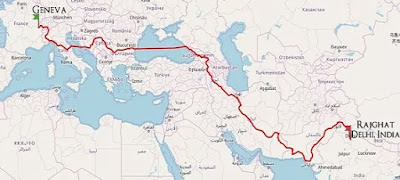
A year-long trek for 'Justice and Peace' begins October 2, 2019, in New Delhi, India. Participants will march about 6,214 miles for 370 Days, crossing 16 countries, to Geneva, Switzerland, arriving on the 22nd of September, 2020. A part of the trek is happening in Canada.
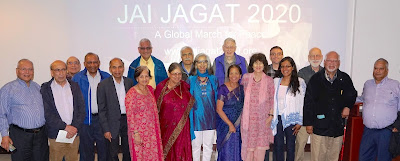
Details of the Jai Jagat 2020 trek were presented at a slide-lecture hosted by the Mahatma Gandhi Peace Council, held at Carleton University on June 15th. About 30 attended. I took photos.
Trekkers will pass near Doukhobors in the South Caucasus, and board a ship at Batumi, Georgia, the same port where many Doukhobors left Russia beginning in 1898, eventually arriving in Canada. Most Canadian Doukhobors still use the pre-1920 Russian name Batum for Batum Oblast (province) and city. The original plan was to walk around the Black Sea through Russia and Ukraine, but Russian officials are 'not interested' in allowing this march through their territory.
Dr. Jill Carr-Harris is Canadian with Ph.D. studies from the University of Toronto, who lived for 30+ years in India. She teaches peace and Gandhian nonviolence, and is married to a like-minded Indian peace activist who is the leader of Jai Jagat 2020. She came to Canada to promote the events, raise funds, and meet with family and friends before she begins the year-long walk.
Dr. Carr-Harris opened her 1-hour lecture exclaiming Jai Jaget!, a greeting used in India 'to recognize each person as a member of the universal family' — 'an act of peace'. In her first lecture slide, she labeled the trek 'A Global March for Peace'.
In 2017 she introduced the Jai Jagat 'campaign' in Ottawa, and has returned to 'update' the news and 'get some people engaged' — 'grassroots ... action'.
In 2014, I met her husband Rajagopal P. V. in Ottawa, Canada when he and Jill came to introduce their early plans for these treks.
Both husband and wife view human behaviour as basically good, but we need to support ways to assure global survival for all living things — ‘not just making money’ for ourselves. In our most difficult moments, nonviolence training teaches us to be compassionate, must be used to 'organize society', and be integrated into all the higher academic fields (sciences and humanities). 'A Gandhian perspective ... educating young people ... to get them to think about peace and nonviolence'.
Jill Carr-Harris stated that the late Murray Thomson and UN Ambassador Doug Roche are the 'grandfathers of peace' in Canada. Roche 'said we are moving from a culture of violence, a culture of war, ... into to a culture of peace ... but, there are small ups and downs'.
Her slides are not shown on the web except in this video, and are included here.
Dr. Carr-Harris reported that 50 people have committed to walk the entire 10,000 kilometers. Everyone is welcome to join and leave at any place and time. Many peace groups along the route are organizing partial marches, joining the permanent marchers for a few kilometers. Many not on the main route from India are planning local marches. some to join the movement in Geneva. European countries are accommodating marchers with special visas. Peace organizations around the world can recognize and join in the global effort. First Nations are now marching from New Brunswick to Maine, USA, before winter.
There are social media campaigns in 4 countries, including Canada. In addition to Dr. Carr-Harris, the Canadian event advisor is Dr. Anne Pearson, Shastri Indo-Canadian Institute (Alberta), Global Peace Centre Canada (Ontario).
Her final announcement was that a 'Peace and Non-Violence Department' is being planned in Rajasthan, India. It precedes our Canadian Peace Initiative for a similar government department.

- October 2, 2019, is the 150th birthday of Mahatma Gandhi (1869 – 1948), and the annual United Nations International Day of Non-Violence. The march begins at the resting grounds of Gandhi in Raj Ghat, New Delhi, India.
- September 21, 2020, is the annual United Nations International Day of Peace. About 5,000 will participate in an Geneva Action Forum - People’s Parliament for 8 days at the United Nations Office at Geneva, Switzerland.

Details of the Jai Jagat 2020 trek were presented at a slide-lecture hosted by the Mahatma Gandhi Peace Council, held at Carleton University on June 15th. About 30 attended. I took photos.
Trekkers will pass near Doukhobors in the South Caucasus, and board a ship at Batumi, Georgia, the same port where many Doukhobors left Russia beginning in 1898, eventually arriving in Canada. Most Canadian Doukhobors still use the pre-1920 Russian name Batum for Batum Oblast (province) and city. The original plan was to walk around the Black Sea through Russia and Ukraine, but Russian officials are 'not interested' in allowing this march through their territory.
Dr. Jill Carr-Harris is Canadian with Ph.D. studies from the University of Toronto, who lived for 30+ years in India. She teaches peace and Gandhian nonviolence, and is married to a like-minded Indian peace activist who is the leader of Jai Jagat 2020. She came to Canada to promote the events, raise funds, and meet with family and friends before she begins the year-long walk.
 |
| Dr. Jill Carr-Harris |
In 2017 she introduced the Jai Jagat 'campaign' in Ottawa, and has returned to 'update' the news and 'get some people engaged' — 'grassroots ... action'.
In 2014, I met her husband Rajagopal P. V. in Ottawa, Canada when he and Jill came to introduce their early plans for these treks.
Both husband and wife view human behaviour as basically good, but we need to support ways to assure global survival for all living things — ‘not just making money’ for ourselves. In our most difficult moments, nonviolence training teaches us to be compassionate, must be used to 'organize society', and be integrated into all the higher academic fields (sciences and humanities). 'A Gandhian perspective ... educating young people ... to get them to think about peace and nonviolence'.
Jill Carr-Harris stated that the late Murray Thomson and UN Ambassador Doug Roche are the 'grandfathers of peace' in Canada. Roche 'said we are moving from a culture of violence, a culture of war, ... into to a culture of peace ... but, there are small ups and downs'.
Her slides are not shown on the web except in this video, and are included here.
4 Phases of the Jai Jagat Campaign
|
Dr. Carr-Harris reported that 50 people have committed to walk the entire 10,000 kilometers. Everyone is welcome to join and leave at any place and time. Many peace groups along the route are organizing partial marches, joining the permanent marchers for a few kilometers. Many not on the main route from India are planning local marches. some to join the movement in Geneva. European countries are accommodating marchers with special visas. Peace organizations around the world can recognize and join in the global effort. First Nations are now marching from New Brunswick to Maine, USA, before winter.
There are social media campaigns in 4 countries, including Canada. In addition to Dr. Carr-Harris, the Canadian event advisor is Dr. Anne Pearson, Shastri Indo-Canadian Institute (Alberta), Global Peace Centre Canada (Ontario).
What Can People In Canada Do?
|
Her final announcement was that a 'Peace and Non-Violence Department' is being planned in Rajasthan, India. It precedes our Canadian Peace Initiative for a similar government department.
- I took 49 photos.
- Lecture videos and some of my photos are at: 'Jai Jagat 2020 by Jill Carr-Harris, Mahatma Gandhi Peace Council website, Ottawa.
- Learn more at: Jai Jagat 2020.
- Facebook.com/JaiJagat2020
- Twitter: #jaijagat2020
- Facebook: Jai Jagat Toronto Chapter
- Wabanaki Water Walkers make way through N.B. heading to Maine, Global News, June 7, 2019. — A Jai Jaget march by First Nations began in Canada.
- In 1966, Cesar Chavez led a 300-mile march in California to protest condition of farm workers. He began with 50 people, ages 17 to 63, and added more than 10,000 in less than a month by the end.

