Showing posts with label Center for Global Nonkilling. Show all posts

Sunday, 6 March 2022

90 Years of Memories

On February 19, 2022, about 60 people and I celebrated my 90th birthday ONLINE!
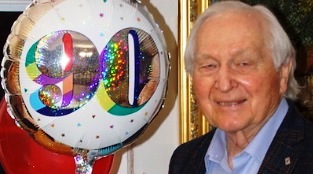
My wife and our daughters arranged the event which featured prerecorded video messages, phone calls, and some sent an email or letter. Thank you all.

In early February my daughter Tamara and her husband John, and Kristina with her daughter Milena, decided to arrange a virtual party. They invited many people to submit short video messages at a website, or any way the guests would like. About 60 people participated resulting in a 1.5 hour video and more than a dozen emails, cards and letters.

Kristina wanted to create a photo album of my life, and we selected about 50 photos which became a slide show presentation of my '90 Years of Memories'.

See everything here:

  • Videos submitted (1.5 hours) — Link to be added.
  • Slide show of my life — Link to be added.
  • Emails received

During the planning process, I began to reflect on my 90 years and listed these highlights of my life so far, a short version of my biography and 50 Years of Doukhobor Studies.

  1. Born in 1932 in this farm house to parents and grandparents who came from Russian Doukhobor roots. Believed that hospitality, love and nonkilling are the way to a world without wars.

  2. Met Tyrus R. Cobb world famous baseball pioneer. Invited for tryout in 1953 to Pittsburgh Pirates in California. Did not make it, but exercises that I learned from Lloyd Percival of CBC Sports College of the Air persist today 70 years later.

  3. At the University of Saskatchewan in Saskatoon, where I took my BA in Arts and Sciences in the 1950s, I produced 50 monthly journals of The Inquirer at my grandparent's attic next door, which led me to become a journalist, photographer, scholar, and peace activist.

  4. After attending the World Festival of Youth and Students in 1957 in Moscow, this led me to make 12 additional trips to the Soviet Union and Russia as a bridge-building effort between the East and the West (1957, 1964, 1980, 1991, etc, ). The wisdom of getting to know the stranger persists today as one of key steps to help the people and the planet to survive.

  5. In the early 1960s, at UBC in Vancouver, I was privileged to get my MA in Anthropology and Sociology, with my thesis on 'A Study of Russian Organizations in the Greater Vancouver Area' (PDF, 15 GB). The Cold War, I discovered, was the critical element in what brings people together and what splits them apart.

  6. In 1964, as a Russian and English speaking grad of UBC, I was invited to the International Ethnological Congress in Moscow where I met anthropologists Margaret Mead and Sol Tax.

  7. In 1980, as guest Doukhobor peacemaker and photo journalist, I reported on the Summer Olympics in Moscow as a Slavic representative for North and South America. What an awesome responsibility!

  8. Over the past 60 years I have organized a number of scholarly ethnographic studies and exchanges across North America (including a 1990 3-month North American Ethnographic Expedition with Russian scholar Svetlana Inikova), the Soviet Union and Russia on my ancestors the Doukhobors and East-West understanding. Together with my work in the provincial and federal governments as social scientists, this led me to publish over 25 books and 50 articles; the gifting to the Saskatchewan Archives and BC Archives major collections of textual materials and photographs on Doukhobors, rural development, Native Indians, and ethnography; the creation of a Spirit Wrestlers website and blog with Arizona scholar Andrei Conovaloff.

  9. In November 2007, I presented a paper on 'Tolstoy and the Doukhobors' at the First Leadership Forum in Hawaii where the Center for Global Nonkilling formed; and served as reporter and photographer for 13 Ottawa Peace Festivals.

  10. In 1982 co-organized with Community Doukhobors, the First International Intergroup Symposium of Doukhobors, Molokans, Mennonites and Quakers, held in Castlegar, British Columbia, with many prominent people including the great grandson of Lev N. Tolstoy, a major world writer and proponent of nonkilling. The meeting endorsed a letter to the UN on disarmament and getting rid of wars.

  11. With distinguished Doukhobor lawyer Peter G. Makaroff (the first non-Anglo-Saxon grad in Western Canada with a law degree in 1918), and participating Doukhobor, Quaker and Mennonite reps, in 1964 and 1965, I coordinated and helped organize four major peace manifestations in Western Canada urging the government to cease research and production of chemical and biological weapons of mass destruction, and work towards the survival of our human species.

  12. Between 1996 and 1998, served as guest co-Curator with Dr. Robert Klymasz on 'The Doukhobors: Spirit Wrestlers' exhibit at the Canadian Museum of Civilization, commemorating the centenaries of the  Doukhobor destruction of weapons in 1895 in Russia and the January 1899 arrival of the first Doukhobors to Canada.

  13. We all know that it takes a village to raise members of a family. My grandparents and parents along with my newly acquired families and offspring deserve praise for their support. Son Lev is professor at Memorial University in Newfoundland where he is modeling the last Ice Age and is searching the major parameters of climate change. Daughter Tamara, now retired as a museum professional, recently spent the last three years working in Nunavut as Project Manager, Wrecks HMS Erebus and HMS Terror National Historic Site. Their spouses, Dorothee Bienzle is an accomplished researcher and doctor, and John Pinkerton is a retired international manager for Parks Canada. Their children Jaspar and Katya along with Tamara and John's offspring (Nicholas and Elena) are outstanding students, athletes and outdoors people like their parents. I always marvel at being so lucky to be part of their family circle. 

  14. As well, I marvel at the challenge of keeping alive my 30-year marriage with Kristina Kristova, a pioneering journalist who once served for 24 years as anchor person with the Bulgarian National Television. Her daughter Milena is a music teacher in Ottawa, while son Orlin is in Sofia, Bulgaria, as a professional keyboard composer / musician. Kristina introduced me to her most fascinating Bulgarian community who have given me the title of 'Honourary Member' although I have not learned much Bulgarian language.

  15. In the 90 years of my life, this family along with all the people that I have met around the world (in person, in books and in the media), I consider all of you remarkable and many are friends and wisdom people. Bolshoe spasibo! Thank you very much! You have taught me so much. I wish all of you to live at least to 90 with good health, joy, peace and happiness.

  16. Personally, I look forward to many more years of productive life. In my work, I never got rich in money, but rich in ideas, in friendship, and in the vision of my ancestors for a peaceful world without wars.

Thursday, 1 July 2021

Nonkilling Message at Global Colloquium

On June 28th, 2021, I was one of 13 people honored to address a 3-hour online international conference titled: ‘Creating an affirmative nonkilling world’. This was my presentation text, which you can watch me read on this video at time 2:24:00.

My presentation begins at time 02:24:00

Nonkilling Message at Global Colloqium June 28, 2021

Hello dear colleagues around the world in commemorating the birth anniversary of the Late Professor Glenn D. Paige — one of the wisdom people of the world — a prophet of nonkilling.

It is very appropriate that Dr. Paige’s birthday on June 28th has been designated as International Nonkilling Day. This date always reminds me also about the historical event of my Doukhobor ancestors. It was on midnight of June 28, 1895 that 7,000 of my Russian Spirit Wrestlers / Doukhobor ancestors burnt their guns in the first mass protest in history against militarism and wars. They reasoned that the spark of God and Love resides in everyone, therefore it is wrong to kill another human being.

Russian writer and philosopher Lev N. Tolstoy pioneered this idea in his book The Kingdom of God is Within You (1894); his message of getting rid of wars inspired the Doukhobors to drop their guns and then get rid of them. When persecution followed, Tolstoy, his intellectual friends and Quakers helped with the migration of one-third of the most persecuted (7,500) to Western Canada in 1899. My grandparents were part of this group.

 At the First Global Nonkilling Leadership Forum in Hawaii in 2007, I was honoured to add Tolstoy as one of the pioneers of Nonkilling to that of Mahatma Gandhi, Martin Luther King Jr. and other world leaders and humanists. (Proceedings, page 207) Tolstoy absolutely condemned all wars and looked forward to a new vision of humanity. This vision in modern times came forth from Dr. Glenn D. Paige with the Nonkilling paradigm and hope for a new world order. 

Historically, Tolstoy and the Doukhobors both used the word ‘nonviolence’, but their real meaning, I discovered, was nonkilling. I am honoured that Glenn Paige gifted this insight to me which I have since adopted because nonkilling encompasses the broader notions of love including compassion, universal humanity, and world citizenship.

As a peace activist in many organizations such as the Canadian Peace Initiative and the World Beyond War Inc, I have often used the word ‘Nonkilling’ to describe what I consider to be one of the urgent needs of the day to save us from the scourge of war, terrorism and abuse  and preserve our civilization. Routinely, I end my emails with the words: ‘In search of truth and a nonkilling society.’ Let’s hope the new generation will embrace these important values that Glenn Paige pioneered for the sake of our children, our grandchildren, and the society of human beings.

With the Bulletin of the Atomic Scientists at 100 seconds to midnight, we must urgently work together to stop the slaughter of humanity. Nonkilling is the hope and the way to the future.

Update: Nonkilling Day June 28, 2025, 3 Jul 2025

—————

Note: You can enter a Comment only with a Google Account. If you do not have a Google Account, email your Comment to KJTarasoff@gmail.com

Wednesday, 24 March 2021

'Guns to butter' for a Better Future

There are many ideas towards a plan for world peace and development. See 'More' below.

I summarized two proposals posted in March 2021 which I believe are fresh, feasible and authentic regarding converting 'guns to butter' for a better future.

1.  Close all USA military bases


The Quincy Institute for Responsible Statecraft (QI), has been brave enough to tell the world that some 750 US military bases around the world appear to have little or no usefulness in keeping the country safe and prosperous. 

In a one-hour webinar 'Taps for America's Empire of Bases?', QI president Andrew Bacevich moderated David Vine, Christine Ahn, and John Glaser.

These 3 experts agreed:
  • There are NO exaggerated threats to the USA from the Middle East and elsewhere.
  • The greatest threat to peace is the military-industrial complex.
  • All bases abroad should be closed and the troops sent home. Open Letter to President Biden, March 4, 2021.
  • Funding for peace diplomacy and domestic infrastructure (health care, transportation, education, clean water, housing, etc.) should be greatly increased.
The Quincy Institute is a new US 'think tank' founded in December 2019. It is 'the most truthful and daring of the dozens of these entities that exist in the Washington DC area', according to Sharon Tennison, Founder and Director of Center for Citizen Initiatives, in a March 11th letter to its members.

2.  Putin's 'open system'

Matthew Ehret, Senior Fellow at the American University in Moscow and editor-in-chief of the Canadian Patriot Review explains global 'win-win cooperation' for the future in 'Putin's Vision for an Anti-Fascist/ Open System Future and You' (The Canadian Patriot, March 10, 2021).

Ehret reports that President Putin speaks about an 'open system' of international behaviour that would avoid wars and instead would focus on cooperative efforts of multi world nations for joint security and development, such as the following:
  • Space diplomacy among Russia, USA, and China. Increase working together to explore space.
  • Asteroid defense. Implement a proposal by the Chief of Roscosmos Dmitry Rogozin, nick named the 'Strategic Defense of Earth'. by aiming US President Reagan's 'Star Wars' Strategic Defense Initiative (SDI) away from targets on earth to aim for incoming meteors and asteroids.
  • Arctic and Far East Development. By further expanding the 'Silk Road' on rails as proposed 150 years ago, but from South America, north across the Bering Strait, to Europe. Ships are now crossing the thawed Arctic Circle. Development of new cities, mining, transport corridors and energy benefits all nations connected.
  • 'Guns to butter' in an 'open system' world. If all nations cooperate to divert military spending to social needs, poverty can end and global warming stopped.
Ehret concludes: 'If Russia, America, China and other nations of the UN Security Council and BRICS were to apply their best minds to solving these problems rather than fall into a new arms race, then not only would either country benefit immensely, but so too would humanity more broadly.' Agreed! Let's hope it becomes a reality.

This means that we all need to look inward and have the moral courage to make this happen. Peace starts with us. Yes, 'Guns to butter' for a better future!

More

Peace Quest, Rideau Institute, World Federalists. Webinar: 'Peace Prospects in the Biden Era (Thursday, April 1, 2021, 6:30 PM ET). — Free webinar on Zoom. Featuring Douglas Roche.

Canadian Foreign Policy Institute and World Beyond War Canada. Free webinar on Zoom: 'Why Canada Should Leave NATO'. Saturday, April 3, 2021, 3 PM ET. — Free webinar on Zoom.

New Hampshire Peace Action. 'Peace & Justice Conversations:Is Russia truly our enemy? Should we risk nuclear war?' April 12, 2021, 7:00 pm - 8:30 pm ET. — Free webinar on Zoom.

Escobar, Pepe. Welcome to shocked & awed 21st century geopolitics. In Information Clearing House, March 23, 2021.

Fry, Stephen. The Terrifying $1.2 Trillion Plan That Could Kill 90% of Humanity, March 16, 2021. YouTube, 11.16 minutes.

O’Connor, Taylor. 10 Global Peacebuilding Networks. In Transcend Media Service, March 15, 2021. [We can add to this list many others, such as: Center for Global Nonkilling, World Beyond War, Project Ploughshares, Center for Citizen Initiatives, Coalition to Oppose Arms Trade, Voice of Women for Peace, and PeaceQuest. For alternative news sources see Honest World News.]

Zuesse, Eric. Why It’s Especially Necessary to End NATO Now. In Modern Diplomacy, March 15, 2021.

Benjamin, Medea and Nicolas J.S. Davies. Biden’s Foreign Policy — Ten Problems, One Solution. In The Progressive, March 13, 2021.

Healy, Hazel. 10 Steps to World Peace. In New Internationalist, September 18, 2018.

Glaser, John. 'Withdrawing from Overseas Bases: Why a Forward ‐ Deployed Military Posture Is Unnecessary, Outdated, and Dangerous'. Cato Institute, Policy Analysis No. 816, July 18, 2017.

United Nations. Dept. of Economic and Social Affairs. Transforming our world: the 2030 Agenda for Sustainable Development. Adopted September 25, 2015. Preamble: This Agenda is a plan of action for people, planet and prosperity. It also seeks to strengthen universal peace in larger freedom….The 17 Sustainable Development Goals and 169 targets which we are announcing today demonstrate the scale and ambition of this new universal Agenda….'

World Beyond War.org. A global movement to end all wars.

Center for Global Nonkilling. Promoting change toward the measurable goal of a killing-free world.

Updates

Sahiounie,  Steven.  US-NATO provocation in Ukraine to stop Russian pipeline.  The Duran, April 7, 2021.

Paul, Ron. Why Is the Biden Administration Pushing Ukraine to Attack Russia? OpEdNews Op Eds, April 5, 2021. 

Lavelle, Peter, CrossTalk, RT, April 2021. The End of Ukraine? YouTube, 25 minutes. — Lavelle hosts three panelists: Mary Dejevsky,  Independent columnist, London; Earl Rasmussen, Executive Vice-President, The Eurasia Centre, Washington, DC; and Gabriel Gavin, journalist, policy consultant, Moscow, Russia.

Baldwin, Natylie. The Situation in the Donbass, In Natylie's Place: Understanding Russia, April 3, 2021. — The situation in the Ukraine is extremely dangerous. Heavily armed Ukrainian soldiers with USA weapons are threatening the Russian Republic, as Russian soldiers stand by ready to respond if attacked.

Thursday, 30 April 2020

Weapons Don't Fight Pandemics

The current virus pandemic should revive the 'guns or butter' debate summarized in this short version of “Weapons don't fight pandemics,” (Opinion by Miodrag Soric, Deutsche Welle, April 26, 2020) enhanced with political cartoons and links.

Corona and Goliath, by Tom Janssen (Image 236189),
Caglecartoons.com, The Netherlands, March 13, 2020.

The COVID-19 pandemic shows that ... Virus outbreaks ... cannot be contained by military force. Time for a security rethink, ...

... The ... corona virus pandemic shows how ... badly, different states are ... prepared ...

America Unprepared for Virus, by Matt Wuerker, Politico, March 4, 2020.

... since 2003, we have witnessed the SARS, swine flu, MERS, Ebola and Zika virus outbreaks. Governments ... had ample time to prepare ... for a potential disaster ...

Mighty armies, underfunded health care systems

Tanks, fighter planes and aircraft carriers — where many crew members have fallen ill with the coronavirus — are useless against a pandemic. ...

Worse than the war machine, by Joel Pett (Image 182503),
LexingtonHerald-Leader, Kentucky, March 31, 2020.

... US President and Army General Dwight D. Eisenhower, ... in 1953, ... said:
'Every gun that is made, every warship launched, every rocket fired signifies, in the final sense, a theft from those who hunger and are not fed, those who are cold and are not clothed.* This world in arms is not spending money alone. It is spending the sweat of its laborers, the genius of its scientists, the hopes of its children.'
* 63 years later: 'Just 10 percent of world military spending could knock off poverty', by Belinda Goldsmith, Reuters, April 4, 2016.

... the Twin Tower attacks [9-11, New York City] ... seem ... trivial compared to the ... [tens of thousands] ... dying from COVID-19 ....

... the US and other nations have failed to recognize the biggest threats to our safety: pandemics, climate change and environmental destruction.

Occupation in the time of Corona: How to protect yourself from the Military,
by Mir Suhail, 12 Mar 2020. — Artist illustrated himself.

Leaders have underestimated those threats and ... [possible] ... food riots, especially in Africa and parts of Asia.

Isolationism, protectionism won't help

... viruses and climate change don't care for national borders. ... ultimately forcing people into poverty.

WW3 is cancelled, but you get hit with corona virus,
Tom and Jerry Starecat meme.

... the global community must cooperate. ... rich countries in the global North, chiefly the US, must take leadership and show they have learned from past mistakes. Only then can our world become a safer place for all.

We hope that the 'Defence and Security' industries planning the CANSEC 2021 will shift to virus defence, health security, food and water security, and the prevention of wars. 'Scientists To Stop CoVid-19' was just proposed by 12 non-military USA citizens. Governments need to work now towards the creation of a world without wars. 

Wednesday, 22 January 2020

4 gods-within us — continued in 2020

On Friday January 17, the 4 of us held another one of our adhoc coffee get-togethers at a local cafe in Ottawa, Ontario. We met for 1.5 hours.


We began by reviewing our domestic activities since we last met in the fall of 2019.

Oral Tradition

Our major discussion was the role that oral tradition and folk singing has played over the centuries as a conduit for people to share their inner messages with themselves and the world. This was especially useful for much of human development when most were illiterate. Oral tradition carried the message from one generation to the next.

We observed that folk singing, when done authentically, helps humans to breathe deeply from the bottom of their stomachs, providing more oxygen for our bodies to function. By doing this, it enhances our self-image and self-well being, thus affecting our personal health.

Intuitive Spanish artist Alberto suggested that deep breathing gives us access to the inner spirit and our connection with the divine. For him, this is the real genius of genuine folk singing which connects many generations through time, giving us the feeling of depth and eternity resembling the divine.

Bill shared the following, summarized:
I was impressed by an interview of author Karen Armstrong with Michael Valpy in January 11, 2020 Globe and Mail (she is the author of The Lost Art of Scripture) where as a comparative religion scholar she states that she found that all world religions have one thing in common — a spiritual dimension where human is seen as an image of the Divine.

Karen says: ‘The origins of the divine were presented as performances. They were sung, recited, acted out. They were intended to transport the audience into a transcendental spiritual dimension.’ At another place she explains that ‘until the 18th century most people listened to the scriptures. It sung or performed. Because most people couldn't read and before the invention of printing it was impossible to own a copy of the Bible. So you listened to your scripture and it was sung .…’ (Karen Armstrong explores the purpose of sacred texts in The Lost Art of Scripture, The Globe and Mail, January 7, 2020.)

That reminded me of two such sources: Flamenco dancing and singing from Spain and the Sindhi Sufi and Bhagat traditional singing and dancing from the Indus Valley, the Sindh province of Pakistan. The lyrics in those songs and the style of singing reflect yearning and longing by lover (seeker) and the beloved (divine) coming right from deep within, from one's spiritual heart. Those traditions have continued for centuries in those two cultures. Examples:
Koozma spoke about the oral tradition of the Doukhobors. He gave a contemporary example in Canada of a Doukhobor singer Ron Kalmakoff from Saskatchewan who moved to British Columbia and after many years following the passing of his grandmother, returned to visit her graveside and the community where she grew up. He then composed a beautiful nostalgic, emotional ode to his grandmother.

Russia

Koozma mentioned Vladimir Putin’s Presidential Address to the Federal Assembly, January 15, and proposed changes to the Russian Constitution. He said it was a 'game changer' showing the President as a world statesman and Russia as an evolving nation for the better.

Previous 3 reports: 4 gods-within us — 2013, 2014, 2019

Friday, 10 January 2020

Stop wars! Stop the killings!
— A Poem for Our Times


My ancestors the Spirit Wrestlers / Doukhobors
in 1895 burnt their guns calling on humanity
to stop wars once and for all —
or face the fate of dying together as fools.

We were inspired by the Russian writer Lev N. Tolstoy
who influenced Gandhi and Martin Luther King Jr.
in the use of nonviolence and love in solving human problems.

Yet wars have continued with hundreds of millions killed
slaughtered on the battlefields of hell.
When will we ever learn?
The stench of mass murders
affects us all — mothers, fathers, young and old.

It robs us of the human potential for
creating peace on earth
with free healthcare, free education,
housing, clean environment, and more.
Our heritage as human beings is at stake,.

Have we not heard of the wisdom of
‘Thou shalt not kill’?
Have we not known that pointing a gun at another person
is not a friendly act?

Why are we making millions
from perpetual wars
through the manufacture of
weapons of mass destruction?
Humanity Wake Up!

Are we deaf to the wisdom of our ancestors to
‘Stop Wars! Stop the killings!’
‘Do we not know that we are our brothers and sisters keepers?’.
How many ears will it take to hear
the cry of children orphaned by war?
When will we ever learn?

At the forthcoming arms show in Ottawa of 12,000 people
gathered to see the latest free market killers,
a few brave souls will gather at the gates with signs
‘Stop the murders’.’Stop the killings’.
‘Stop manufacturing killer weapons’.
Close down CANSEC.

When will we discover
peaceful alternatives to violence and wars?
When will we stop becoming rich from wars?
Or have we been hijacked by the almighty dollar,
killing our competition, grabbing oilfields or whatever?

Statesmen and women of the world
stand up and be counted.
Stop playing chess with our lives.
And media workers, cease being pawns
of the military industrial complex — your job
is to seek the truth and share it with the world.

The sacred choice is in our hands, my dear friends:
Life, love, beauty and humanity;
or the Stone Age of human extinction?
That is the question of the new decade.
Is anyone listening to the current words of wisdom:

NEVER AGAIN. STOP NATO.
DIVEST, DISARM, DEMILITARIZE.
OUTLAW WARS. STOP THE KILLINGS! LET’S BECOME NONKILLING HUMANS— RESPECT LIFE, LOVE and HUMANITY.

This poem was written for the 5th World Beyond War Conference in Ottawa, May 26-30, 2020.


Peace groups will oppose the 2020 CANSEC weapons show in Ottawa on May 30-31, 2020. Please come out and support the movement to save humanity from the scourge of war.

Wednesday, 6 November 2019

A Quaker Summary of Fighting

Book review.
  • Are you worried about increasing hate crimes?
  • Does it feel like our world is becoming more divided?
  • Do you care about peace?
In 2017 the Peace Program Coordinator and Communications Coordinator for the Canadian Friends Service Committee (Quakers) proposed to answer these questions scientifically by conducting a peace literature review and bibliography. He originally planned to compile a 50-page report to summarize:
  • What does science reveal about achieving interpersonal peace, avoiding conflict and hatred?
  • Do we really need to fight?
The short project continued for 2 years, and grew to 327 pages. To include as much as possible into the book, the font size was reduced, yet much had to be omitted. Perhaps a second volume will be published to compile the rest of their research.


Matthew Legge. Are We Done Fighting? Building Understanding in a World of Hate and Division (New Society Publishers, Gabriola Island, BC, 2019): 327 pp. Copyright by Canadian Friends Service Committee (CFSC, Facebook).

I read the book with much interest and then attended a book launch by the author on October 23th, 2019 at the Friends’ Meeting House, Ottawa, Ontario. Some 30 people attended. A question-answer period followed.

The event was audio recorded by Ken ‘Kensky’ Billings, and posted for you on pCloud, linked from his Digileak Canada website:
Matthew Legge (pronounced: ‘Le-ZHAY’) has been on a book tour across Canada, speaking on radio, at universities, bookstores, and Friends Meeting Houses; and teaching a few workshops. See schedule at bottom of AreWeDoneFighting.com. This is his first presentation fully recorded and posted online.


My Review

This book is a 2-year cooperative effort of many people: the author Matthew Legge — an anthropology graduate from the University of Toronto — and his staff at the Quaker Centre in Toronto.

Matthew emailed to me:
‘The book has about 750 end notes that made it into the final copy. I can't say how many hundreds of books and studies I read, many hundreds did not make it into the book. I didn't do 100% of the research myself. 2 other staff and volunteers did parts and sent me things.’
The book is mostly a literature review of many sources related to avoiding violence — 'Evidence and techniques you can use right now'. The research team examined publications in psychology, anthropology and sociology of peace, mostly focusing on cultural ‘interpersonal peace issues’, not inter-government politics.

The author presents many tips for avoiding personal conflict and misunderstandings in daily living, but little about preventing WW3. The intent was to examine what is known about ‘hate and division’ in society. A very challenging aspect of war prevention!

In 24 short chapters, each ending with helpful tips, the author attempts to reach people with different educational, political, religious and cultural backgrounds. The result is a comprehensive text with many insights into the fundamental issues of hate and division, without a guarantee of what will work or not work. Although very useful as an academic study, in my opinion it fails to be a practical guide to action.


Positives

Gems I found especially useful and noteworthy:
  1. Equality is a useful ingredient in respecting people and countries. Trying to be overly superior to others will not lead us to a peaceful world. We need to acknowledge that we are all part of one world community and need to work together to survive.
  2. The understanding of ‘power over’ and ‘power-from-within’ are useful concepts in avoiding exploitation and violence (pages 23-24). Working together for a ‘win-win’ outcome would also help. 
  3. ‘....The peace virus can demand patience and perseverance, and the way we live it out makes a difference to the results we get’ (page 49). Peace virus is transmitted to children through modelling (page 126). Parents and teachers, please take note and be a model for living.
  4. The ‘creative power of silence’ can be used to begin a meeting (page 44), as is done effectively in many Quaker meetings. This is mindfulness at work.
  5. Among the communication skills, try communication instead of changing someone’s beliefs by shooting down our opponent (page. 56). Recognize, acknowledge, and even respect other views. Work together on common ground issues such as climate change, disarmament, etc.
  6. Emotions are contagious — treat them with care (p. 84). We can all be manipulated towards goodness or violence. Psychologists tell us that our interdependence and malleability shapes what we think and do. Beware of psychological warfare (page 79).
  7. Effective communication involves shared values of rapport building, careful listening and observing, and seeking truths (page 94). Take note of body language. Use humour when appropriate, but avoid humiliation (page 90).
  8. War ‘is not natural’ (page 124), but is a learned behaviour. It follows that we can learn to create a peaceful world.
  9. There is a problem today with mainstream media where the bias is towards sensationalism, such as the bomb. How about seeking good news stories?
  10. Establishing Ministries of Peace around the world is ‘an intriguing idea for improving the capacity and will to engage in prevention’ (page 228).

Negatives

The 327 pages of fine print, of which 52 pages are end-notes and index with even finer print makes it very difficult to read.

Though over 1,000 books and articles are listed, many important items for peacemaking familiar to me were not listed. It appears that the author and his team did not look at my website and blog which are full of valuable aides for peacemaking. I suggest adding these 7 missing items/topics.
  1. The Center for Citizen Initiatives in California has escorted groups of “citizen diplomats” (mostly Americans) to Russia since 1984 to engage in personal dialog. President Sharon Tennison has visited Russia for 35 years and rejects the war propaganda. “Misunderstandings, fallacious accusations, flare ups and demonizing ... we see the need and possibility for changing this situation. When real people in large numbers get involved, amazing things begin to happen. Join us!” Next trip: June 2020.
  2. In June 1895 my ancestors burnt their guns as a public resolve to get rid of wars. The war / peace issue is very much part of the Doukhobor movement, and I continue to be part of that movement to create a world without wars. Since the 1950s, I have been working steadily on a study of Spirit Wrestlers / Doukhobors with connections to the wider peace movement. A dozen books have been published and countless articles are in print and many more are steadily being produced in my Spirit-Wrestlers website and blog.
  3. 'A Study of Russian Organizations in the Greater Vancouver Area', 1963, my MA thesis in anthropology and sociology. During the first Cold War, I attended the University of British Columbia and studied the issues of what brings people together and what splits them apart. I found that both hot and cold wars split societies apart and cause undue suffering to humanity. If   we are to achieve a sustainable nonkilling society, this means we urgently need to get rid of the ‘scourge of war’ and make war a crime against humanity!
  4. ‘Opening Doors For Survival: A Handbook on Soviet-West Initiatives’, 1986. I produced this unpublished practical manuscript which was expanded and published in very limited numbers in 1991 by Peace Train Foundation in Ottawa, Canada as Discovering Soviet-West Cooperation. A Handbook on Soviet-West Bridge-Building Initiatives. The insights into peace-making are as valid today as they were in the 1980s.
  5. 'Doukhobor — Quaker Connections : Talk with Young Friends in Ottawa', December 6, 2009 Presentation Outline, Comments (updated 2019). Includes useful suggestions of what young Friends can do to make a contribution to society. The article also includes the story of effective peace manifestations  in Western Canada in the 1960s involving Doukhobors, Quakers, Mennonites, Fellowship of Reconciliation, and other groups. 
  6. Dr. Glenn D. Paige’s book Nonkilling Global Political Science, (2002), advanced the thesis that it is possible for humans to stop killing each other. The thesis supports the conclusion of the World Report on Violence and Health (Geneva, 2002) that human violence is a ‘preventable disease’. In November 2007, Dr. Page organized the First Global Nonkilling Leadership Forum, Hawaii, at which I presented my paper: ‘Tolstoy and the Doukhobors’. Wisdom people from around the world united to create a Nonkilling Society. The forum launched the Centre for Global Nonkilling ‘to promote change for a killing-free society’. While killing is deeply entrenched in world culture, it is not universal. Nonkilling is a new paradigm for a brave new world. The wider peace community should take note.
  7. 150 Canadian Stories for Peace — An Anthology, 2017. One of my contributions here was 'Opening Doors for Survival during the Cold War' (pages 101-102). In 1984-1985 I held 17 living room discussions on East-West bridge-building. My article concludes: ’With fake news in today’s Cold War world, are we not repeating again the dangerous lies about our northern Russian neighbours and others? When will we ever learn?’

Contact the author Matthew Legge at Canadian Friends Service Committee (CFSC, Quakers), 60 Lowther Avenue, Toronto, Ontario M5R 1C7, Canada. Phone: 416-920-5213 Web: quakerservice.ca. Facebook/Twitter/Instagram: @CFSCQuakers. Get a free chapter of CFSC's book at: AreWeDoneFighting.com


More reviews

Enter your comment below.
For help, see 'Blog comment instructions'.
If you use the Safari browser on a MacIntosh computer, sorry, you cannot enter a comment.

Monday, 29 July 2019

'Wake up' — Let's Prevent Nuclear War

Why is the threat of WW3 at an all time high?

The Doomsday Clock, maintained by the Bulletin of the Atomic Scientists since 1947, shows the likelihood of a man-made global catastrophe. During the past 3 decades it has steadily moved to an all time danger. Why? What can we do?

August 6 will be the 74th anniversary of the bloody 1945 atomic bombings of Hiroshima and Nagasaki in Japan. By educating ourselves about the global politics and propaganda of war, I hope we will prevent WW3 and a nuclear holocaust, by protesting war industries, writing our governments, alerting our family and friends — anything to protect future generations.


The chart (click to enlarge) shows minutes to doom. The lower, the worse. It got worse from the end of WW2 (1945) through the Korean Conflict (1951-1953), then relaxed after the Cuban Missile Crisis (1962), and remained fairly steady during the Strategic Arms Limitation Talks (SALT) decade (1969-1979). Again it got worse, until President Reagan (1981-1989) and Secretary/President Gorbachev of Russia (1985-1991) began peace negotiations, which ended with the breakup of the Soviet Union (1991). Since then, for nearly 3 decades, threats have steadily escalated to an all time closeness to doomsday.

How did this nearly 30-year decline happen? Evidence points to the expansion of NATO and the USA foreign policy of perpetuating wars.

I believe that Russia is not our enemy, we are. To explain, I recommend three videos online. The first is in English, and two are in Russian on YouTube.


1. The Putin Interviews : Vladimir Putin & Oliver Stone Discuss NATO, by Oliver Stone, Information Clearing House, July 22, 2019 — Many short videos with English subtitles, and text.

2. В Борьбе за Украину. Нерассказанnая История Украины;(2019) [The Struggle for Ukraine. (or) The Untold Story of Ukraine]. (Russian: 83 minutes), by Oliver Stone. (Wikipedia Russian) — The film shows how the USA and the West were directly involved in the 2014 Maidan coup in Ukraine. Snipers killed 100+ people to entice Ukraine and Western countries to blame Russia and President Putin. A tragic flop! Due to NATO circling Russia, the film concludes a higher probability of a nuclear war. Putin and his Ukrainian associate Viktor Medvedchuk are interviewed, and Professor of Political Science at the University of Ottawa, Ivan Kachanovsky, who for five years has been investigating this story.

3. Голливуд как источник мужество [Hollywood as source of manhood], Бесогон ТВ (Besogon TV), Channel 24. (Russian, 55 minutes). — Explains how Mikhail Gorbachev and Boris Yeltsin sold out the USSR to the West on the promise that the West was ready to help the Russians, instead the USA wanted to destroy Russia. While the USSR disarmed and became ‘pacifist’, USA did not. USA propaganda claimed to spread ‘freedom and democracy’ but murdered tens of thousands, fooling most Americans to believe they were ‘victims’ of the uncivilized ‘them’ — like heroes in a Hollywood movie. On March 1st, 2018, Putin was reelected President of the Russian Federation, with a majority 77% of the votes. Due to the broken promise, on that day Putin announced the development of superior atomic weapons, so as to wake the sleeping world up to what is happening today. Narrator Nikita Mikhalkov shows that Hollywood created fictional heroes who defeat 'Chinese, Russians, animals', and others in the interests of the American Empire. War is shown, not 'democracy'. In contrast, Putin says the real heroes were those who lost their lives defending their motherland.


More

Monday, 1 July 2019

Peace Trek from India to Switzerland

A year-long trek for 'Justice and Peace' begins October 2, 2019, in New Delhi, India. Participants will march about 6,214 miles for 370 Days, crossing 16 countries, to Geneva, Switzerland, arriving on the 22nd of September, 2020. A part of the trek is happening in Canada.

In the Hindi language, Jai Jagat means 'victory to the world', 'victory to the planet', 'victory to all'. It also names a series of grass-root marches — 2007, 2012, and Jai Jagat 2020 — to address poverty, discrimination, climate crisis, and healing conflict and violence — the 17 Sustainable Development Goals.


Details of the Jai Jagat 2020 trek were presented at a slide-lecture hosted by the Mahatma Gandhi Peace Council, held at Carleton University on June 15th. About 30 attended. I took photos.

Trekkers will pass near Doukhobors in the South Caucasus, and board a ship at Batumi, Georgia, the same port where many Doukhobors left Russia beginning in 1898, eventually arriving in Canada. Most Canadian Doukhobors still use the pre-1920 Russian name Batum for Batum Oblast (province) and city. The original plan was to walk around the Black Sea through Russia and Ukraine, but Russian officials are 'not interested' in allowing this march through their territory.

Dr. Jill Carr-Harris is Canadian with Ph.D. studies from the University of Toronto, who lived for 30+ years in India. She teaches peace and Gandhian nonviolence, and is married to a like-minded Indian peace activist who is the leader of Jai Jagat 2020. She came to Canada to promote the events, raise funds, and meet with family and friends before she begins the year-long walk.

Dr. Jill Carr-Harris
Dr. Carr-Harris opened her 1-hour lecture exclaiming Jai Jaget!, a greeting used in India 'to recognize each person as a member of the universal family' — 'an act of peace'. In her first lecture slide, she labeled the trek 'A Global March for Peace'.

In 2017 she introduced the Jai Jagat 'campaign' in Ottawa, and has returned to 'update' the news and 'get some people engaged' — 'grassroots ... action'.

In 2014, I met her husband Rajagopal P. V. in Ottawa, Canada when he and Jill came to introduce their early plans for these treks.

Both husband and wife view human behaviour as basically good, but we need to support ways to assure global survival for all living things — ‘not just making money’ for ourselves. In our most difficult moments, nonviolence training teaches us to be compassionate, must be used to 'organize society', and be integrated into all the higher academic fields (sciences and humanities). 'A Gandhian perspective ... educating young people ... to get them to think about peace and nonviolence'.

Jill Carr-Harris stated that the late Murray Thomson and UN Ambassador Doug Roche are the 'grandfathers of peace' in Canada. Roche 'said we are moving from a culture of violence, a culture of war, ... into to a culture of peace ... but, there are small ups and downs'.

Her slides are not shown on the web except in this video, and are included here.

      4 Phases of the Jai Jagat Campaign
  • PHASE 1: Nonviolent training, local action and youth engagement.
  • PHASE 2: Global Peace March: from Raj Ghat, New Deli India to Geneva Switzerland with Peace Conferences along the way.
  • PHASE 3: GENEVA Action Forum & Dialogue with UN & Financial Institutions.
  • PHASE 4: Follow up Advocacy County/Local Level Action and Advocacy.

Dr. Carr-Harris reported that 50 people have committed to walk the entire 10,000 kilometers. Everyone is welcome to join and leave at any place and time. Many peace groups along the route are organizing partial marches, joining the permanent marchers for a few kilometers. Many not on the main route from India are planning local marches. some to join the movement in Geneva. European countries are accommodating marchers with special visas. Peace organizations around the world can recognize and join in the global effort. First Nations are now marching from New Brunswick to Maine, USA, before winter.

There are social media campaigns in 4 countries, including Canada. In addition to Dr. Carr-Harris, the Canadian event advisor is Dr. Anne Pearson, Shastri Indo-Canadian Institute (Alberta), Global Peace Centre Canada (Ontario).

     What Can People In Canada Do?
  • Working to Galvanize:
    • Social Media Unit in Atlantic Canada
    • Communication Group in Southern Ontario
    • Teachers Group in Western Canada
  • Connecting with Mahatma Gandhi Foundations in Edmonton, Hamilton and Ottawa to Raise Jai Jagat in 2nd October Program
  • Small Fundraising Efforts (For marchers)
  • Working on Marches in Canada
  • Join the March (Either the Long March of Other European Marches)
  • Sending Journalist Students to Join Marches.

Her final announcement was that a 'Peace and Non-Violence Department' is being planned in Rajasthan, India. It precedes our Canadian Peace Initiative for a similar government department.


Tuesday, 8 January 2019

Lev Tolstoy and American Philosophy

“Lev Tolstoy and American Philosophy” (Лев Толстой и американская философия), including Canadian Doukhobors, was an open lecture with a Microsoft PowerPoint slide presentation given in Russia on October 11, 2018, at 5 pm by Dr. Irina A. Anosova.

This lecture stems from her 1995 PhD dissertation: "American Philosophy in the Context of Leo Tolstoy’s Spiritual Legacy." While researching Tolstoy, she became interested in Doukhobors, contacted Koozma, and came to Canada in 2005 and 2010 for field research. This short lecture was an overview of her message to appreciate Tolstoy and Doukhobors.

She was the second speaker for the event “Tolstoy Library: a century-long project” (Библиотека Толстого: проект длиною в век) celebrating the 190th birthday of Lev Tolstoy and the 100th anniversary of the Lev Tolstoy Library (No 2) on Vasilievsky Island, a bourough in the center of St. Petersburg, Russia.

Tolstoy Library and event poster.

The library was founded in 1918 and named in 1920 to commemorate the 10th anniversary of the death of L.N. Tolstoy. The library displays history, art, film and video, has meeting rooms and about 89,000 books.

Anosova's 23-slide presentation was in Russian, which she sent to Koozma to post online. We translated, edited, and added links. Slide #18 (Doukhobor meetings) was added because she mislabled slide #17 (USCC dove formation, 1999) as a “regular Doukhobor meeting.”

Download the enhanced Microsoft PowerPoint slide file (PPT 5,436 KB). <2018_Anosova_Tolstoy_American_Philosophy.ppt>

Dr. Anosova (centre) showing title slide in the library "green room".

Dr. Anosova reviewed the many American philosophers who influenced Tolstoy, and explained Tolstoy's connection with Canadian Doukhobors. She began with American transcendentalism from the 1700s through the mid 1800s (Franklin, Jefferson, Paine, Channing, Emerson, Thoreau); progressed to nonresisters (Mennonites, Quakers, Ballou, Garrison); then introduced Doukhobors.

Several photos gathered during her 2010 trip across Canada were used — women pulling plow, painting of a village in Saskatchewan, USCC centennial, USCC human dove formation, staff of the Doukhobor Discovery Centre, and a tribute to Koozma J. Tarasoff for all his help.

Other speakers presented the website “All of Tolstoy in one click” (Весь Толстой в один клик), readings from Tolstoy's three novels, the exhibit “Discovering Tolstoy again” (Открывая Толстого заново), and a Tolstoy family tree poster.

The event was announced in a poster (above), formal press release (below), then reported on a news blog with 6 photos (below) taken at the event attended by about 15 people. We hope many will see this story and the slides.

More by Dr. Irina Anosova,
Dept.of Philosophy, St. Petersburg State University of Culture and Arts, Russian Federation.

Saturday, 13 October 2018

World Beyond War Conference 2018

Toronto, Ontario September 21 - 22, 2018.


Brief report from Greta Zarro, Organizing Director of World Beyond War:
  • #NoWar2018 was a huge success.
  • More than 200 attended.
  • See the conference on our video channel — youtube.com/worldbeyondwar
  • The theme of replacing war with the rule of law was well explored by activists and experts who formed new alliances, strategic plans for future work on education, closing bases, and divestment, and developed possible ideas for creative actions.
  • Our small budget and 3 half-time staff impressed several who thought we were a large well funded organization. Please donate.
  • Patricia Kambitsch of Playthink did some amazing illustrations to capture the vibe of the conference plenaries. See her work and more in our Facebook photo album.
  • Website updates will be posted as time permits.

Koozma J. Tarasoff’s Comments

On June 24 2018, I posted: Suggestions for 'World Beyond War' Conference in Toronto Sept. 21 - 22, 2018.

After watching the conference video Highlights of #NoWar2018, here are some of my quick impressions, questions and answers:
  • How can we persuade the world powers to get rid of nuclear weapons? Today the stockpile of nuclear weapons is 14,575. They are a serious threat to our civilization. Making money from killing is evil!
  • Canadian military heads are not too interested in peace because they look to the USA as a favourite country with their many dangerous toys of war. (William Geimer).
  • Canada’s Foreign Affairs Dept. claims it needs ‘hard power’ instead of peacekeeping resulting in increasing the military budget to $22 billion, the highest ever. Only 173 Canadian soldiers are in peacekeeping today. And we have Canadian soldiers in Latvia, Lithuania and Poland provoking Russia. (Tamara Lorincz).
  • Many or most soldiers returning home from the field suffer Post Traumatic Stress Disorder. War is evil. Let’s stop it and begin the process of living as civilized homo sapiens.
  • We are facing nuclear war, dying oceans, decaying cities, water shortage, growth inequality, etc., all adding to a breakdown of civil society. We need peace urgently so that we can work together to deal with the looming ecological global crisis. (Kent Shifferd).
  • We need to find alternatives to war with compulsory international mechanisms for nonviolent dispute resolution. (James Ranney).
  • Departments and other infrastructures for peace to promote legal frameworks for conflict resolution by peaceful means at home and abroad. (Saul Arbess).
  • Misinformation technologies are challenging the role of diplomacy in society. We need to persuade FaceBook to be accountable for its actions. (Branka Marijan).
  • The United Nations charter states that war is illegal, ‘with exceptions’. But the 1928 Kellogg-Briand Pact had no exceptions; it was an international agreement in which signator states promised not to use war ‘to resolve disputes or conflicts of whatever nature or of whatever origin they might be, which may arise among them’. (David Swanson).
  • Humans have the ability to choose not to go to war. We can, for example, create Departments of Peace in our governments. Where there is a will, there is a way. (Karen Johnson).
  • Americans have over 1.3 million military personnel in about 5,000 bases around the world requiring a $610 billion budget to service them. Yet only 5% of this budget ($30 billion) could solve starvation in our world. Where is our wisdom?
  • Peace education should apply to all levels in our education system, beginning with Grade one. Peace is everybody's business. (Rose).
  • There is a nationalist myth that Canada is a peaceful country that does not believe in wars. Advancing empire support and businesses abroad contradict this myth. (Yves Engler).
  • Colonial domination of indigenous peoples was an act of genocide and war. (Azeezah Kanji).
  • Mass movements win, while fringe movements don’t. We need to mobilize minorities for national consensus by resisting wars and building peace. (Kevin Zeese).