Showing posts sorted by relevance for query 4 gods. Sort by date Show all posts

Wednesday, 19 November 2014

Return of ‘4 gods-within us’

In December 2013, four friends, kindred souls, met together for coffee in downtown Ottawa, resulting in a blog ‘4 For Coffee: a meeting of 4 gods-within us’. Today, November 18th, 2014, the four of us met again with new insights into human behaviour from the personal to the world order. See all my meeting reports.
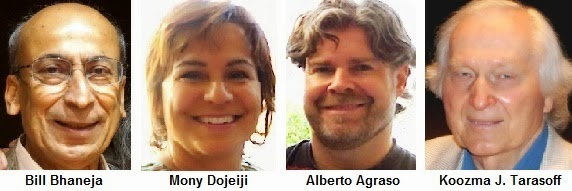

We 4 are: Bill Bhaneja, a retired political scientist, Ottawa, playwright and author of Quest for Gandhi — A Nonkilling Journey (2010), and Troubled Pilgrimage: Passage to Pakistan (2013); Mony Dojeiji and Alberto Agraso, co-authors of Walking for Peace — an inner journey (2013), and I Am Happy (2013); and me, Koozma J. Tarasoff.

The common ground of the four ‘gods-within us’ is the spirit of love that permeates our lives and gives us meaning as individuals and as a human species. This spirit within gives us optimism to act as Gods within the confines of a friendly planet. Our intention is to act with passion, but equally to be socially responsible for our actions.

Highlights of what we discussed for 2 hours:
  • Mildred L. NormanPeace Pilgrim (1908-1981), who walked 25,000 miles for peace from 1953 to 1981, spoke about peace among nations, groups, individuals, and the very important inner peace — because that is where peace begins. Her life and work showed that one person with inner peace can make a significant contribution to world peace.
         Both the inner and outer voice were affected by whether we were driven by ego or by our conscience. She said that she began to realize that it was as though we had two selves or two natures or two wills with two different viewpoints. Because the viewpoints were so different, there was a struggle in our lives between the two selves; ultimately it took her 15 years to understand the real meaning of life. It was a challenge and a treat to observe and act from an egoless viewpoint.
         In her search for meaning in life, Peace Pilgrim expressed a need to deal with the world situation today. ‘… Certainly all present wars must cease. Obviously, we need to find a way to lay down our arms together. We need to set up mechanisms to avoid physical violence in a world where psychological violence still exists. All nations need to give up one right to the United Nations — the right to make war….We need a Peace Department in our national government to do extensive research on peaceful ways of resolving conflicts. Then we can ask other countries to create similar departments’ (Steps Toward Inner Peace, pages 31-32).
  • Gandhi — We explored the question of how inner peace could be achieved. Mahatma Gandhi in An Autobiography: The Story of my Experiments with Truth, worked towards two spiritual principles to attain inner peace — this is similar to what Peace Pilgrim sought. Gandhi describes these principles as Aparigraha (non-possession) (An Autobiography.., page 276) and Sambhava (equability). (Bhaneja, Quest for Gandhi, pages 101, 104, 105.) Once you work towards those principles you start understanding the meaning of following Vedantic prayer for inner peace:
               O'Lord lead me from Distinction to Distinctionlessness;
               O'Lord lead me from Ego to Egolessness;
               O'Lord lead me from Desire to Desirelessness.
    This understanding leads us to the notion that we are children of the same God, the same common humanity, and the same divine. We also start understanding Gandhi's message that there is no 'other', no enemy. Gandhi used to remark: 'Hate the Sin, not the Sinner' (Bhaneja, Quest for Gandhi, page105.).
  • Brotherhood — Real citizenship ought to embrace the world. We are all members of the human family. This means that Stephen Harper (Prime Minister of Canada) is as much a brother as is Vladimir Putin (President of the Russian Federation). Members of ISIS are our brothers, too, even though we do not support their violent behaviour. When we label and dehumanize these individuals, it becomes difficult to see them as capable of change, of thinking and acting in different ways. Our anger or frustration at their actions can influence our capacity to see them as human beings too. 
  • Propaganda — Politics on the other hand has been driven by power and control where ego gets an upper hand over conscience; when noble ideals and human rights enshrined in Constitutions are often violated and compromised especially for economic gain. Historically fear and labeling have been used as one of many techniques of propaganda for crowd control. Politicians have often used these mechanisms underhandedly as a way to hijack the population without respecting the rights of citizens to share their legitimate ideas. Let’s be careful how we use the word ‘terrorism’. As well, we need to be aware of corporate groups such as ISIS (the so-called 'Islamic State') which spreads fear designed to hijack vulnerable populations for their own purposes. The same happens even in democracies, where fear is used to create division among the populace and hence justify actions.
  • War — During the Nuremberg trial after WWII, Hermann Goering, Hitler's second in command, said in his cell to the prison psychologist:
         ‘Why, of course, the people don't want war. Why would some poor slob on a farm want to risk his life in a war when the best that he can get out of it is to come back to his farm in one piece. Naturally the common people don't want war: Neither in Russia, nor in England, nor for that matter in Germany. That is understood. But, after all, it is the leaders of the country who determine the policy and it is always a simple matter to drag the people along, whether it is a democracy, or a fascist dictatorship, or a parliament, or a communist dictatorship. Voice or no voice, the people can always be brought to the bidding of the leaders. That is easy. All you have to do is tell them they are being attacked, and denounce the peacemakers for lack of patriotism and exposing the country to danger. It works the same in any country’ (Bold added). (Gilbert, G.M. Nuremberg Diary, 1995: 278).
  • Truth — Words used carefully can become so powerful that they literally fly around the world and influence social policy. What do such words as the following mean: ‘democracy’, ‘peace’, ‘nonviolence’, ‘nonkilling’, ‘spirituality’, and ‘compassionate city’? But when these and other words become mere labels, become routinized and institutionalized, they can betray us and lose the original meaning. Remember that the first casualty of war is information. Journalists should strive for accuracy and avoid spreading untruths.
  • Our Behaviour — Wisdom people such as Aristotle have urged us that there needs to be a balance between the head and the heart. This is what conscience is about. Ultimately, it is our behaviour that makes the difference. Or as my Doukhobor ancestors used to say: Бог да Бог, но ты не буть плох (You can speak all you like about God, but behave yourself. Literally: God yes God, but don’t you be bad.).
References

Wednesday, 22 January 2020

4 gods-within us — continued in 2020

On Friday January 17, the 4 of us held another one of our adhoc coffee get-togethers at a local cafe in Ottawa, Ontario. We met for 1.5 hours.


We began by reviewing our domestic activities since we last met in the fall of 2019.

Oral Tradition

Our major discussion was the role that oral tradition and folk singing has played over the centuries as a conduit for people to share their inner messages with themselves and the world. This was especially useful for much of human development when most were illiterate. Oral tradition carried the message from one generation to the next.

We observed that folk singing, when done authentically, helps humans to breathe deeply from the bottom of their stomachs, providing more oxygen for our bodies to function. By doing this, it enhances our self-image and self-well being, thus affecting our personal health.

Intuitive Spanish artist Alberto suggested that deep breathing gives us access to the inner spirit and our connection with the divine. For him, this is the real genius of genuine folk singing which connects many generations through time, giving us the feeling of depth and eternity resembling the divine.

Bill shared the following, summarized:
I was impressed by an interview of author Karen Armstrong with Michael Valpy in January 11, 2020 Globe and Mail (she is the author of The Lost Art of Scripture) where as a comparative religion scholar she states that she found that all world religions have one thing in common — a spiritual dimension where human is seen as an image of the Divine.

Karen says: ‘The origins of the divine were presented as performances. They were sung, recited, acted out. They were intended to transport the audience into a transcendental spiritual dimension.’ At another place she explains that ‘until the 18th century most people listened to the scriptures. It sung or performed. Because most people couldn't read and before the invention of printing it was impossible to own a copy of the Bible. So you listened to your scripture and it was sung .…’ (Karen Armstrong explores the purpose of sacred texts in The Lost Art of Scripture, The Globe and Mail, January 7, 2020.)

That reminded me of two such sources: Flamenco dancing and singing from Spain and the Sindhi Sufi and Bhagat traditional singing and dancing from the Indus Valley, the Sindh province of Pakistan. The lyrics in those songs and the style of singing reflect yearning and longing by lover (seeker) and the beloved (divine) coming right from deep within, from one's spiritual heart. Those traditions have continued for centuries in those two cultures. Examples:
Koozma spoke about the oral tradition of the Doukhobors. He gave a contemporary example in Canada of a Doukhobor singer Ron Kalmakoff from Saskatchewan who moved to British Columbia and after many years following the passing of his grandmother, returned to visit her graveside and the community where she grew up. He then composed a beautiful nostalgic, emotional ode to his grandmother.

Russia

Koozma mentioned Vladimir Putin’s Presidential Address to the Federal Assembly, January 15, and proposed changes to the Russian Constitution. He said it was a 'game changer' showing the President as a world statesman and Russia as an evolving nation for the better.

Previous 3 reports: 4 gods-within us — 2013, 2014, 2019

Monday, 21 January 2019

4 gods-within us — continued

For the past 6 years, 3 friends and myself occasionally meet for coffee in downtown Ottawa . We first met at local peace events and discovered we shared a common humanity of ‘the god-within’. We enjoyed meeting for coffee, and soon called ourselves the ‘4 gods-within’.

This is my third report about our meetings which began in December 2013.


We are: Bill, a retired political scientist, author and Gandhian fellow; Mony, MBA, author and television producer and her artist husband Alberto; and me.

On January 16 we began our 2019 meeting with a flood of new ideas heralding a new era of nonkilling, love and joy.

Koozma presented two ethical stories from Jon-Lee.

Story One was about a group of alumni who got together for a visit with their wise professor. When the conversation soon turned to complaints about endless stress of work and life, the professor offered his guests coffee. He returned from the kitchen with a large pot of coffee and an eclectic assortment of cups: ‘porcelain, plastic, glass, crystal, some plain, some expensive, some quite exquisite.’ Quietly he invited them to help themselves to some fresh coffee.
As his former student had a cup of coffee in hand, the professor quietly cleared his throat and began to patiently address the small gathering. ‘You may have noticed that all of the nicer looking cups were taken up first, leaving behind the plainer and cheaper ones. While it is only natural for you to want only the best for yourself yet that is actually the source of much of your stress-related problems.’
He continued. ‘Be assured that the cup itself adds no quality to the coffee. In fact, the cup merely disguises or dresses up what we drink. What each of you really wanted was coffee, not a cup, but you instinctively went for the best cups. Then you began eyeing each other’s cups.
‘Now consider this: Life is coffee. Jobs, money and position in society are merely cups. They are just tools to shape and contain life, and the type of cup we have does not truly define nor change the quality of the life we live. Often, by concentrating only on the cup, we fail to enjoy the coffee….’
The happiest people don’t have the best of everything, they just make the best of everything. So please remember: Live Simply. Love Generously. Care Deeply .Speak Kindly.
And remember — the richest person is not the one who has the most, but the one who needs the least.
Story Two was about a 92-year-old wise man, whose wife just died. He was waiting patiently in the lobby of a nursing home, ready to move in himself. As he maneuvered his walker to the elevator, the nurse provided a visual description of his tiny room, including the eyelet sheets that had been hung on his window.
‘I love it,’ he stated with enthusiasm.
‘Mr. Jones, you haven’t seen the room; just wait.’
‘That doesn’t have anything to do with it,’ he replied.
‘Happiness is something you decide on ahead of time. Whether I like my room or not doesn’t depend on how the furniture is arranged....it’s how I arrange my mind. I already decided to love it. It’s a decision I make every morning when I wake up. I have a choice; I can spend the day in bed recounting the difficulty
'I have with parts of my body that no longer work, or get out of bed and be thankful for the ones that do.
‘Each day is a gift, and as long as my eyes open, I’ll focus on the new day and all the happy memories I’ve stored away. Just for this time in my life.
‘Wise age is like a bank account. You withdraw from what you’ve put in.
‘So, my advice to you would be to deposit a lot of happiness in the bank account of memories! Thank you for your part in filling my Memory bank. I am still depositing.’
Remember the simple rules to be happy:
    1. Free your heart from hatred.
    2. Free your mind from worries.
    3. Live simply.
    4. Give more.
    5. Expect less.
We discussed 5 films
  1. The Good Place ’ is a fantasy comedy series on Netflix on common grounds of morals and ethics. It reminded me of my University of Saskatchewan days where I took a fascinating philosophy course on Morals and Ethics from the memorable Dr. Robert Paton.
  2. The Reluctant Saint ’ is a 1962 film about Joseph of Cupertino, a 17th-century Italian Franciscan friar and mystic, who did not seem to fit in anywhere, but found a solid place in society with simple actions of love.
  3. Inner Worlds, Outer Worlds ’ is a 5-part series on YouTube, which explores the inner and outer worlds via different philosophies. It provides us with a wider perspective in seeing ourselves as part of nature.
  4. Brother, Son, Sister, Moon’ is another classic film, an examination of the life of Saint Francis of Assisi. This man spoke to the poor in France and other parts of Europe by denouncing the wealth of the Catholic Church, while rejecting many Catholic dogmas and doctrines, especially the need for ordained priesthood, and working towards a world without wars.
  5. Roma’ is a 2018 film about life of a housemaid in a Mexican neighbourhood Colonia Roma — highly recommended! It is said to be an antidote to our highly fast-paced Smartphone society. We need to stop, look and listen to life in our environment, and enjoy its existence.
We talked briefly about the Mondragon cooperatives in Spain, founded in 1956 by graduates of the local technical college. Its first product was paraffin heaters. By 2014, it employed 74,117 people in 257 companies and organizations in four business divisions: finance, industry, retail and knowledge. Today, they have over 100,000 members, all owners of their workplaces with votes in their businesses.

What is the essence of the god-within?

We ended with this question. Invoking ‘the higher God’ was creatively refrained towards the ‘inner god-within’ as a way to get to the core of humanity. Instead of invoking Jesus Christ, Buddha, Allah, etc., why don’t we simply invoke ourselves by our actions as showing the way of love, beauty, compassion, and nonkilling? Is that not the essence of truth into the mysterious realm of spirituality? After all, are we not real energy-driven instruments of these practical qualities that make us human?

The story of the Greek Gods and Godesses is history. Most people today would acknowledge that ancient story of divine and semi-divine figures as mythology and religion.

In the 21st century, can we now acknowledge that man is connected to divine energy? Can we now publicly proclaim ‘I am an instrument of love and compassion?’ Or ‘I am an instrument of peace?’ When congruent, our intent and our actions of the gods-within form the strategic map of reality as part of one common humanity of brothers and sisters in spirit. The old ethical maxim (‘Do unto others as you wish them to do onto you’) has been enriched. The traditional wisdom masters of the past (Jesus Christ, Buddha, Allah, Lev N. Tolstoy, Mahatma Gandhi, Martin Luther King Jr., etc.) would be pleased.

Friday, 13 December 2013

4 For Coffee: a meeting of 4 gods-within us

I could have titled this log an informal gathering, or a meeting of souls, or kindred souls, or walking for peace, or revealing our inner and outer journey to build a war-less world. But this title best summarizes what I learned.

On Tuseday morning, December 10, I met with three friends at a downtown Ottawa cafe for coffee, to trade books and talk. It was International Human Rights Day and the memorial for Nelson Mandela — a fitting time to meet with three people whom I consider to be co-seekers of inner and outer peace.

We are pilgrims with our own histories, dealing with the stark reality of the day, not of this world. We are working towards a common ground approach to a new vision of human development. We each shared the god-within us, which is a concept common to each of our different ancestral cultures from around the world, and even goes way back to ancient Greek times. This day we became much more aware that the god-within each of us was the same.


They are Bill Bhaneja, a retired political scientist, Ottawa, playwright and author of Quest for Gandhi — A Nonkilling Journey (2010), and Troubled Pilgrimage: Passage to Pakistan (2013); and Mony Dojeiji and Alberto Agraso, co-authors of Walking for Peace — an inner journey (2013), and I Am Happy (2013).


Bill and I have known each other since 2006 while planning the Annual Ottawa Peace Festival, which Bill has since dubbed as ‘the longest peace festival in the world’. Also that year, we both attended the First Global Leadership Forum in Nonkilling in Hawaii where I presented a paper on Lev N. Tolstoy and the Doukhobors and their place in the nonkilling leadership paradigm.

Bill's Hindu background gave him a chance to reflect on the impact of Mahatma Gandhi who had chosen to follow the nonviolent path for social justice and nonkilling peace. From his Vedantic spiritual tradition, Bill was able to grasp the notion that 'we are all Gods' and that through sharing our common humanity, there is another path that will bring about a more peaceful and wholesome society on planet earth. His visit to the subcontinent described in his recent book became a pilgrimage to some of the places where Gandhi stayed during the struggle for India's Independence from the British Rule. Bill's wife comes from the Republic of Ireland, which also struggled in turbulence and change.

I met Mony and Alberto at their table display in Ottawa City Hall during Friends for Peace Day. We exchanged books, and met today to trade a few more books. Mony is a young Lebanese lady from Canada with an MBA, and Alberto is a talented artist from Spain.

Their book Walking for Peace documented their 13-month, 5,000-kilometer odyssey across 13 countries to Jerusalem. Most important, they experienced a spiritual journey, finding their true selves. In December 2003, exactly two years after they began walking, a daughter was born. Their journey of peace now continues with her. Their book received a Global eBook Award in 2012 and was a finalist in the 2012 National Indie Excellence Book Awards; and is being considered for a documentary film. This year the Spanish version of I am Happy got 2nd place in the International Latino Book Awards.

During their journey they read Conversations With God, in which the depressed author wrote an angry letter to God asking questions which led him to reconnect  immediately with the divine presence. From the book, Alberto learned to listen carefully, reach out to touch others with his new insights, and began an inner journey of wisdom into himself and the world.

Mony also read Peace Pilgrim, by Mildred Norman who did a 28-year-walk for a meaningful way of life. I told them that in 1957 the Peace Pilgrim stayed at our house in Saskatoon, Saskatchewan, and I heard her message about working to make North America a more peaceful continent. She walked like a pilgrim with only a tooth brush, comb and a map, wearing the same clothes every day (blue pants and blue tunic that held everything she owned). She never used money. I published two articles about her: Peace Pilgrim Gives a Challenge to Doukhobors, in our Doukhobor magazine The Inquirer, July 1957.

Alberto spoke about his experience with shamans who provided him with magical insights into his search for solutions to seemingly unsolvable problems. I shared the same about two elderly Fringe Saulteau Indian medicine men in the Broadview area of Saskatchewan that I met during my research in the 1960s. These men at the age of 90 were real practitioners of healing, finding lost objects, and being trusted as wisdom people for a territory of thousands of kilometers around them. They died sometime after I left the community without sharing their magic with their brothers and sisters. Why? They could not trust most of their tribal members because their 'medicines' were so powerful that they could harm life if not used with care.

I explained that my father's parents came to Canada from Russia in 1899 during the large Russian Doukhobor migration here, while my mother Anastasia arrived 27 years later at the age of 15. She was about to be deported in Quebec City (because she came alone on account of the German couple she travelled with got sick and stayed in Liverpool, England) when a French-Canadian couple travelling beside her said 'she came with us.' The Canadian couple saved the day and Mom continued alone by train to Saskatoon where she met her cousin. She met and married my Dad. My brother John was born in 1928, four years before me.

My Doukhobor (Spirit-Wrestlers) philosophy of love originated on the high steppes of Trans-Caucasia, southern Russia, where on midnight of June 28-29, 1895, 7000 Doukhobors burnt their guns in three locations. My inspiration comes from this first mass world protest against militarism and wars. Lev N. Tolstoy called war 'the slavery of our times' and was in contact with Mennonites, Quakers, Gandhians and the Transcendentalists in the USA, and the arms burning was a sign that the seeds of Jesus Christ were alive and well.

My pacifistic ethic comes from family stories about respecting others as worthy human beings. Though Mom only had three months of schooling, she was learned in the hospitality ethic and knew how to weave rugs, socks, slippers and doilies, make a wonderful garden, as well as to cook delicious meals. From this Slavic heritage I learned about hard work, beauty, nonkilling, creativity and bridge-building across boundaries.

We spoke about the spirit of love that permeates our lives and gives us meaning as individuals and as a human species. The Spirit Within or the Love Within (as used by Doukhobors), or the Light Within (as used by Quakers) all give us optimism to act as Gods within the confines of a friendly planet. Our intention is to act with passion, but equally to be socially responsible for our actions.

We all seemed to be on the same page when we saw the need to focus on the meaning of life. As photos tell a thousand words, actions are central to our adventure in what we mean by love and understanding. The 'win-win scenario' is required in our search for truth and goodness. We are in this together in the long run.

No one has a monopoly on truth. Keeping ourselves segregated into a sect, a tribe, or a race is too narrow. It took 27 years for Nelson Mandela in prison to eventually transform the narrow thinking of the apartheid regime, resulting in the release of this brave patient man from prison and his eventual win as the first Black president of South Africa in 1994.

It is a tribute to Nelson Mandela that he sought to reconcile the differences between races in his country and to eventually come to the conclusion that there are better alternatives to fear and violence. Love and reconciliation is the dual highway for today and the future. That seems to be the visionary path that the four of us have come to in our respective journeys.

The Power of One is a reminder that we can make a difference in our lives and that of our society. At the same time, 'our relationship to others' gives reality to us as equal social beings. We are part of a larger whole. Because of this connection, we need to learn to live with one another as friends. Here the nonkilling philosophy comes fully into play with the measurable goal of a killing-free world by means open to human creativity in reverence for life. A Department of Peace at the cabinet level would be one of the practical ways to move countries in the direction of a world culture of peace.

We need to allow the freedom of each to 'walk our talk' in our own style, and continue to support the cooperative path in which 'we all win'. The survival of our civilization depends on creating a balance between the 'I' and the 'We'.

Bravo to the Hundred Monkey effect in which a new behaviour or idea is claimed to spread rapidly by unexplained, even supernatural, means from one group to all related groups once a critical number of members of one group exhibit the new behaviour or acknowledge the new idea.

December 10th, 2013 was indeed a remarkable day for me! I was glad to celebrate it with dear friends and I am sharing it with each of you. Peace to the God-within you!

See all my meeting reports.

Monday, 10 August 2020

Ancient Ritual of Kurban

It’s been 3 years since my Bulgarian-born wife Kristina Kristova suffered a stroke in July 2017. Her recovery progressed well so far. She is walking and continues to get stronger from daily exercises. Periodical dizziness remains. She thanks the Divine (God) for her healing.

To ensure that this forward progress continues, she thanks the friends who helped in her recovery, and needed to make kurban soup. Kristina says that in Bulgaria, this traditional thick soup was made when people want to wish someone good health, especially after a person suffers from an accident and needs time to recover, or to pray for good harvest, fertility of the animals and good clean nature.

Photos from: Classic Kurban Soup, TastyCraze.com; and
Simple Bulgarian Banista, Recipe by mis liz, Food.com.

She prepared a large pot of kurban soup — with many pieces of lamb and fresh veggies which I cut up (carrots, tomatoes, green onions, peppers, parsley). She also made banitsa, a Bulgarian filo pastry baked with cheese, which she baked rectangular on a large cake pan.

We prepared kurban gifts for 4 Bulgarian couples who are close friends, and delivered to each a quart of soup, several banista, and nice handwritten thank you card of love and good will.

After the last delivery, Kristina invited me to a nice restaurant for seafood to thank me for my help as her caregiver and to celebrate her recovery. This was our first visit to a restaurant since the mid-March closure of all restaurants in Ottawa due to the Covid-19 pandemic. Stage 3 of Ontario's COVID-19 regional reopening plan began July 17. As we enjoyed our food, we talked about the kurban soup and its meaning and history.

From Kristina’s understanding, kurban is an ancient ritual going back to paegan times, when the people looked for ways to thank the Gods for giving life to humanity, for healing, and for good fortune. As village people got together to eat and celebrate, an elder or priest would bless the food before the meal began. Today this could take place without a priest, as we have done.

For an extensive history, see: Kurban in the Balkans (Курбан на Балкану), editors: B. Sikimić and P. Hristov, 2007, Belgrade : Institut for Balkan Studies, Serbian Academy of Sciences and Arts. 302 pages.

I learned that ‘Kurban’, kourbania in Greek, korban in Hebrew, and Qurban in Arabic, all refer to ‘ritual animal sacrifice … to bring man back to God, or rather to facilitate this approach.’ Some use it to venerate Saints, and it evolved into secular traditions, as Kristina was inspired.

For me, kurban is a kind of superstition of hope, an opportunity to give thanks to the powers that be, to bring people together to commemorate and honour and pray for improvement in their lives.

Twice in my younger life I witnessed ceremonies and traditions similar to kurban.

In the mid-1950s in Saskatchewan, during my field work as an anthropologist for a couple of years, I studied the local Native Canadians in 4 reserves. After their rain dances and sweat lodges they held communal feasts, with meat dishes and rice as a staple.

In the 1980s in Azerbaijan, during a trip with the USSR-Canada Friendship Society our group was hosted by locals. They honoured us with a surprise feast of a barbecue lamb slaughtered and roasting as we arrived, but did not know that most of our group were vegetarians. It was an embarrassing experience for all. Upon understanding their custom, we expressed grateful appreciation to our hosts.

I grew up among nonkilling Canadian Doukhobors who abandoned any animal sacrifice rituals in Russia. I learned that it continues in forms today, around the world in many other cultures to celebrate health, appreciation, a religious holiday, the fall harvest, friendship, peace, blessings, etc.

My webmaster, Andrei Conovaloff in Arizona, USA, grew up with the tradition of animal sacrifice among Spiritual Christian Dukh-i-zhizniki. He says in Russian they call it zhertva (жертва: sacrifice, offering), similar to ‘sacrifice in Judaism’ (жертвоприношения в иудаизме), and ‘korban’ in Hebrew.

His family lived on a farm west of Phoenix colonized in the 1910s by his grandfather's generation of immigrants from the Caucasus. They raised and butchered their own animals for home consumption, and for communal (obshchiy) meals at their rural congregation when it was their turn to prepare the feast. 

Their religious communal meals are 4-course traditional Russian feasts with large bread loafs, tea (chai) with vegetables (lettuce, tomatoes, cucumbers, lemon squeezed), borshch (soup) or lapsha (egg noodle soup), roasted meat and boiled eggs, and fresh fruit in season. The eggs are for the very few vegetarians, who also get postni borshch, without animal broth. Besides cube sugar for chai, other sweets could be dates, raisins, pastries, and whatever else the severs provide.      

Hymns are sung between each course, and speakers lecture while congregants eat. Doukhobor meals in Canada are similar, but much shorter in time without meat, or continuous singing and speaking.

The Dukh-i-zhiznik meat offering is preferably a lamb, slaughtered similar to Jewish kosher and Muslim halal. Urban Dukh-i-zhizniki typically pay select community butchers to do the task for them. For large gatherings, beef is cheaper. Since the 1970s, concerns about cholesterol and cost allowed offering meat to be chicken or fish. When the meat offering course is served, often the most zealous elder(s) will be ritually ‘seized by the Holy Spirit’, jump with both hands raised to the end of the song, and sometimes deliver a message from God in Russian. Since the Holy Spirit is always present, jumping and prophesy can be expressed anytime during meetings, most often when fast loud spiritual songs are sung.

The Dukh-i-zhiznik communal meal is typically closed to outsiders, leftovers must be given only to Christened members, to their homebound elderly, to their own animals to be eaten (chickens, sheep), and discarded animal fat and bones buried. Nothing is fed to non-kosher pets (dogs, cats). People not Christened in the faith should not eat their zhertva food. Some zealots in the faiths may chase outsiders away as unclean pork-eaters. A few liberal congregations tolerate outsiders (ne nashi), particularly at large weddings and funerals.

In 1985 the practice of burying zhertva bones in the city created a media frenzy for a few weeks in a suburb of Los Angeles which scared most of the Dukh-i-zhizniki in Southern California to this day. Neighborhood kids who saw bones being buried outside a meeting house after meals imagined that the strange people were eating human babies. See: Borshch Bones NOT Human Sacrifice.