Showing posts with label Canadian Dept. of Peace Initiative. Show all posts

Monday, 10 August 2020

Tragedy of Hiroshima and Nagasaki

Tōrō nagashi — floating paper lanterns — began August 6, 1947. It was copied from the traditional August Buddhist Obon festival as a consolation to the souls of the millions of Japanese citizens who perished during World War II. 

Photo by Brent Patterson.

Due to my caution about CoVid-19 at my age, I chose to not attend this year’s annual 1945 A-bombing of Japan Memorial, hosted in Ottawa by the Society of Friends. I only missed 2 since 2009. About 60 people attended.

Photo by Brent Patterson.

This year the event was held at a pond along the Rideau Canal Western Pathway, a few meters east of Queen Elizabeth Parkway, at Third Ave, a few meters north of the new Flora Footbridge that crosses the Rideau Canal. (Google map) 

The proposed footbridge with labels added and red arrow pointing to location of
the Tōrō nagashi ceremony (Image from: Support Flora Footbridge, Facebook) 

It has been 75 years since the atomic bomb was dropped by the USA on Hiroshima, followed three days later with another one on Nagasaki, resulting in over 200,000 instant deaths and many more injured and dying.

In Special coverage: Hiroshima & Nagasaki at 75, The Bulletin of Atomic Scientists, warns us that we are all living in a ‘particularly dangerous period of our nuclear age’. Civilization is at stake. Time left in January 2020 : 100 seconds to midnight.

Though there are many fine books and articles for this 75th year milestone, I don’t find convincing evidence for preventing nuclear war. Concerned citizens and world leaders need to stand up and prevent a world holocaust that would take us back to the Stone Age. These are just 6 items online that reflect my thinking:

Robert Freeman. 75 Years On: Reflections and Preflections on Hiroshima. Common Dreams, August 7, 2020. — ‘We cannot change what happened, neither the heinous military nor the tragic moral stains that indelibly mark its occurrence. But we can transcend it, rise above it, by naming it, acknowledging it, repudiating it, and committing ourselves to a greater expression of the people and society we imagine and hope ourselves to be. It is the only option for a sane, safe, and civilized future.’

PBS. 75 years after Hiroshima, should the U.S. president have the authority to launch a nuclear attack?, (USA Public television), August 5, 2020. — No U.S. President should have absolute authority to initiate a nuclear attack. Too many were mentally impaired while in office. William Parry, former Secretary of State, concluded: ‘Ronald Reagan and Gorbachev said it best, which is, a nuclear war cannot be won and must never be fought.’

Helen Caldicott. The Lessons We Haven’t Learned. The Progressive, August 3, 2020. — ‘... make friends with ... all nations and reinvest the trillions of dollars spent on war, killing, and death, saving the ... world with renewable energy including solar, wind, and geothermal, and planting trillions of trees. ... free medical care for all U.S. citizens, along with free education, housing for the homeless, and care for those with mental illness.’

Gary G. Kohls, MD. Why Americans Believe That Bombing Hiroshima Was Necessary. LewRockwell, August 1, 2015. — The American government was ‘... fully aware of Japan’s search for ways to honorably surrender months before Truman gave the fateful order to incinerate Hiroshima. Japan was working on peace negotiations through its ambassador in Moscow as early as April of 1945, with surrender feelers from Japan occurring as far back as 1944. ... all of Japan’s military and diplomatic messages were being intercepted. On July 13, 1945, Foreign Minister Togo wrote: “Unconditional surrender ... is the only obstacle to peace.” …(BUT) … ‘profiteers … Wall Street, the Pentagon, the weapons industries and their lapdogs in Congress … (did) … what is profitable or advantageous for our over-privileged, over-consumptive, toxic and unsustainable American way of life, …’

Amy Goodman and David Goodman. Atomic Bombing at 75: Hiroshima Cover-up -- How Timesman Won a Pulitzer While on War Dept. Payroll. Consortium News, August 4, 2020. Enhanced from: Hiroshima Cover-up: How the War Department's Timesman Won a Pulitzer, Common Dreams, August 10, 2004 — By boldly disobeying US military orders and censors, Australian journalist Wilfred Burchett was the first western reporter to get to Hiroshima, 30 days after the bomb, and have an uncensored eye-witness report published about an ‘atomic plague’. Burchett was extensively bullied by US agents. To negate the story, the US War Department used their hired propagandist, William L. Laurence, the Pulitzer Prize-winning science reporter for The New York Times, to deny massive deaths from radiation. ‘“Atomic Bill” Laurence revered atomic weapons.’ In 2003 the Times discussed removing a 1932 Pulitzer awarded to their Moscow bureau chief (1922–1936) Walter Duranty, but did not. This prompted the authors to recommend that Laurence’s prize be ‘stripped’.

Setsuko Thurlow. Hiroshima survivor, anti-bomb activist, and 2017 Nobel Prize winner living in Toronto, wrote a letter to Prime Minister Justin Trudeau, on June 22, 2020, urging him to ‘acknowledge Canada’s involvement in and contributions to the two atomic bombings and issue a statement of regret on behalf of the Canadian Government for the immense deaths and suffering caused by the atom bombs that utterly destroyed two Japanese cities.’ She also urged him to sign the United Nations Treaty on the Prohibition of Nuclear Weapons.

My Conclusion

Prevention. Prevention. Prevention of nuclear war is the key to world survival. Atomic wars must never be fought. Hiroshima and Nagasaki warn us of the danger if we do not act urgently and sensibly to prohibit atomic weapons development and wars.

I was 13 years old in 1945. I got the censored news on radio and newsreels at cinema. Let’s give hope to our children and grandchildren and everyone else that atomic wars must never take place, and that wars be banned as criminal behaviour.

I want an international War Prohibition Treaty! — like the 1920 League of Nations, the 1928 General Treaty for Renunciation of War as an Instrument of National Policy,  the 1933 Anti-war Treaty of Non-aggression and Conciliation, and the 2017 United Nations Treaty on the Prohibition of Nuclear Weapons. Every country should have a well-funded Department of Peace and a nonkilling foreign and domestic policy.

See all my reports since 2009: 1945 A-bombing of Japan Memorials.
——————
Note: You can enter a Comment only with a Google Account. If you do not have a Google Account, email your Comment for posting to KJTarasoff@gmail.com

Saturday, 13 October 2018

World Beyond War Conference 2018

Toronto, Ontario September 21 - 22, 2018.


Brief report from Greta Zarro, Organizing Director of World Beyond War:
  • #NoWar2018 was a huge success.
  • More than 200 attended.
  • See the conference on our video channel — youtube.com/worldbeyondwar
  • The theme of replacing war with the rule of law was well explored by activists and experts who formed new alliances, strategic plans for future work on education, closing bases, and divestment, and developed possible ideas for creative actions.
  • Our small budget and 3 half-time staff impressed several who thought we were a large well funded organization. Please donate.
  • Patricia Kambitsch of Playthink did some amazing illustrations to capture the vibe of the conference plenaries. See her work and more in our Facebook photo album.
  • Website updates will be posted as time permits.

Koozma J. Tarasoff’s Comments

On June 24 2018, I posted: Suggestions for 'World Beyond War' Conference in Toronto Sept. 21 - 22, 2018.

After watching the conference video Highlights of #NoWar2018, here are some of my quick impressions, questions and answers:
  • How can we persuade the world powers to get rid of nuclear weapons? Today the stockpile of nuclear weapons is 14,575. They are a serious threat to our civilization. Making money from killing is evil!
  • Canadian military heads are not too interested in peace because they look to the USA as a favourite country with their many dangerous toys of war. (William Geimer).
  • Canada’s Foreign Affairs Dept. claims it needs ‘hard power’ instead of peacekeeping resulting in increasing the military budget to $22 billion, the highest ever. Only 173 Canadian soldiers are in peacekeeping today. And we have Canadian soldiers in Latvia, Lithuania and Poland provoking Russia. (Tamara Lorincz).
  • Many or most soldiers returning home from the field suffer Post Traumatic Stress Disorder. War is evil. Let’s stop it and begin the process of living as civilized homo sapiens.
  • We are facing nuclear war, dying oceans, decaying cities, water shortage, growth inequality, etc., all adding to a breakdown of civil society. We need peace urgently so that we can work together to deal with the looming ecological global crisis. (Kent Shifferd).
  • We need to find alternatives to war with compulsory international mechanisms for nonviolent dispute resolution. (James Ranney).
  • Departments and other infrastructures for peace to promote legal frameworks for conflict resolution by peaceful means at home and abroad. (Saul Arbess).
  • Misinformation technologies are challenging the role of diplomacy in society. We need to persuade FaceBook to be accountable for its actions. (Branka Marijan).
  • The United Nations charter states that war is illegal, ‘with exceptions’. But the 1928 Kellogg-Briand Pact had no exceptions; it was an international agreement in which signator states promised not to use war ‘to resolve disputes or conflicts of whatever nature or of whatever origin they might be, which may arise among them’. (David Swanson).
  • Humans have the ability to choose not to go to war. We can, for example, create Departments of Peace in our governments. Where there is a will, there is a way. (Karen Johnson).
  • Americans have over 1.3 million military personnel in about 5,000 bases around the world requiring a $610 billion budget to service them. Yet only 5% of this budget ($30 billion) could solve starvation in our world. Where is our wisdom?
  • Peace education should apply to all levels in our education system, beginning with Grade one. Peace is everybody's business. (Rose).
  • There is a nationalist myth that Canada is a peaceful country that does not believe in wars. Advancing empire support and businesses abroad contradict this myth. (Yves Engler).
  • Colonial domination of indigenous peoples was an act of genocide and war. (Azeezah Kanji).
  • Mass movements win, while fringe movements don’t. We need to mobilize minorities for national consensus by resisting wars and building peace. (Kevin Zeese).

Sunday, 24 June 2018

Suggestions for 'World Beyond War' Conference in Toronto Sept. 21 - 22, 2018

The forthcoming peace conference in Toronto, Canada in September 2018 appears like the ultimate in world peace conferences. Its organizer is David Swanson, founder and Director of World BEYOND War.


The confirmed speakers are impressive, including retired Canadian anthropologist Dr. Saul Arbess, who is currently the Director of the Canadian Peace Initiative (formerly known as the Canadian Dept. of Peace Initiative) that I have been associated with since its birth in 2006.

The conference shows much promise, and these additions would make it more effective.

The Doukhobors should be included under 'War Abolishers' (right column). In 1895, 7,000 Russian pacifists in Russia burned their guns — a public declaration to the world that violence and wars are wrong and that non killing is the way of the future. As a Doukhobor, I have been taught that it is wrong to kill another human being because there is a spark of god/love/beauty in each of us, and war is a crime.

At least three speakers from important organizations should be included in the Speaker's List:
  • Prof. Johan Galtung, Transcend Media Service, a peace journalist for over 65 years. He is founder of Transcend International and rector of Transcend Peace University.
  • A representative for The Center for Global Nonkilling founded in 2007 by the late Dr. Glenn D. Paige in Hawaii. Its goal: 'to promote change toward the measurable goal of a killing-free world'.
  • Sharon Tennison of The Center For Citizen Initiatives, California, builds bridges of peace through citizen diplomacy between Russia and the USA.
World BEYOND War is a global network of volunteers, activists, and allied organizations advocating for the abolition of the very institution of war. Its success is described as being driven by a people-powered movement. Support their work for a culture of peace. World BEYOND War PO Box 1484 Charlottesville, VA 22902 USA

Wednesday, 4 April 2018

Issues for the World Peace Forum

Plans are in full swing to hold the 12th World Peace Forum in Toronto, Canada April 19 -22, 2018, organized by the Schengen Peace Foundation.


This year the program is "Leadership for Peace" — conflict resolution, connecting peacemakers to women, stability and peace, and finding common global values.

I will not be able to attend the Toronto Peace Forum. So I emailed to my peace network, some of whom are attending, a set of issues that I believe would make the Peace Forum more dynamic and relevant:
  • A paradigm shift from a war economy and culture to one based on nonkilling peace.
  • Support the United Nations to get rid of 'the scourge of war' and confirming that life is a human right and that nonkilling is the way of the future.
  • Disarmament is the road for getting rid of weapons of mass destruction and beginning a new era of normalizing civilized life.
  • Propaganda. Recognizing that wars have been started by misinformation. Because the media and the politicians have an important role in preventing wars, how do we encourage them to be professionally responsible?
  • Education. Bringing up children of goodwill requires good schools, full health coverage, housing, transportation, and a healthy environment; and continuing education for everyone.
  • Respect our neighbours including nations, via bridge-building, diplomacy, international laws, and Departments of Peace. Avoid regime change,  military bases abroad. Get to know the stranger.

Several people replied by email.
Also see comments at bottom.
———————————————————————————
From Steve Staples:

Thanks Koozma. First I had heard about it.
———————————————————————————
From Gord Breedyk:

Thanks Koozma, I will look for opportunities to make those points. We aren’t sure what the “Forum” will be like, never having attended before. However, we felt we couldn’t pass it up, since it is so close There are four of us from Civilian Peace Service attending.
———————————————————————————
From Bill Bheneja:

Thank you Koozma for pointing these excellent peace themes so succinctly.

Saul and I attended one of the earliest Peace Forums in Vancouver in 2006, one of the many workshops/seminars there was on Department of Peace; it was in connection with Second Global Summit of Departments of Peace conference being held in Victoria, we had several high level speakers including US Congressman Denis Kuccinich and Dot Maver.
———————————————————————————
From Peter Stockdale:

I agree.
———————————————————————————
From Murray Thomson:

Very good, Koozma, Champion of Nonkilling (I hate the word but love its meaning)! Stay nonkillingableforever.
Reply from Bill Bhaneja:

Thank you, Murray. It was great to be out with the like- minded. 100 years ago, people hated the word Nonviolence, except a few like Tolstoy and Gandhi. 100 years from now when we become sick of deliberately taking human lives, Nonkilling will be the word. That sounds so high minded!

As I post this article on April 4th, I am reminded that 50 years ago Martin Luther King Jr. was assassinated on this day in the USA by a lone gunman. Because King made a radical indictment of US empire, militarism, capitalism and racism, the main stream media demonized him. Here are King's words of wisdom which organizers of the World Peace Forum need to take to heart by speaking truth to power:
'We as a nation must undergo a radical revolution of values. . . . When machines and computers, profit motives and property rights are considered more important than people, the giant triplets of racism, extreme materialism and militarism are incapable of being conquered.' — the Rev. Martin Luther King Jr., April 4, 1967.
King's legacy is a moral reminder to all of us that we must persevere against the forces of evil not just with words but with deeds for nonkilling peace — or face human extinction. The 12th World Peace Forum is an opportunity to address this challenge. The question is: Will the participants dare to do so?

Monday, 18 December 2017

Peace Networking Works

As a Doukhobor, I have striven to develop a personal network among people for peace, particularly where I live in Ottawa. I often attend peace events, lectures and meetings with The Society of Friends, Ottawa Peace Festival, Canadian Department of Peace Initiative (CPI), No War/Paix, and other efforts promoting world peace.

In 2007 I was invited to attend the First Global Nonkilling Leadership Forum where I met over 30 participants from 20 countries. I presented my paper: Tolstoy and the Doukhobors and expanded my peace network.

P.V. Rajagopal addressing a panel discussion:
'Mahatma Gandhi Today: In India and the World',
Carleton University, June 23, 2017.

There I met and befriended many like-minded people for peace including Dr. S. Jeyapragasam and P.V. Rajagopal, co-editors of Ahimsa Nonviolence, journal of the International Gandhian Institute for Nonviolence and Peace (IGISP), India. Since then, P.V. has visited Canada where we met again on several occasions. During our conversations he invited me to contribute articles to this international journal.

In the latest issue of Ahimsa Nonviolence (May-August 2017), two of my short articles were published at the beginning and end of the journal.
  1. 'What I have learned from peace activism in the world', pages 84-85
  2. 'Remember peace and nuclear disarmament on "Remembrance Day"', pages 158-159 — Excerpt from my blog post on 13 Nov 2017.


Comments by email

After I sent the link of the journal (PDF) to my peace network on December 1st, I got 8 replies:

————————————
Dr. S. Jeyapragasam, India
Dear Brother,
I thank you for your email. I admire and appreciate your continued noble work for Peace and Nonviolence. Let us remain in touch. 
With gratitude, regards and prayers.
————————————
Bill Bhaneja, Ottawa, Ontario
Thank you so much for this empowering piece and the work you have been doing all these years holding light to truth and building bridges for peace. It has been a privilege to work side by side over the past decade. Also, wonderful to see after a long time the PDF copy of Ahimsa Nonviolence, your article rightfully deserved the lead in this issue.
In Unity of Peace.
————————————
Hon. Douglas Roche, Edmonton, Alberta
Thank you for sharing your wonderful article, which I read with great appreciation. I am grateful for all you do to keep us focused on the peace issues. 
All the best.
————————————
John and Barb Taylor, Vancouver, British Columbia
Thank you for your many contributions toward peace. I remember you from a Peace and Disarmament conference in Ottawa in the mid-1980s. I was there from Halifax as a member of Voice of Women. Afterwards, you sent me an envelope of photos from the event, which I still have.
I read with interest your article at the beginning of the Ahimsa Nonviolence journal cited below. If we still had our Vancouver WILPF Peacelines journal, I would ask for permission to reprint it. Even more, I appreciated your photo report from the Peace observance of Remembrance Day in Ottawa on Nov. 11, 2017. I was unable to copy and reprint it, so urge all those interested to click on your Spirit Wrestlers website and scroll to the bottom three pages to view it.
Just as Professor Thompson "said that ‘this was the best Remembrance Day’ that he [had] experienced,” I was encouraged by the Peace Poppy campaign in Vancouver last month. For the second year in a row, a ceremony of placing white poppy wreathes, “Let Peace Be Their Memorial,” was held at the Seaforth Peace Park in Vancouver. I had the feeling that afternoon that despite our smaller numbers, we were beginning to turn a corner in more people understanding that “To remember is to end all wars.”
————————————
Ken Bilsky, Ottawa, Ontario
A nice article on peace activism and your efforts: 'Koozma Blinded by the Might...'
Until we change the economic system 180 degrees and have a PUBLIC banking system that respects all life and shares the resources of the earth in a sustainable way with everyone, we will continue to struggle and people will suffer unnecessarily. The Capitalist system is trashing the planet and the US Military Industrial Complex is sending us into more and more wars which could end in a nuclear winter. Canada is lock step with the USA and NATO in beating the war drums and creating more carbon instead of less.
The geo-engineering that has been going on the last 50 years to slow down global warming by spraying our atmosphere is compounding the problem along with the heavy use of carbon based fuels which is driving the drastic climate change chaos. A double edged sword of problems and concern for most life on this planet.
Our oceans have become the sewers of the earth, our ancient forests are less than 5% of all the trees and our ancient grasslands are less than 1% of what they were just a few hundred years ago. The ship hasn't turned around yet. It will take a major change in consciousness and the violence ingrained in our capitalist culture will need to be washed away as our 'Modus operandi' for human conflicts. Along with that we need to treat all life with respect and understanding. The mammals, birds, fish, insects etc, deserve their own space on this planet if we want to keep a diversity of species and the continuation of a healthy life cycle. Instead we are adding more and more toxins into the system and are surprised by the negative effects. We are truly deaf, dumb and blind when it comes to earth management using symbiotic and holistic principals.
I think self ownership is a subject that we have to start debating more along with the need for local autonomy and a respect for freedom to control our own destiny. Patents need to be short and quickly move into the Commons so that everyone can modify, improve, innovate and benefit from new ideas. As we connect the dots, we see that everything we do has an effect and we need to be more aware and mindful of what we are doing to our mother.
Time is short to make such drastic changes and realistically Gaia, born from chaos, is not going anywhere but we definitely are. 
Peace, love and resistance.
————————————
Lawrence Klippenstein, Winnipeg, Manitoba
Thanks very much for your Christmas note on peace and congrats for 60 years of work on it! My involvement may be more like 40 years and not as much writing to show for it. Right now it is has to do with promotion of my book Peace and War and giving verbal encouragement like I am doing now. I am in fact working on a second edition of my book with the CDs and paperbacks I did produce all gone but one of each.
————————————
Miguel Figueroa, Canadian Peace Congress
Thank you very much for sending us this link to your article published in Ahimsa Nonviolence. We appreciate the spirit and passion of your message, and your continuing commitment to the cause of peace.
————————————
Max Zbitnoff, Boston, Massachusetts., USA
Here's to you and your 60+ years of peace making. It has been a pleasure and privilege to know you.   [In 1995, Max created a T-shirt in honour of the Spirit-Wrestlers / Doukhobor arms-burning centenary.]

 ————————————
Readers may leave comments below.

Wednesday, 13 December 2017

150 Canadian Stories of Peace — the book


Ottawa, Canada. Dec. 13, 2017 — In recognition of Canada’s 150 years of Confederation, a collection of stories — told by ordinary Canadians aged 4 to 88 — is released. The Anthology 150 Canadian Stories of Peace was compiled by Gordon Breedyk, Mony Dojeiji, Evelyn Voigt, and Koozma J. Tarasoff.

Read it free online at 150canadianpeacestories.com

‘We wanted to hear the voices of Canadians, and how they are contributing to a culture of peace,’ says Mony Dojeiji, member of the volunteer committee who gathered these stories. ‘The main criteria were that the stories be true and concise, fitting on one page.

From almost 200 submissions, 150 were chosen by an independent review committee for this book. We are honoured to bring them to you.’

There are stories expressed in prose, poetry and song. Stories that are joyful and funny. Stories that are sad and heart-wrenching. All inspire and invite reflection.

Stories take place in the schoolyard, homes and communities, and on the international scene, documenting Canada’s role in development and diplomacy.

The online book website links to a blog (for comments) and 17 story categories (shown here in alphabetical order):
  1. ADR/ Restorative Justice/ Mediation
  2. Business/ Private Sector
  3. Children and Youth
  4. Education
  5. Environment
  6. Family/ Relationship
  7. French/ Francais
  8. Heath/ Medical
  9. Indigenous/ First Nations
  10. Innovation/ Cutting Edge
  11. International/ Development Assistance
  12. NGO's/ Civil Society/ Co-op/ Unions
  13. Protest/ Activism
  14. Spirituality/ Inner Peace/ Reflections
  15. The Arts
  16. United Nations/ Peacekeeping/ Governance
  17. Women in Peace
The 4 organizers (listed below) believe that ALL stories of peace are important and have chosen to make them ALL available for free viewing on 150canadianpeacestories.com.

Submission of stories is not closed. Readers are invited to submit their stories which could be added to the website.

The book can be purchased at Amazon.com in paperback and Kindle e-book, or by contacting the organizers in Ottawa at 150peacestories@gmail.com. Images available upon request.

Project Organizers
More Information

Saturday, 20 May 2017

GREETINGS: 70th USCC Youth Festival

“Celebrating 70 Years ~ A Journey for Peace ~ Past, Present Future”
Grand Forks and Castlegar, British Columbia
May 19-22, 2017 

Dear Brothers and Sisters in Spirit —

Congratulations to the USCC, volunteers and visitors who made the annual Doukhobor Youth Festivals happen!

70 years is a lifetime for many people.
Well done our pioneering and younger friends!
In these many years, there have been many achievements:
  • You have shown that cooperation is possible in a world of run-away capitalism and that the road to a ‘win-win’ scenario is important for the sustainability of human life on Earth.
  • By bringing people together, you have achieved a unity of spirit and built bridges of understanding between the East and the West. You have reminded us that we are living in One World where ‘respect’ is a golden word.
  • By bringing together songs from the heart you have made the wider world more beautiful.
  • Finally, and most important, you remind us of the mission statement of our ancestors who sought to develop a world without wars. Burning weapons in 1895 is another way of saying that today we need to work actively to drastically reduce our military industrial complex, get rid of NATO, and encourage the development of an architecture for peace — such as setting up a Department of Peace in Canada’s parliament.
You have made us Doukhobors and non-Doukhobors proud by celebrating our unity of spirit and friendship, the beauty of song, the sound of joy, the sharing of wisdom for a nonkilling society, and the hope for a world at peace.

— Koozma J. Tarasoff and Kristina Kristova, Ottawa, Canada.

Monday, 2 May 2016

'Building a Culture of Peace' — Rogers TV

Show:Ottawa Experts — 1 hour — Rogers TV Ottawa Cable 22
Topic:'Building a Culture of Peace'
Host:Mony Dojeiji
Guests:Bill Bhaneja and Koozma J. Tarasoff
Date, Time:Tuesday May 3, 8 pm.
Rebroadcast: May 4, 9 am — May 5, 1 pm. May 7, 10 am. May 9, 1 pm.

From Walking for Peace, Facebook, by Mony Dojeiji 

Peace activists will be interviewed on Rogers TV Ottawa Cable 22, Canada.

Host Mony Dojeiji will lead a conversation about their combined 70 years of peace building — 60 years for Koozma and 10 for Bill

The program will appear live with telephoned questions from the viewing audience. The phone number will appear on screen during the show. The show will be repeated each of the following 2 days.

Update May 8, 2016

Ottawa Peace Elders on Rogers TV, by Koozma J. Tarasoff, May 7, 2016 — Program summary.

Update May 10, 2016

Show video online in 3 parts
  1. https://youtu.be/Eej8J2v2Mmo
  2. https://youtu.be/6ZAg0jXbpFI
  3. https://youtu.be/OBzmAJuqZjs

Friday, 20 March 2015

500 Protest Bill C-51 in Ottawa

Over 500 people protested against Bill C-51 on Parliament Hill in Ottawa on Saturday afternoon, March 14, 2015.(1)

In freezing drizzle, hundreds gathered at noon in front of Prime Minister Stephen Harper’s offices, chanted and staged speakers, then walked to the "Peace Tower" on Parliament Hill where they peacefully, but loudly proclaimed their defence of freedom, to reject fear and stop Harper’s Secret Police Bill.

Events included 10 speeches, chants, "Bill C-51 Song" by the Ottawa Raging Grannies,(9) and '"Three Traitors": a play for today' performed by The Quaker Theatre Team.(10,11,12) The rally ended at 2 pm.

This Ottawa Day of Action Against Bill C-51, organized by #StopC51, was one of 73 held across Canada.

Many who took photos and videos posted them online. Local news covered the event. See me with camera behind the lady in yellow holding the sign in The Ottawa Citizen; and see my 101 photo album and a shorter slide show in Google+ Story.(7) Also see 94 photos by Mike Gifford.(8) Dr. Qais Ghanem made a 50-minute video of the speakers and singers(9) and a 5-minute video of the Quaker Theatre Team.(11); but Jane Keeler posted her 5-minute video of the Quaker Theatre play(12) and a 2-minute video of the singing Ottawa Raging Grannies the same day.(10)

The proposed legislation is in the form of an Omnibus Bill which the Conservative government is rushing to push through without any amendments, so as to bolster its own support of this year’s federal election.

If passed, the Bill would give full access (without our knowledge or consent) to 17 federal departments and agencies about personal data of its citizens, publicly designed to identify and suppress security threats. These agencies include the RCMP and Canada’s two spy agencies, the Canadian Security Intelligence Service (CSIS) and Communications Security Establishment (CSE). But also it includes the Canada Revenue Agency, the departments of Citizenship and Immigration, Health and Transport.

Privacy Commissioner of Canada Daniel Therrien has broader concerns about information sharing in the proposed legislation.

… Another bill, C-44, which is aimed at empowering CSIS, raises “fundamental questions for privacy,” he said, as well as U.S. whistle-blower Edward Snowden’s recent revelations about massive electronic surveillance operations.

“Is that the kind of society we want to live in, where ordinary Canadians, law-abiding individuals, are the subject of intrusive monitoring and profiling by national security agencies?” he asked. (2)

This dangerous piece of legislation opens the door to undermining the rule of law, human rights and democracy itself. It would be the first step in CSIS being turned into full secret police. The Bill threatens to stifle discussion on such issues as:
  • Questioning the right of government to go to war. (Recall the Preamble to the UN Charter: 'to save succeeding generations from the scourge of war….').
  • The right of government to expand its military efforts in the Middle East.
  • The right of government to meddle in the Ukraine.
  • Questioning army training for high school credits in Canada. (Army training for high school credit has first students, CBC News, Feb. 2, 2015.).
  • Challenging the gun lobby. (Remember that kids brought up without fear of guns and vigilantism leads to healthy citizens.).
  • Using the label of ‘terrorism’ as an excuse to arrest citizens without due process of law. This relates to the surveillance of environmentalists, indigenous peoples, and peace activists.
  • Those grassroots activists who oppose the Alberta tar sands, the TransCanada pipeline and tanker projects as well as the Trans-Pacific Partnership and Trade Promotion Authority.
  • Creating a Department of Peace in Canada.
Using the club of fear, the government claims that the state needs extra powers to counter radicalization and ISIS. However, the existing laws, many professionalists believe, are sufficient to deal with this threat in Canada. The real solution lies in prevention. In our foreign policy, we need to work for peace. We need to prevent soldiers from going abroad, being killed, injured and being affected by Post Traumatic Stress Disorder.

In other words, the Prime Minister and the state ought to stop militarizing Canada and bring its troops home. Using those billions of dollars saved, Canadians can then deal with climate change and clean environment, income inequality, full free universal public health care and education, culture and sports programs accessible to all, good governance, and serious attention to upgrading public infrastructure across the country.

More
  1. Campanella, Emanuela. 'Hundreds gather in front of PM's offices to protest anti-terror bill. The Ottawa Citizen, March 15, 2015.
  2. Berthiaume, Lee. 'All Canadians would be trapped in anti-terror legislation's 'web', warns privacy commissioner.' The Ottawa Citizen, March 6, 2015.
  3. Nick Rose. ‘Some Kind of Monster: A Brief History of Harper’s Big Fat Omnibus Bills.’ Vice Media, March 12, 2015.
  4. Alyssa Stryker and Carmen Cheung. ‘Six Things Protesters Need to Know about Bill C-51.’ The Tyee, March 14, 2015.
  5. Russwurm, Laurel L. 'Canada is about to lose Free Speech and Civil Rights. interweb freedom, March 12, 2015.
  6. Michael Geist. 'Why Anti-Terrorism Bill is Really an Anti-Privacy Bill: Bill C-51's Evisceration of Privacy Protection.' Michael Geist's Blog, March 12, 2015.
  7. 101 images online by Koozma J. Tarasoff; and a shorter slide show in Google+ Story.
  8. Stop C-51 - Ottawa, 94 photos by Mike Gifford, flickr.
  9. 1000 Ottawa Canadians Against Harper's Draconian Bill C51, 50-minute documentary video by Dr. Qais Ghanem, Dialog with Diversity, March 16, 2015. Shows speakers Paul Champ, Yavar Hameed, Clayton Thomas-Muller, Monia Mazigh, Larry Rousseau, Jessica Squires, and Ottawa Raging Grannies singing their "Bill C-51 Song" at minute 28:55.
  10. "The C-51 Picnic" by the Raging Grannies of Ottawa, 2-minute video by Jane Keeler, March 14, 2015. Lyrics for "Bill C-51 Song" by the Ottawa Raging Grannies.
  11. Quaker Theatre Group Against Bill C51. 5 min. video by Dr. Qais Ghanem, Dialog with Diversity, March 20, 2015. Script below.
  12. Three Traitors— a play by Carl Stieren, performed by the Quaker Theatre Team. 5-min video by Jane Keeler, March 14, 2015. Script below.
  13. Script: 'Three Traitors' by Carl Stieren, Carl-Ink.com, performed by the Quaker Theatre Team in Ottawa, March 14, 2015. Vidoes above. Thanks to Carl for submitting the script and links to videos.
  14. Anti-terrorism bill C-51 'dangerous' legislation, 100 academics say, CBC News, Feb 27, 2015.

Wednesday, 19 November 2014

Return of ‘4 gods-within us’

In December 2013, four friends, kindred souls, met together for coffee in downtown Ottawa, resulting in a blog ‘4 For Coffee: a meeting of 4 gods-within us’. Today, November 18th, 2014, the four of us met again with new insights into human behaviour from the personal to the world order. See all my meeting reports.


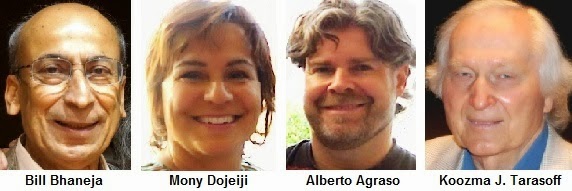
We 4 are: Bill Bhaneja, a retired political scientist, Ottawa, playwright and author of Quest for Gandhi — A Nonkilling Journey (2010), and Troubled Pilgrimage: Passage to Pakistan (2013); Mony Dojeiji and Alberto Agraso, co-authors of Walking for Peace — an inner journey (2013), and I Am Happy (2013); and me, Koozma J. Tarasoff.

The common ground of the four ‘gods-within us’ is the spirit of love that permeates our lives and gives us meaning as individuals and as a human species. This spirit within gives us optimism to act as Gods within the confines of a friendly planet. Our intention is to act with passion, but equally to be socially responsible for our actions.

Highlights of what we discussed for 2 hours:
  • Mildred L. Norman — Peace Pilgrim (1908-1981), who walked 25,000 miles for peace from 1953 to 1981, spoke about peace among nations, groups, individuals, and the very important inner peace — because that is where peace begins. Her life and work showed that one person with inner peace can make a significant contribution to world peace.
         Both the inner and outer voice were affected by whether we were driven by ego or by our conscience. She said that she began to realize that it was as though we had two selves or two natures or two wills with two different viewpoints. Because the viewpoints were so different, there was a struggle in our lives between the two selves; ultimately it took her 15 years to understand the real meaning of life. It was a challenge and a treat to observe and act from an egoless viewpoint.
         In her search for meaning in life, Peace Pilgrim expressed a need to deal with the world situation today. ‘… Certainly all present wars must cease. Obviously, we need to find a way to lay down our arms together. We need to set up mechanisms to avoid physical violence in a world where psychological violence still exists. All nations need to give up one right to the United Nations — the right to make war….We need a Peace Department in our national government to do extensive research on peaceful ways of resolving conflicts. Then we can ask other countries to create similar departments’ (Steps Toward Inner Peace, pages 31-32).
  • Gandhi — We explored the question of how inner peace could be achieved. Mahatma Gandhi in An Autobiography: The Story of my Experiments with Truth, worked towards two spiritual principles to attain inner peace — this is similar to what Peace Pilgrim sought. Gandhi describes these principles as Aparigraha (non-possession) (An Autobiography.., page 276) and Sambhava (equability). (Bhaneja, Quest for Gandhi, pages 101, 104, 105.) Once you work towards those principles you start understanding the meaning of following Vedantic prayer for inner peace:
               O'Lord lead me from Distinction to Distinctionlessness;
               O'Lord lead me from Ego to Egolessness;
               O'Lord lead me from Desire to Desirelessness.
    This understanding leads us to the notion that we are children of the same God, the same common humanity, and the same divine. We also start understanding Gandhi's message that there is no 'other', no enemy. Gandhi used to remark: 'Hate the Sin, not the Sinner' (Bhaneja, Quest for Gandhi, page105.).
  • Brotherhood — Real citizenship ought to embrace the world. We are all members of the human family. This means that Stephen Harper (Prime Minister of Canada) is as much a brother as is Vladimir Putin (President of the Russian Federation). Members of ISIS are our brothers, too, even though we do not support their violent behaviour. When we label and dehumanize these individuals, it becomes difficult to see them as capable of change, of thinking and acting in different ways. Our anger or frustration at their actions can influence our capacity to see them as human beings too. 
  • Propaganda — Politics on the other hand has been driven by power and control where ego gets an upper hand over conscience; when noble ideals and human rights enshrined in Constitutions are often violated and compromised especially for economic gain. Historically fear and labeling have been used as one of many techniques of propaganda for crowd control. Politicians have often used these mechanisms underhandedly as a way to hijack the population without respecting the rights of citizens to share their legitimate ideas. Let’s be careful how we use the word ‘terrorism’. As well, we need to be aware of corporate groups such as ISIS (the so-called 'Islamic State') which spreads fear designed to hijack vulnerable populations for their own purposes. The same happens even in democracies, where fear is used to create division among the populace and hence justify actions.
  • War — During the Nuremberg trial after WWII, Hermann Goering, Hitler's second in command, said in his cell to the prison psychologist:
         ‘Why, of course, the people don't want war. Why would some poor slob on a farm want to risk his life in a war when the best that he can get out of it is to come back to his farm in one piece. Naturally the common people don't want war: Neither in Russia, nor in England, nor for that matter in Germany. That is understood. But, after all, it is the leaders of the country who determine the policy and it is always a simple matter to drag the people along, whether it is a democracy, or a fascist dictatorship, or a parliament, or a communist dictatorship. Voice or no voice, the people can always be brought to the bidding of the leaders. That is easy. All you have to do is tell them they are being attacked, and denounce the peacemakers for lack of patriotism and exposing the country to danger. It works the same in any country’ (Bold added). (Gilbert, G.M. Nuremberg Diary, 1995: 278).
  • Truth — Words used carefully can become so powerful that they literally fly around the world and influence social policy. What do such words as the following mean: ‘democracy’, ‘peace’, ‘nonviolence’, ‘nonkilling’, ‘spirituality’, and ‘compassionate city’? But when these and other words become mere labels, become routinized and institutionalized, they can betray us and lose the original meaning. Remember that the first casualty of war is information. Journalists should strive for accuracy and avoid spreading untruths.
  • Our Behaviour — Wisdom people such as Aristotle have urged us that there needs to be a balance between the head and the heart. This is what conscience is about. Ultimately, it is our behaviour that makes the difference. Or as my Doukhobor ancestors used to say: Бог да Бог, но ты не буть плох (You can speak all you like about God, but behave yourself. Literally: God yes God, but don’t you be bad.).
References

Monday, 3 November 2014

Next Book Presented

Why I Wrote My Book on Spirit Wrestlers / Doukhobors? was my presentation to 39 people at ‘Arts Night’ in Ottawa on Friday evening October 31st, 2014.

The event was a monthly public educational meeting organized by a local artist for guest artists in literature, visual and music. I was the first of three speakers, each given up to half an hour to present and answer questions. It was a fun and educational experience with a diverse group.


I used my time to educate the audience about Doukhobors, talk about my last book and the next book in-progress — Spirit-Wrestlers: Doukhobor Pioneers and their Friends (2016).

I was pleased that most of the audience had heard of Doukhobors, and three gave rather accurate descriptions. I wanted to deliver what I thought were the most important aspects of the Doukhobor movement before I talked about writing. To save time, I prepared a one-page handout.

I wrote the book for 3 reasons:
  • biographies — our people
  • misinformation — misconceptions, myths
  • posterity — next generations
I gave summaries of 5 Doukhobors as sample biographies from my 2002 book and the update book in-progress.
  • Peter Oglow (1913 - 2004)
  • Nick Troubetzkoy
  • Kim Kanigan
  • Jim Deacove
  • Elaine and Alfred Podovinikoff
Then I covered two misconceptions, and finished with a case for nurturing and educating our children towards a nonkilling society. We had time for 7 questions, added to the end of my text.

Read the text of my presentation and questions, and click on the images to see what was projected on the large screen. At the end is the handout. And here are 21 photos of this Arts Night.

Thursday, 14 August 2014

The Peace Tower should stand for ‘Peace’


Recently I strolled around downtown Ottawa to the Parliament Hill and among the many war monuments. I heard a band playing and positioned myself among the tourists to again watch the Changing of the Guards, a summer ritual performed in front of the Parliament buildings.

Towering above all was our impressive Tower of Victory and Peace, the iconic ‘Peace Tower. ’

I asked myself, shouldn’t the Peace Tower represent ‘peace’ as it did 50 years ago?

In the 1950s PM Lester B. Pearson showcased Canada as a ‘nation esteemed thorough the world for its policies of neutrality, peacekeeping, and honest brokering.’(1)

In contrast, today PM Stephen Harper is determined to display Canada as a military nation.

In this same spot during the 2014 Canada Day celebrations, Harper referred to Canada as 'a courageous warrior…as the best country in the world.' (2). For the past ten years he supported the Afghanistan war, and recently assisted the NATO blockade of Russia, to attract local Ukrainian-Canadian votes. Purchasing very expensive F-35 fighter jets is debated as more important than practical search and rescue planes.

In this decade Canada is spending $120 million to commemorate wars for PR and tourism.(3) Schools are encouraged to ‘celebrate’ the upcoming 100th year anniversary of World War I, and the cadet program costing $5 million a year continues.

A permanent impact on education was changing the name of the Canadian Museum of Civilization to the Canadian Museum of History and refocusing it narrower to Canadian history, with the same Director (Mark 'Neill) for the nearby Canadian War Museum. The Director was appointed by the PM.

Absent from the Parliament Hill area are peace statues. The only one in the area is Reconciliation: The Peacekeeping Monument. No streets or bridges are named for peace in Ottawa. Only Winnipeg has a Mahatma Gandhi Way, (220 m. long) leading to the Canadian Museum for Human Rights.

Compare to UK, England, where a statue of Nelson Mandela in their Parliament Square was unveiled in 2007, and a statue of Mahatma Gandhi will be installed next year.

If Canada is to showcase peace to other countries, statues of these world moral leaders must be in the centre of Canada's capital to complement our Peace Tower and offset all the war monuments and statues.

The Canadian Department of Peace Initiative (CDPI) hopes to create a cabinet level department to transform military spending to a peace culture. A Private Members Bill was tabled in 2011, three years ago. While lobbying for CDPI progress, citizens are also working their public relations.

Peace Tower Movement

Rededicating the Peace Tower as a public icon that promotes peace and good governance is a project led by PeaceQuest — ‘to underline the importance of peace … as a basic Canadian value.’(4)

To recast this national logo, the Ottawa Peace Festival — a coalition of 20 peace groups in the Ottawa area — will open its festival on Sunday September 21 on Parliament Hill for its 8th year, but this time to rededicate the tower.

The festival theme: ‘Peacing Together the Canada We Want’ will launch from the Peace Tower for 12 days at 17 locations around the capital. 29 events, hosted by 20 groups are free and open to the public — art exhibitions, lectures, panel discussions, films, peace walks, music, food, and lots of education. Related topics cover domestic violence, PSTD, history, pollution and climate change.

I say let’s celebrate peace, but mourn war.


References
  1. Dan Gardner. ‘Lester Pearson Would Not be Impressed.’ Ottawa Citizen, 11 Aug. 2006, p. A15.
  2. Statement by the Prime Minister of Canada on Canada Day, ugnayan, 4 July 2014.
  3. Dennis Gruending. PeaceQuest wants Peace Tower rededicated, group promotes 'counter narrative' to militarism, dennisgruending.ca, 11 July 2014.
  4. Let’s rededicate the Peace Tower … to peace, PeaceQuest.ca, 23 October 2013.

Wednesday, 26 March 2014

Demonize War Not People !

In 1900 Lev. N. Tolstoy declared: War is ‘the slavery of our times’.

Today I declare: ‘War is a ‘public enemy’ — criminal and extremely damaging to society.

In 1895, my Spirit Wrestler (Doukhobor) ancestors burned their guns to say that the spirit of love/God in each of us forbids us to kill each other. Both Tolstoy and the Doukhobors did not condemn people, they rightly condemned the criminal evil of violence and wars.

During the current Russia-Ukraine crisis, puffed up by the news, I have been appalled by the demonizing rhetoric of Western leaders, the follow-the-herd mentality of much of the media, the eagerness of the government-military-industrial complex to increase spending, and the naivety of so many who think threat of war is the best solution.

The total cost of war in the past century is estimated at over 80 million. (The Canadian Friends Service Committee  have estimated the cost to be over $1 trillion. I suspect the real cost to be well over $2 trillion.) During World War II, Russians lost over 27 million people. The Nazi siege of Leningrad cost over 700,000 civilian lives — more than total number of soldiers killed during WWII from the U.S., U.K., and Canada. And today we know that many more surviving soldiers have PTSD (Post Traumatic Stress Disorders) which affects many more family and friends — uncounted millions of people suffer. 

To me it seems that only winners in war are those who profit from it (namely, the oil magnates, Big Banks and the Military industrial complex). This is a huge, preventable crime against humanity!

Historian Margaret MacMillan suggests that World War I could have been avoided if civil people negotiated alternatives to find win-win solutions. She said there was ‘nothing inevitable about the war’. The leaders of Europe could have chosen peace.(1)

Violence and war are learned behaviours. The 1986 Seville ‘Statement on Violence’ declared ‘...Just as wars begin in the minds of men’, peace also begins in our minds. The same species who invented war is capable of inventing peace. The responsibility lies with all of us.(4)

Glenn D. Paige of the Center for Global Nonkilling, has a solution. Dr. Paige presents a convincing case that we can stop lethal violence. What would happen if part of the annual $2 trillion spent on war was diverted to avoiding war?(2)

I also blame journalists who naively assume war is inevitable, and stereotype people into races who must fight each other. I suggest alternative peace seeking interview questions:
What are you doing to prevent war?
  • What is your position on creating a Department of Peace in parliament?
  • What are you doing to secularize our country, to integrate nationalities and religions?
  • How can our educational institutions better promote peace?
  • What programs do you support for international friendship?
  • What is the progress of reducing our nuclear weapons?
Avoiding war is a primary task of our civilization today. By diverting war funds to peace we focus on life, health research, education, pollution, infrastructure (roads, bridges, transportation) and quality of life for all.

Let’s get on with it before the patriotic war flames consume us.

Research
  1. Margaret MacMillan. 2002. Six Months That Changed the World: The Paris Peace Conference of 1919.
  2. Glenn D. Paige. 2002. Nonkilling Global Political Science.
  3. Joam Evans Pim (ed). 2013. Nonkilling Security & The State.
  4. David Adams, et al. 1989. ‘The Seville Statement on Violence: A Status Report.’ Journal of Peace Research, vol. 26: 120-121.
  5. Ralph Nader. March 24, 2014. ‘Obama to Putin: Do as I Say Not as I Do’.
  6. Thalif Deen (IPS - Transcend Media Service). March 24, 2014. ‘Ukraine Coup Lawful, Crimea Referendum Unlawful?’.
  7. Prof. James Petras (Transcend Media Service). March 24, 2014. ‘Violence and Terror: The Ukrainian Colombian Road to Empire Building.’
  8. Norman Pollack (CounterPunch). March 24, 2014. ‘Ukraine as Stalking Horse: The Rise of Fascism in the West.’
  9. Uri Avnery (Transcend Media Service). March 24, 2014. ‘A Hundred Years Later.’
  10. Robert Parry (Consortium News). 'Ukraine: The Danger of False Narrative.' March 27, 2014. 

Friday, 13 December 2013

4 For Coffee: a meeting of 4 gods-within us

I could have titled this log an informal gathering, or a meeting of souls, or kindred souls, or walking for peace, or revealing our inner and outer journey to build a war-less world. But this title best summarizes what I learned.

On Tuseday morning, December 10, I met with three friends at a downtown Ottawa cafe for coffee, to trade books and talk. It was International Human Rights Day and the memorial for Nelson Mandela — a fitting time to meet with three people whom I consider to be co-seekers of inner and outer peace.

We are pilgrims with our own histories, dealing with the stark reality of the day, not of this world. We are working towards a common ground approach to a new vision of human development. We each shared the god-within us, which is a concept common to each of our different ancestral cultures from around the world, and even goes way back to ancient Greek times. This day we became much more aware that the god-within each of us was the same.


They are Bill Bhaneja, a retired political scientist, Ottawa, playwright and author of Quest for Gandhi — A Nonkilling Journey (2010), and Troubled Pilgrimage: Passage to Pakistan (2013); and Mony Dojeiji and Alberto Agraso, co-authors of Walking for Peace — an inner journey (2013), and I Am Happy (2013).


Bill and I have known each other since 2006 while planning the Annual Ottawa Peace Festival, which Bill has since dubbed as ‘the longest peace festival in the world’. Also that year, we both attended the First Global Leadership Forum in Nonkilling in Hawaii where I presented a paper on Lev N. Tolstoy and the Doukhobors and their place in the nonkilling leadership paradigm.

Bill's Hindu background gave him a chance to reflect on the impact of Mahatma Gandhi who had chosen to follow the nonviolent path for social justice and nonkilling peace. From his Vedantic spiritual tradition, Bill was able to grasp the notion that 'we are all Gods' and that through sharing our common humanity, there is another path that will bring about a more peaceful and wholesome society on planet earth. His visit to the subcontinent described in his recent book became a pilgrimage to some of the places where Gandhi stayed during the struggle for India's Independence from the British Rule. Bill's wife comes from the Republic of Ireland, which also struggled in turbulence and change.

I met Mony and Alberto at their table display in Ottawa City Hall during Friends for Peace Day. We exchanged books, and met today to trade a few more books. Mony is a young Lebanese lady from Canada with an MBA, and Alberto is a talented artist from Spain.

Their book Walking for Peace documented their 13-month, 5,000-kilometer odyssey across 13 countries to Jerusalem. Most important, they experienced a spiritual journey, finding their true selves. In December 2003, exactly two years after they began walking, a daughter was born. Their journey of peace now continues with her. Their book received a Global eBook Award in 2012 and was a finalist in the 2012 National Indie Excellence Book Awards; and is being considered for a documentary film. This year the Spanish version of I am Happy got 2nd place in the International Latino Book Awards.

During their journey they read Conversations With God, in which the depressed author wrote an angry letter to God asking questions which led him to reconnect  immediately with the divine presence. From the book, Alberto learned to listen carefully, reach out to touch others with his new insights, and began an inner journey of wisdom into himself and the world.

Mony also read Peace Pilgrim, by Mildred Norman who did a 28-year-walk for a meaningful way of life. I told them that in 1957 the Peace Pilgrim stayed at our house in Saskatoon, Saskatchewan, and I heard her message about working to make North America a more peaceful continent. She walked like a pilgrim with only a tooth brush, comb and a map, wearing the same clothes every day (blue pants and blue tunic that held everything she owned). She never used money. I published two articles about her: Peace Pilgrim Gives a Challenge to Doukhobors, in our Doukhobor magazine The Inquirer, July 1957.

Alberto spoke about his experience with shamans who provided him with magical insights into his search for solutions to seemingly unsolvable problems. I shared the same about two elderly Fringe Saulteau Indian medicine men in the Broadview area of Saskatchewan that I met during my research in the 1960s. These men at the age of 90 were real practitioners of healing, finding lost objects, and being trusted as wisdom people for a territory of thousands of kilometers around them. They died sometime after I left the community without sharing their magic with their brothers and sisters. Why? They could not trust most of their tribal members because their 'medicines' were so powerful that they could harm life if not used with care.

I explained that my father's parents came to Canada from Russia in 1899 during the large Russian Doukhobor migration here, while my mother Anastasia arrived 27 years later at the age of 15. She was about to be deported in Quebec City (because she came alone on account of the German couple she travelled with got sick and stayed in Liverpool, England) when a French-Canadian couple travelling beside her said 'she came with us.' The Canadian couple saved the day and Mom continued alone by train to Saskatoon where she met her cousin. She met and married my Dad. My brother John was born in 1928, four years before me.

My Doukhobor (Spirit-Wrestlers) philosophy of love originated on the high steppes of Trans-Caucasia, southern Russia, where on midnight of June 28-29, 1895, 7000 Doukhobors burnt their guns in three locations. My inspiration comes from this first mass world protest against militarism and wars. Lev N. Tolstoy called war 'the slavery of our times' and was in contact with Mennonites, Quakers, Gandhians and the Transcendentalists in the USA, and the arms burning was a sign that the seeds of Jesus Christ were alive and well.

My pacifistic ethic comes from family stories about respecting others as worthy human beings. Though Mom only had three months of schooling, she was learned in the hospitality ethic and knew how to weave rugs, socks, slippers and doilies, make a wonderful garden, as well as to cook delicious meals. From this Slavic heritage I learned about hard work, beauty, nonkilling, creativity and bridge-building across boundaries.

We spoke about the spirit of love that permeates our lives and gives us meaning as individuals and as a human species. The Spirit Within or the Love Within (as used by Doukhobors), or the Light Within (as used by Quakers) all give us optimism to act as Gods within the confines of a friendly planet. Our intention is to act with passion, but equally to be socially responsible for our actions.

We all seemed to be on the same page when we saw the need to focus on the meaning of life. As photos tell a thousand words, actions are central to our adventure in what we mean by love and understanding. The 'win-win scenario' is required in our search for truth and goodness. We are in this together in the long run.

No one has a monopoly on truth. Keeping ourselves segregated into a sect, a tribe, or a race is too narrow. It took 27 years for Nelson Mandela in prison to eventually transform the narrow thinking of the apartheid regime, resulting in the release of this brave patient man from prison and his eventual win as the first Black president of South Africa in 1994.

It is a tribute to Nelson Mandela that he sought to reconcile the differences between races in his country and to eventually come to the conclusion that there are better alternatives to fear and violence. Love and reconciliation is the dual highway for today and the future. That seems to be the visionary path that the four of us have come to in our respective journeys.

The Power of One is a reminder that we can make a difference in our lives and that of our society. At the same time, 'our relationship to others' gives reality to us as equal social beings. We are part of a larger whole. Because of this connection, we need to learn to live with one another as friends. Here the nonkilling philosophy comes fully into play with the measurable goal of a killing-free world by means open to human creativity in reverence for life. A Department of Peace at the cabinet level would be one of the practical ways to move countries in the direction of a world culture of peace.

We need to allow the freedom of each to 'walk our talk' in our own style, and continue to support the cooperative path in which 'we all win'. The survival of our civilization depends on creating a balance between the 'I' and the 'We'.

Bravo to the Hundred Monkey effect in which a new behaviour or idea is claimed to spread rapidly by unexplained, even supernatural, means from one group to all related groups once a critical number of members of one group exhibit the new behaviour or acknowledge the new idea.

December 10th, 2013 was indeed a remarkable day for me! I was glad to celebrate it with dear friends and I am sharing it with each of you. Peace to the God-within you!

See all my meeting reports.