Showing posts with label Biography. Show all posts

Wednesday, 26 October 2022

Mich Ozeroff, 83 (1939 - 2022), Langham, Saskatchewan

Michael 'Mich' Ozeroff, 83, died October 23, 2022, at the Langham, Saskatchewan Care Home. 

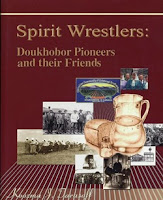
He was one of 33 biographers in my most recent book Spirit Wrestlers: Doukhobor Pioneers and their Friends. Here is my Introduction:

Mich Ozeroff is a retired successful farmer, Saskatchewan Wheat Pool Director, choral singer, and Doukhobor community activist in creating a cooperative, just, and peaceful society. 

He and his wife Dorothy reside in Langham, Saskatchewan where he continues to encourage the development of a rich culture and the authentic ethics of the Doukhobor movement. 

With the help of others, Mich recently produced a remarkable visual and audio study of the Saskatchewan Doukhobor Youth Festivals 1955 - 1968, recording their history, communities, choirs, singers and recorded songs and photos.

Michael ('Mich') Ozeroff, Saskatoon Funeral Home, November 2022.

Mich Ozeroff, Saskatchewan Wheat Pool Director. In Koozma J. Tarasoff, Spirit Wrestlers: Doukhobor Pioneers and their Friends (2022): 287-299.

Koozma J. Tarasoff, Mich Ozeroff, Elmer Verigin and Andrei Conovaloff, Saskatchewan Doukhobor Youth Festivals, 1955 - 1968. Summary of history, communities, choirs, singers, recorded songs and photos. 22 pp. 

—————
Comments: Beginning in 2024, you can only self-enter a Comment below with a 'Google Account' (gmail). This prevents irrelevant anonymous comments (spam and admail).  If you do not have a Google Account, email your Comment to KJTarasoff@gmail.com for posting.

Jack Tarasoff, 89 (1933 - 2022), Calgary, Alberta

Jack Tarasoff, 89, died August 26, 2022 in Calgary, Alberta. 

Jack was one of 33 biographers in my book Spirit Wrestlers: Doukhobor Pioneers and their Friends. 
Here is my Introduction to him:

Jack Tarasoff is a retired professor of First Nations Studies and Adult Education. Curretly he resides with his Welsh wife Jan in Calgary, Alberta. 

From attending many First Nations feasts, Swet Lodges, and Pow Wows, Jack considers that he has gained the wisdom of being a 'a professor for the Underdog Natives'. From being an executive member of the Federation of Russian Canadians and being active with Doukhobor groups, Jack learned the meaning of contributing to the common good, stopping the killing of fellow human beings, and rejecting the destruction of all life on the planet.

Read his entire biography.  
  • Obituary Jack Tarasoff (1933-2022), in Calgary, Alberta. by Dignity Memorial. A Memorial Service will be announced at a later date.
—————
Comments: Beginning in 2024, you can only self-enter a Comment below with a 'Google Account' (gmail). This prevents irrelevant anonymous comments (spam and admail).  If you do not have a Google Account, email your Comment to KJTarasoff@gmail.com for posting.

Tuesday, 25 January 2022

New Book on Doukhobor Biographies

Spirit Wrestlers: Doukhobor Pioneers and Their Friends
has just been published as a text with 459 pages and 340 images, and as a free eBook online. See press release

This 2022 book is a continuation of my 2002 book ― Spirit Wrestlers: Doukhobor Pioneers’ Strategies for Living ―  with 106 long and 93 short biographies

To update the first book 20 years later, I invited more people associated with the Doukhobor Movement to submit their biographies, and many did. A total of 132 biographies have been published.

33 biographies came from around the world ― Canada (24), Russia (5), USA (2), Caribbean West Indies (1), and Australia (1). Four have no direct Doukhobor heritage. 

They are:
  • scholars
  • lawyer
  • ministers
  • educators
  • professors
  • civil servant
  • medical doctor
  • administrators
  • heritage builder
  • Slavic specialist
  • community activist
  • geophysical engineer
  • petroleum consultant
  • wheat pool director
  • singers and musicians
  • museum professional
  • artist, storyteller, dancer
  • communications worker
  • early childhood educator
  • digital technology expert
  • ethnographer and folklorist
  • entrepreneur with a conscience
  • organic candy maker in Australia
  • organic architect in the Caribbean
  • international consular property manager
  • Canadian family in Russia living
    next to the Lev N. Tolstoy estate 
These 33 Doukhobor pioneers and their friends exhibit an extraordinary spirit and talent to create a peaceful and healthy society. Their combined lessons of friendship, love, problem solving, and respect for humanity give us hope for the future of our species on planet earth. 

This large book with 340 images was a voluntary effort. The printing was funded by a very generous donation from geological engineer Michael N. Chernoff of West Vancouver, born in Veregin, Saskatchewan. His big brother Charlie has a biography in the book. 

A limited number of printed copies were distributed to the biographers, to select libraries and archives around the world, to several book reviewers, and to a number of individuals (‘the unsung heroes’). The distribution was made free as an expression of loving dedication to the Doukhobor experience and their hope for a peaceful nonkilling world society. 

The online version will be updated over time. Printed copies can be ordered from Manager Jia Hou, Merriam Print Inc., 252 Laurier Ave. East, Ottawa, Ontario K1N 6P4. Phone Jia at 613-567-5050, or email print252@gmail.com 

About the Editor

Koozma J. Tarasoff was born in 1932 on an isolated Saskatchewan farm 35 miles north-west of Saskatoon. With father John K., mother Anastasia, and brother John J. in the early 1940s, he moved to Saskatoon for public schooling. He got his BA in social sciences at the University of Saskatchewan in 1958. In 1962 enrolled at the University of British Columbia and earned his MA in Anthropology and Sociology in 1964. 

Is first job for three years was for the Province of Saskatchewan doing ethnographic studies of the Native Indians in the Broadview area. Next he joined the Federal Government in Winnipeg and then Ottawa where he worked for Regional Economic Expansion with submarginal rural areas and Natives. In the spring of 1979, the Canadian Council of Rural Development where he was last working was dissolved and he lost his job. That change allowed him to work as an independent ethnographer, photojournalist, and author on the Doukhobors and the peace movement. 

To date, Koozma Tarasoff has written 25 books, including those on native Canadians, rural development, east-west peace making, and major works on his heritage ― the Spirit Wrestlers / Doukhobors. With webmaster Andrei Conovaloff of Arizona, USA, Koozma today hosts the Spirit Wrestlers website and blog ― www.Spirit-Wrestlers.com ― from Canada’s capital Ottawa. 

Update: February 4, 2022

Among the many people who got a copy of this new book was David Swanson, director of World BEYOND War, ‘a global movement to end all wars’. He was inspired by the contents, and on January 28, 2022, posted: ‘Can We Learn Anything From Russian-Canadian Pacifists?’  

Swanson mentioned Tolstoy, Doukhobors, 1895 Burning of Arms, and quoted a paragraph from Dr. Ashleigh Androsoff's biography.

In response to Swanson’s article, Jim Popoff and Dr. Androsoff sent replies to me, which are copied below in the Comments section. Please add your comments and replies on either blog.

Note that the comment posted after Swanson article by Andrei Conovaloff is missing 3 links:
     'For clarification of the first 2 paragraphs, see:
—————
Note: You can enter a Comment below only with a Google Account. If you do not have a Google Account, email your Comment to KJTarasoff@gmail.com   This requirement was the easiest way to prevent irrelevant anonymous comments (spam and admail).

Friday, 22 November 2019

‘Saskatchewan Doukhobors’ documentary shown in Ottawa

Some 80 people attended the movie ‘We’ve Concluded Our Assembly: The Saskatchewan Doukhobors’ at the historic Mayfair Theatre on November 10, 2019, in Old Ottawa South. The 90-minute documentary was followed by a discussion led by producer-organizer Ryan Androsoff with Spirit Wrestler Productions.

Mayfair Theatre markee.                        Ryan Androsoff.

Available for sale were DVDs of the film (90 minutes), CD recordings of the Saskatchewan Doukhobor Prayer Service (42 minutes, Russian and English); and a booklet 'Song Lyrics and Credits' (Russian, transliterated Russian, English) with a list of financial contributors and acknowledgements of participants. All can be bought online and at the gift shop of the Saskatoon Western Development Museum and the Doukhobor Discovery Centre in Castlegar, BC. Donate; the Project is $20,000 short of breaking even.

In 2016, Ryan Androsoff initiated the ambitious Saskatchewan Doukhobor Living Book Project ‘with the mission of preserving the oral history and spiritual traditions of the Saskatchewan Doukhobor community for future generations’ as a soundscape, and to ‘start a conversation about the future of Doukhoborism for generations to come.’

This Project is specifically about ‘Independent Doukhobors’ in Saskatchewan, who comprise about one-fourth of all Canadian Doukhobors, and are partly organized as the Doukhobor Cultural Society of Saskatchewan (DCSS). Most descendants of Community Doukhobors in British Columbia are not the focus.

This was my third viewing of the entire project. As soon as it was available, Ryan mailed me the DVD, CD and booklet to review.

The documentary film opens with a typical Sunday gathering (called sobranie in Russian) of Independent Doukhobors in Saskatchewan. A traditional prayer service was performed by 8 men and 20 women (28 singers) who recited and sung Doukhobor psalms in Russian (translations provided).

The location was the Blaine Lake Doukhobor Community Home (which in my opinion is erroneously called the Doukhobor Prayer Home) located 80 km (50 miles) north of Saskatoon, Saskatchewan. Blaine Lake is one of the 5 remaining active Independent Doukhobor meeting halls in Saskatchewan.

Inter-weaved throughout the 90 minutes were interviews of 30 men and women from ages 8 to 95, historic images, maps, and video clips of Doukhobor events in Saskatchewan (like the annual Doukhobor Peace Day under a tent with community picnic outdoors).

A total of 42 participated, 12 members of the choir were not interviewed. About a third are closely related family.

William Kanigan spoke with pride about one of his two sons who turned down a lucrative military contract because it would have contradicted with his heritage roots.

I enjoyed the freshness of Jonathan Kalmakoff's daughters, Katie and Emily, who told stories learned from their father, a Doukhobor genealogist and historian. Hundreds of articles, charts and maps are on his Doukhobor Genealogy Website.

The documentary ended at the sobranie with the hymn (in Russian and English): 'We've Concluded Our Assembly'. Credits followed.

Themes covered:
After the film, questions were asked about the Doukhobor migration to Canada beginning in 1899, if there was a Doukhobor meeting in Ottawa [No], about singing, and the transliteration of Russian to English.

At the end of the Question period, I thanked the producer and made the following comments:
This is a beautiful contribution to the cultural treasure of Doukhobors in Saskatchewan. The film will be remembered by children and grandchildren for years to come. They will recall that their ancestors believed in the Spirit of God within each person (based on a deep philosophy of love, truth, hospitality, and humanity), that peace is the way to a sustained future on Planet Earth. Nonviolence or nonkilling is central. Also they will remember that the collective style of life gave their ancestors strength to survive. And this attitude will likely prevail and give the new generation strength to carry on their mission into the future.

Ryan Androsoff and his team are to be greatly applauded for their efforts in creating this documentary film. Fundraising was a big challenge met by Doukhobors and others. The team interviewed 30 people who said many good things. The inclusion of several young people in the interviews is an acknowledgement that the new generation expects a voice with new changes. And the intent of the film was correct — ‘to help start a conversation about the future of Doukhoborism for generations to come.'
Topics not covered about the Doukhobor Movement in Saskatchewan
  • The real contribution of Doukhobor settlers to Saskatchewan and Canada. See my book: Spirit Wrestlers: Doukhobor Pioneers' Strategies for Living, 2002; and search for major sources on Doukhobor pioneers in the Public Archives of Saskatchewan found on the campus of the University of Saskatchewan. Also check for ‘Saskatchewan’ articles on the Doukhobor Genealogy Website.
  • The marvelous Doukhobor bread-baking project at the Saskatoon Exhibition annually since 1955. This is a national and international door-opener on the Doukhobors.
  • The inspiring peace manifestations organized by Doukhobors, like attorney Peter G. Makaroff in the 1960s, and others — an inspiration for future generations in helping save our civilization from destruction.
  • The unique contributions of Saskatchewan Doukhobor journals of The Inquirer, The Dove, and The Doukhobor Sheaf to alternative media.
  • Classes on Doukhobor history and culture are currently taught at the University of Saskatchewan in Saskatoon by Dr. Veronika Makarova. Also Dr. Ashleigh Androsoff teaches history courses which includes Doukhobor pioneers.

Background

In 2016, I helped Ryan promote this project on Ottawa radio (Independent Doukhobor Project on Radio, July 20, 2016), and continued to help announce the project four more times on my website (1 Aug. 2016, 28 Oct. 2017, 20 May 2019, 27June 2019).

For over two years money was raised (crowdfunding, donors), the choir rehearsed, film and audio crews hired, and hours spent recording the meeting service, psalm singing, and interviews with many people, including me. Today, the project is about $20,000 short of covering all costs.

Donors from around the world and across Canada.
Click here to see world donor map.
Click on map pins (blue markers) to see donors names.

Dr. Ashleigh Androsoff helped with research, scripts and interviews. She is a history professor at the University of Saskatchewan, and Ryan’s 3rd cousin. See her 2011 doctoral dissertation: 'Spirit Wrestling: Identity Conflict and the Canadian “Doukhobor Problem,” 1899-1999'.

The project has cost about $57,000 to produce, of which $27,000 has been paid by grants and donors around the world. $20,000 remains to be paid. Please donate.

Ryan has promoted the project on TV, radio and newspapers, all documented on his website doukhoborlivingbook.ca and Facebook.

Doukhobor soundscape at the Western Development Museum, Saskatoon.
Each singer had a microphone, and 4 video cameras recorded simultaneously.
For the soundscape, each singer is played on a speaker on a pole at that
singer's position in the choir. Walk through this virtual sobranie.
Ryan said it is "... an immersive experience, like you were there."

Over 200 people attended the project launch on June 28, 2019, at the Western Development Museum (WDM) in Saskatoon, with a dazzling walk-through multimedia soundscape and exhibit that continued through October 20, 2019. The WDM has featured local Doukhobor history in the past, but this was the largest exhibit.

On June 29, 2019, the film was shown at the Broadway Theatre in Saskatoon, followed by a discussion.

DVD, CD and booklet available online from the gift shop of the Saskatoon Western Development Museum and the Doukhobor Discovery Centre in Castlegar, BC.

More

Tuesday, 11 June 2019

Tribute to ‘Jack’ McIntosh (1940–2019)

John Duncan Lawrence "Jack" McINTOSH
Born: September 19, 1940 — Whitewood, SK
Died: May 29, 2019 — Richmond, BC — Age 79, cancer.


This shy bibliographer from the University of British Columbia (UBC) was a brilliant and generous scholar that many of us will miss. He was a friendly soul who wished the best for each of us regardless of our religion, politics, or education.

He was born in Saskatchewan and raised in the Castlegar area of British Columbia among Doukhobors, where he began to learn Russian from classmates at Stanley Humphries Secondary School. After studying Russian for two years at UBC, Jack studied in Russia where he attended Baptist meetings with former Molokane. Upon returning to Canada, he got ‘great on-the-job training’ translating for government, journals and the Soviet press.

His best friend from high school, Gerald (Jerry) D. Palsson (see comment below) had become a librarian and encouraged Jack to do the same. Jack entered the Librarian program at UBC, where he was employed, excelled, retired in 2001, and continued to volunteer to the end. He managed the UBC Doukhobor Collection and was a tremendous aide to Canadian Doukhobors.

Jack and I exchanged historic materials on the Doukhobors, Lev N. Tolstoy, and peace-making since the 1960s. He gifted me a copy of his 416-page 'Expanded Bibliography on the Doukhobors' that he hoped to get published, but never did. The Bibliography served me well. Whenever I needed some important source, he always mailed me a photocopy, and later emailed a file. See a sample draft page from the 1960s.

In the early 1980s, Jack was invited to interpret and participate in the Expanded Kootenay Committee on Intergroup Relations (EKCIR). We trusted him due to his honesty and many years of personal exposure to and knowledge of Doukhobors. Recently, Jack was impressed with Ashleigh Androsoff's observations and conclusions of the hearings. See her 2011 PhD thesis: Spirit Wrestling Identity Conflict and the Canadian “Doukhobor Problem,” 1899-1999 (pages 386, 390-392; and search for 'EKCIR').

In the early 1990s Jack was our guest during a Learned Societies conference held here in Ottawa. He soon was in our basement looking over my history collection, and I recall how elated he was to find material for his current study.

It is remarkable that a Scottish-Canadian lad learned Russian so well, and that he boldly shared insights that others did not. In the special issue of the Canadian Ethnic Studies in 1995 about Doukhobors, he challenged the accuracy of George Woodcock’s publications.

Jack was sensitive to the oral history of the Doukhobors, and drew on his wide readings to distinguish fact from fiction. His transliteration skills were precise: borshch, pirogi, sobranie, Petrov Den’, stikhi, etc. He wrote with dedication and thoroughness.

When I needed help with the creation of a CD version of Plakun Trava: The Doukhobors, Jack volunteered corrections and suggestions.

Jack helped Jonathan Kalmakoff by translating and/or proofreading at least 19 articles and items for the Doukhobor Genealogy Website (renamed Doukhobor Heritage). 

Jack McIntosh was a dear colleague whom I could trust in time of need. I don’t know of anyone who can fill his void.


Obituary: 'John McIntosh’, Vancouver Sun, June 8, 2019.


'Witness to the Resurrection: Celebrating the Life of Jack McIntosh, June 22, 2019'.


By Jack about Doukhobors

Unfortunately, none of his work is online, open source, except for 19 items on the Doukhobor Genealogy Website.

‘Jack McIntosh — Bibliographer (1940-2019)’. In forthcoming eBook by Koozma J. Tarasoff and Andrei Conovaloff, Spirit Wrestlers: Doukhobor Pioneers and Friends. Submitted 2018. Proposed publication 2020.

‘Maintaining community among a small, dispersed people: Canadian Doukhobor periodical publications on the wall, in the mail and on the Internet’. In Andrew Donskov, John Woodsworth and Chad Gaffield (eds.), The Doukhobor Centenary in Canada (2000): 277-289.

‘Rarely-Cited “Gems” in the Doukhobor Bibliography: Why So Obscure? What Can be Done?’ In Canadian Ethnic Studies, vol. XXVII, No. 8, 1995: 262-269.

‘Update 1973-1993: Excerpts From the Doukhobor Bibliography, Expanded Updated Edition’. In Koozma J. Tarasoff and Robert B. Klymasz, Spirit Wrestlers. Centennial Papers in Honour of Canada’s Doukhobor Heritage (1995): 187-216.

Horvath’s Doukhobor Bibliography (in Progress). Revised and Expanded. Unpublished 1989 version, 428 pp.

Unpublished papers:
  • ‘Maintaining community among a small, dispersed people: Canadian Doukhobor periodical publications on the wall, in the mail and on the Internet', at The Doukhobor Centenary in Canada: a multi-disciplinary perspective on their unity and diversity, University of Ottawa, Ottawa, Ontario. 1999 October 22-24. — Jack generously gave half of his time to 2 guys not on the program, Jonathan Kalmakoff and Andrei Conovaloff, to show their new web sites.
  • ‘The Doukhobor Migration That Never Was’. Panel: ‘Doukhobors in Canada — 100 Years and Beyond’. Canadian Association of Slavists Meeting, Ottawa, Ontario. 1998 June 1.
—————
Comments:  Begining in 2024, you can only self-enter a Comment below with a 'Google Account' (gmail). This prevents irrelevant anonymous comments (spam and admail).  If you do not have a Google Account, email your Comment to KJTarasoff@gmail.com

Tuesday, 4 June 2019

Remembering Alex Ewashen (1932–2019)

EWASHEN Alex May 20, 2019 aged 87 in Creston B.C., Canada. Beloved husband of Julie, (née O'Neill), father of Alexandra and Brian. Funeral service in Creston & District Community Complex, B.C., Canada, on Saturday June 1 at 1.00 p.m (The Irish Times)

Alex Jacob Ewashen (February 21, 1932 ~ May 20, 2019)
Born in Nanton, Alberta. Passed away on May 20th, 2019 in Creston, B.C. 87 years of age. Celebration of Life: Saturday, June 1st, 2019 at 1:00pm, Creston and District Community Complex, “Creston Room”, 312 19th Ave North, Creston, B.C. (G. F. Oliver funeral Chapel)

His brother Larry reported: ‘A very moving funeral yesterday with a choir from the Kootenays.’

Lorne Eckerley. Opinon: Pangs of Loss, This is the Life, Creston Valley Advance, May 20, 2019. — Reporter and friend remembers Alex as a 'moral compass'.

Alex J. Ewashen, Obituaries, Creston Valley Advance, May 20, 2019. — Biography.

Click on image to enlarge.

A Tribute and note for his 'Celebration' on June 1, 2019

Dear Julie and children, Ewashen brothers and many friends,

Alex Ewashen was an outstanding intelligent bright person, with much curiosity, open to the world, with humour, and a good friend to all of us.

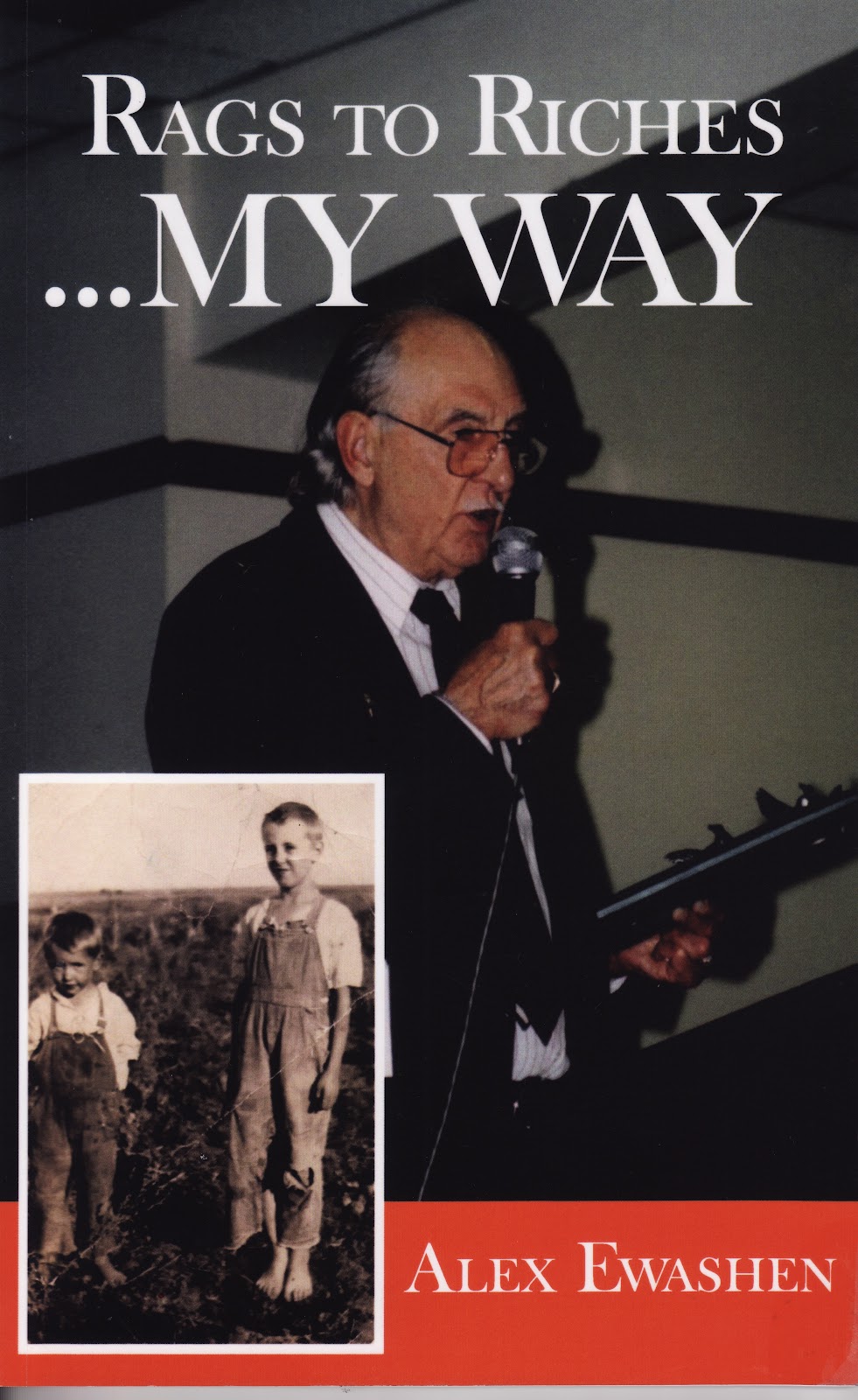
AlexEwashen_book_2014.jpegIn his book Rags To Riches...My Way (2014), which he sent to me and my wife Kristina, Alex inscribed the following words: ‘Koozma and Kristina. Thanks for being a Lifelong Friend. Alex.’

I published a review of his book in July 2015, which Alex proofread via the Internet while he was in the Republic of Georgia on the Doukhobor Heritage Tour, led by Verna Postnikoff.

Also see: Auctioneer publishes memoir, Rags to Riches, by Lorne Eckersley, Creston Valley Advance, October 2, 2014, page 3.

For us, it was a pleasure to meet Alex on many occasions, to correspond with him, and being a lifelong friend is an honour. With Kristina, we were hosted at his home and he and Julie stayed at our place during the visit of the 100-member Voices for Peace Choir to Ottawa in 1995. At one of our visits at his house, we made a nice video interview with Alex and Julie.

Alex was indeed a Doukhobor pioneer. I included him in my big book celebrating over 200 pioneers who showed the way to peace and justice in Canada and helped create a better world. He had curiosity, intelligence, compassion and valued hard work. His life was proof of his Doukhobor philosophy and beliefs. He recognized himself as ‘A Peacenik’ for most of his life and was a bridge-builder. He was creative and talented. With Larry and Bob they created a musical trio and participated in many Doukhobor and public events.

Alex was brave — not afraid to take on new adventures. In 1984, when a Quaker neighbour offered an opportunity to participate in a 50,000 km. Peace and Friendship Caravan, he signed on within a two-hour deadline notice. Then he joined a handful of concerned activists for a 3.5 month travel through 22 countries in Europe promoting Sister Cityship and student exchanges.

Alex had an interesting rich life and a beautiful family! Here are many stories to be shared…. All of us will miss him. However, the good memories will remain.

Вечная память ему. Rest in peace Alex!
With deep condolences to the whole family,

Koozma and Kristina
—————

Note: You can enter a Comment only with a Google Account. If you do not have a Google Account, email your Comment to KJTarasoff@gmail.com

Friday, 7 October 2016

Tribute to Michael M. Verigin (1929 - 2016)


Michael M. Verigin died September 29, 2016. Obituary in Calgary Herald.


To Michael’s children Venera and Liuba and their children and spouses, my wife Kristina Kristova and I send our sincere condolences in the passing of a dear parent and cultural legend. Michael was a stalwart elder whom people looked up to.

In human societies, the elder is one who has experienced life fully and is respected for the lessons of time. Michael M. Verigin was one of those people who worked hard in a coal mine, who lived a long life, preserved the spirit and traditions of his Doukhobor ancestors, and has shared his wisdom with the wider world.

This cultural activist knew much about the Doukhobors in Alberta. His grandfather was among the first settlers to go there in 1915 to establish a Doukhobor colony in the southern foothills area of Cowley and Lundbreck.* As the oldest of six children, Michael Verigin grew up there as a young pioneer helping with the chores of the household. Since marrying Doris (nee Fedosoff) in 1955, he lived in Cowley for much of his life, and for over 60 years was active in the community.

Michael was generous to me with his knowledge, wisdom and hospitality. When I needed to take pictures of his collection, Michael went into his basement, looked into his trunks and brought out rich treasures: old issues of Iskra and Mir, colourful traditional costumes made by his grandparents, old pens and inkwells used in an early one-room school where he attended, and rugs made by his wife. He had a cornucopia of Doukhoboria.

Michael readily stepped in as President of the United Doukhobors of Alberta, as councilman for the village of Cowley, as Board member of the CCUB Trust Fund, representing Alberta and the Alberta Cutural Council. At the Doukhobor Community Home in Lundbreck, he regularly led the sobranie meetings and joined in the singing of traditional psalms and hymns.

True to his tradition, Michael was a strong peace activist who believed that it is wrong to kill another human being because we then destroy the humanity of each. The historic 1895 burning of guns by his Russian ancestors was an event that he felt our society today can learn from. ‘Disarm our weapons of mass destruction and bring our troops home’, he would often proclaim, ‘and respect the Commandment of “Thou Shalt No Kill”.’

From his ancestors he gained the wisdom that sharing and cooperation are essential to human development. He often visited the local Hutterite colonies where he was welcomed as an honorary member. He was against exploitation and excessive materialism. Greediness for him has no place in a healthy society. The dollar cannot be the real measure of human worth.

When the media and some ignorant writers demonized all Doukhobors as fanatics, he was there to defend Doukhobors and speak up for them. For him, ‘burnings or bombings or disrobing’ were contrary to the Doukhobor movement.

In 1995 Michael and his wife Doris organized a beautiful and harmonious ‘Toil and Peaceful Life’ exhibit on the Doukhobors at the Sir Alexander Galt Museum in Lethbridge. It was produced in honour of the 100th anniversary of the burning of guns in Russia and 80 years of Doukhobor settlement in Alberta.

Yes, Michael Verigin was a man of wisdom, a hospitable man, a man to remember. All of us will miss him. May future generations respect and learn from him and his wife how to treat our neighbours with love and compassion.
 — Koozma and Kristina


See M.M. Verigin biography: Koozma J. Tarasoff,  'Upholding the Culture of Alberta Doukhobors', Spirit Wrestlers: Doukhobor Pioneers' Strategies for Living (2002). pages 268-271. 

* Map by Jonathan Kalmakoff, Doukhobor Genealogy Website.

Monday, 3 November 2014

Next Book Presented

Why I Wrote My Book on Spirit Wrestlers / Doukhobors? was my presentation to 39 people at ‘Arts Night’ in Ottawa on Friday evening October 31st, 2014.

The event was a monthly public educational meeting organized by a local artist for guest artists in literature, visual and music. I was the first of three speakers, each given up to half an hour to present and answer questions. It was a fun and educational experience with a diverse group.


I used my time to educate the audience about Doukhobors, talk about my last book and the next book in-progress — Spirit-Wrestlers: Doukhobor Pioneers and their Friends (2016).

I was pleased that most of the audience had heard of Doukhobors, and three gave rather accurate descriptions. I wanted to deliver what I thought were the most important aspects of the Doukhobor movement before I talked about writing. To save time, I prepared a one-page handout.

I wrote the book for 3 reasons:
  • biographies — our people
  • misinformation — misconceptions, myths
  • posterity — next generations
I gave summaries of 5 Doukhobors as sample biographies from my 2002 book and the update book in-progress.
  • Peter Oglow (1913 - 2004)
  • Nick Troubetzkoy
  • Kim Kanigan
  • Jim Deacove
  • Elaine and Alfred Podovinikoff
Then I covered two misconceptions, and finished with a case for nurturing and educating our children towards a nonkilling society. We had time for 7 questions, added to the end of my text.

Read the text of my presentation and questions, and click on the images to see what was projected on the large screen. At the end is the handout. And here are 21 photos of this Arts Night.

Wednesday, 22 October 2014

New Russian website: Doukhobor.RU


Doukhobors: a historical-genealogical archive

A new website was launched in Russian by Valerii Kalmykov on October 1st, 2014 — www.doukhobor.ru


There are sections in-progress for News, History, Library, Search, DNA, Forum, Photo, Video, Audio, and a Blog. The "News" link shows "what's new" — a chronology of additions.

Kalmykov will publish "... family lists for 1840-1845-1853-1873-1886-1897-1932-1947 about Doukhobors in Russia and in the Caucasus — more than 5,000 documents that have never been made ​​public."

His mission statement says: "… each person ... will be aware of themselves as part of one small but very important part of the history of his family."

He recently visited Doukhobors in Georgia and shows photos of the farm and in the home of his host Ivan Kazakov.

His library starts with the earliest extensive documentation of Doukhobors by Orest Novitsky in 1832 and will include other books he has scanned.

The video section appears to have 3 test videos. The first 2 are a popular, about Russian drivers:
"What to do when a neighbor down the road is acting aggressively?" The third, "Rolik" ("roller"), is a 2-second segment taken in Georgia. Expect these to be replaced with other videos.

In the past, he contributed several items to Spirit-Wrestlers.com.
Kalmykov's story is one of 32 (so far) biographies in-progress for Koozma's next book: Spirit Wrestlers: Doukhobor Pioneers and their Friends, an update of Tarasoff's 2002 book.

Tuesday, 19 February 2013

Ode to Kristina

My wife was awarded the Bulgarian Medal and Certificate of Honour!

On February 16, 2013, Kristina Kristova was officially recognised by the Bulgarian Government — the State Agency for Bulgarians Abroad — with the national Paisii Hilendarski Memorable Medal and Certificate of Honour. 

See 70 event photos. [2023 broken link.]

The Certificate states: 'for her significant contribution to the preservation and promotion of the Bulgarian culture and traditions in Canada, for her dedicated work as the founder and leader of the Bulgarian Society in the Capital Region Ottawa-Gatineau, and to celebrate her 70th year jubilee'.  

Medal inscription: 'Bulgarians, know your roots and language.'

In 2000, the Bulgarian Government decreed to issue an annual state award to creators and performers whose works are connected with Bulgarian culture, history and traditions. The award was named for monk Saint Paisii Hilendarski (1722-1773), a national historic spiritual leader, peoples' revivalist and confessor, and founder of the Bulgarian Renaissance. While in monastery (1760-1762) he created the Slav-Bulgarian History — Istoriya Slavyanobolgarskaya — which stimulated the formation of Bulgarian national consciousness.


80 attended, with some from Montreal. Kristina's daughter Milena Krassi was honoured to be the event master of ceremonies at the Bulgarian Embassy, Ottawa, where the celebration took place. During the evening program of speeches, slide shows, and poetry, I added my poem (below). Delicious Bulgarian food was prepared by local volunteers. The first president of the Ottawa Bulgarian Community, Vasil Gatchev, called me an 'Honourary Bulgarian'. 

See 70 event photos. [2023: broken link.]

My Ode to Kristina — a World Citizen

As friend, companion, husband of Kristina —
there is much to say about this interesting person.

Her Bulgarian experience as anchor person on
National TV for more than 20 years,
shows through in her personality.
In editing some of my draft writings, her comments are
appreciated for setting the logic straight,
for being concise, and for showing me
how creative words can impact the message on the public stage.
Her genius in grasping a thought, even in English,
often means rewriting what I considered to be a final draft.

As a pioneer in the local Bulgarian Community,
I have seen her selfless energy at work —
phoning, writing on the computer,
calling compatriots to preserve traditional language and culture,
and urging them to bring their best foot forward
in a multicultural Canada.

That same energy I have seen with other activities —
selling watches and jewelry to eBay customers,
working for a high-tech company,
selling designer clothes, and recently
working as Site Administrator of the International Languages Program on Saturdays.

In all of these works, quality has been her goal.
This often means a long day —
working into the early hours of the morning.
I would of course be called to help —
carry this, copy that, deliver this, take photos,
or help edit a letter in English. With her enthusiasm and good intent,
how could I not help?

Shopping for me with Kristina has been most frustrating.
Why? Because our styles differ.
I generally know what I am looking for, and I go for it;
while her approach is to look and look and look
for something ‘perfect’.
But as we all know, perfection is difficult or impossible to achieve.

In our 20-plus years together
I have seen how adaptable Kristina is.
Learning the English language from practically zero
has been a challenging task. And thanks to her she helped me with my Russian.
Unfortunately, I have not yet learned the Bulgarian language, but
have had to rely much on observation, listening, and instinct.
However, I very much appreciate and admire
the friendship of Kristina and members of the Bulgarian community in Ottawa.

Of course, I have noticed Kristina’s nostalgia for Bulgaria and Europe.
For her, Ottawa at times feels like a small village.
Periodically she reminds me that I came from Saskatchewan —
a country boy born on an isolated farm without any modern conveniences,
35 miles away from the nearest large city.

But for Kristina to be born in the centre of Sofia,
it is natural for her to see herself at the front of things.
Achieving great success in folk dancing,
Master of Ceremonies in thousands of concerts,
and as Anchor Person on TV,
this style has become her tempo in life.
Nostalgia for Kristina in an earlier active life style is normal.

Her Medal of Honour from the Bulgarian Government is long overdue.
Like the Order of Canada in this country, she deserves the respect of
her countrymen and women.
She deserves it —
because she has served well in giving generously to her mother land
just as she is contributing generously today to her adopted country.

My ode to Kristina —
a colourful person of our wonderful world community.
Obicham te!   (I love you!)

How we met

Kristina Kristova and I first met 21 years ago on Russian Christmas day in Ottawa, Canada, January 7, 1992 at a social gathering. We spoke in Russian. She was a news anchor for Bulgarian National TV who had come to Canada to sign a contract with the Canadian Broadcasting Corporation (CBC) in Toronto. Kristina was staying in Ottawa, Canada, where her daughter Milena was getting a Bachelor's Degree in Music at the University of Ottawa, and is now a flute and piano teacher.

Kristina was born in Sofia, Bulgaria during the height of World War II. She was folk dancer with the state folklore ensemble founded and led by Fillip Kutev. During the Cold War the group performed around the world; and, in 1963 toured 25 states in the USA, including Carnegie Hall in New York, and two cities in Canada (Montreal and Ottawa).

In 1968, at the age 26, Kristina won a competition out of about 1,000 candidates which led her to a career as the Anchor Person of the Bulgarian National Television. As a representative of Bulgarian TV abroad, she went to dozens of countries, including Greece, North Korea, and Afghanistan for which she received an Order of Bravery for her interviews on the streets of Kabul. Besides news, she was the Master of Ceremonies for over 7,000 concerts and festivals all over Bulgaria. In brief, Kristina was a very busy person in that small, historically rich and beautiful country called Bulgaria.

From 1995 (when the Ottawa Bulgarian organization was registered) to the present, Kristina was a member of the Board of Directors. From 2004 to 2007 and from 2011 to 2013 she has been President of the National Capital Region Bulgarian Community as well as the Ottawa Region Bulgarian Foundation.

More Views of Kristina

Anna Tzvetkova of Montreal, who was Kristina's colleague at the University of Sofia, Bulgaria, submitted this article with 4 photos to the Bulgarian language newspaper Trud [Labour]: Драги зрители, Христина Христова чукна 70! [Archived: Dear viewers, Kristina Kristova has reached 70!] (February 23, 2013). Two photos [not in archive] show her at work in Bulgaria.

Cartoonist Alexey Talimonov

In September 1991, I met Alexei Talimonov, an international renowned cartoonist and illustrator. He was in Canada heading a delegation of six men associated with the Museum-estate of Leo Tolstoy "Yasnaya Polyana."

We travelled to Durham, Ontario for a special meeting with the Tolstoy Society of Canada (dissolved in 1994). On September 21, I interpreted for a CBC documentary about the delegation and their view of 'the future of farming' for the program Andrienne Clarkson Presents. In Ottawa we met with the Art Director of the National Gallery of Canada.

I met him again in the fall of 1992, when I traveled to Tula, Russia, where Alexei was director of the publishing and printing company Lev Tolstoy. Alexei reprinted the 1900 edition of Vladimir Tchertkoff's Christian Martyrdom in Russia: Persecution of the Doukhobors (Google Book, Archive.org) The new Preface was written by myself and Larry A. Ewashen and published as a Spirit Wrestlers Associates publication (1993).

Alexei, his wife Nila, and two daughters (Lubov and Nina) migrated to England in 1994 and establish careers. Daughter Lyubov Talimonova (1971-2011) was an exceptionally talented painter, writer and illustrator of children's books. One of her paintings, 'Space. Aries Constellation', was taken onto the space station MIR, bearing the stamp of the station's astronaut's signatures on the back.

Ukrainian-born Alexei Talimonov is a successful and award-winning cartoonist and illustrator. He is a member of The Cartoonists’ Club of Great Britain and the FECO. Alexey has exhibited his works worldwide. His cartoons have been published in newspapers and magazines since 1978. Five books of his cartoons were published in Russia, Ukraine and UK. Also Alexey has illustrated several books.
The meat grinder

More then 5,000 of his drawings have been published in various newspapers and magazines in the UK, Russia, Ukraine, USA, Canada, Germany, Italy, Iran, China and other countries. Among the British periodicals are The Lancet, New Statesman, The Oldie, The Spectator, Prospect, Ethical Consumer Magazine, Writers’ Forum, Music Teacher and others.

In Russia Talimonov’s cartoons have been published in Izvestiia, Pravda, Trud, Literaturnaia Gazeta, Krokodil, Zdorov’e, Argumenty i Fakty and others. 

Alexei Talimonov regularly participates in international exhibitions and contests. He is well known for his support of artists in Russia and other countries of the CIS. In 1994 he was awarded the International Goncharov Award as "The Patron of Arts".

See more of Alexey Talimonov's extensive collection of cartoons at

Update 2014: Talimonovs in Tula video

Talimonovs are featured in a Tula repatriation promotional video: Путь домой. Тульская область (The Way Home. Tula oblast. Russian, 26 min. Jul. 30, 2014).

Video frame from daughter's memorial exhibit, Moscow, 17 Dec. 2013.

The video explanations the process for ex-patriot Russians to move to Tula. Examples of 2 families: Talimonovs (from UK, Great Britain) and Dvornikovs (from Kazakhstan). Interview with Aleksey's Nila (min. 3 to 7:40). Meet their grand kids, a friend, see their new home and one next door under construction for their daughter. Meet the Dvornikovs. Back to Talimonovs (min 10:32 to 12:20) at late daughter Liubov's memorial gallery show at the Moscow N.K Roerich museum (Музей имени "Н.К. Рерихa"). (Gallery album) How Tula will reimburses travel expenses for people wishing to relocate. A Narrated tour of historical buildings, life in Tula, museums and the Tula samovar and pryaniki (gingerbread).

Tour the Lev Tolstoy Estate-museum grounds (min 20:06 to 21:00) named "Yasnaya Polyana." Meet Galina Alekseeva, Head of the Research Department, who also collaborated with the Doukhobor Discovery Centre, Castlegar, BC. View a dairy farm, modern factory, medical clinic, and job placement office. Wage and job opportunities explained, and cost of living and housing averages shown. Happy Talimonovs shown at end (min 24:58 to 25:19).

Video of art by Lyubov Talimonova: "Светлая Берегиня" ("Light Keeper", YouTube). 
Update, April 10, 2016: A new Cultural Center Gallery was opened in the village of Freedom in Shchekino district Tula region, Russia, June 4, 2016 in honour of Lyubov. 
Update, May 2026: See her memorial Gallery on her Vkontakte account administered by her father, which links to her extensive memorial website: talimonova-lyubov.com.

Updates

Monday, 7 November 2011

Anna Markova: 'A Doukhobor Martyr'

A Doukhobor Martyr : Anna Markova : 1902-1978 is a chapter in a new book 100 More Canadian Heroines: Famous and Forgotten Faces, by Merna Forster, pages 236-239. This entire 4-page Anna Markova chapter appears on Google Books in 2 file segments — first 3 pages and last 3 pages.

She was passionate about family and faith — and forgiving of those who imprisoned her.

The short 4-page biography, with a photo of a young babushka Markova (above), positions a Doukhobor woman among female scientists, doctors, scholars, educators, pioneers, athletes, business women, politicians, peace activists, artists, actors, an astronaut, detective, soldiers, and other notable women who impacted Canadian history since the 1700s.

'Doukhobor pioneer Anna Markova…' appeared in the announcement: 'Book continues list of Canada's most important women,' Times Colonist (Victoria & Vancouver Island, BC), Oct. 9, 2011.

This book is the second in a series for Forster, who places Markova among the 101th to 200th of her selection of heroines in Canadian history. References used were:
  • George Woodcock and Ivan Avakumovic, The Doukhobors (Toronto: Oxford University Press, 1968).
  • Jim Popoff, "Passing of a Doukhobor Martyr" and "An Interview with Anna Petrovna Markova," Mir No. 17, pages 2-23, May 1979.
  • Koozma J. Tarasoff, 'An Esteemed Babushka Who Weathered the Storm,' Spirit Wrestlers: Doukhobor Pioneers' Strategies for Living, 2002, pages 113-114.

Forster concludes: 'Anna Petrovena Markova [Voykin] … One of the first Canadian Doukhobor social activists, she is still remembered as a visionary. The local newspaper noted, "She was zealous, but not a zealot, and a staunch advocate of enlightenment, family unity, spiritual and moral rebirth."' And she adds that Markova was memorialised in 4 ways:
Forster missed much online: