Showing posts with label Russian. Show all posts

Thursday, 21 July 2022

Frank Wm. Konken, 94 (1927-2022)

Click to Enlarge

One of the early times I learned of Frank was when we published this article in The Inquirer, February 1956: 'The Capacity Crowd Thrilled by Choir', News from British Columbia by John J. Chernenkoff —

On January 13 a capacity crowd saw the Grand Forks Youth Choir (Union of Spiritual Communities of Christ) put on a concert at the K. P. Hall [Knights of Pythias Hall, Salmo, B.C.].

Frank Konken, master of ceremonies and director of the 30 voice mixed choir, introduced the numbers in both Russian and English. The first part of the program consisted of hymns and spiritual numbers while the second part took on a classic and romantic vein.

Choir members John Novakshonoff, Peter and Lucy Gretchen urged the strengthening of Doukhobor faith and the promotion of better understanding between peoples.

For decades I periodically kept in touch with my friend, singer-musician Frank Konken. Our last call was a few days before he died on December 10, 2021. In a letter to me January 6th, 2022, his wife Ruby wrote: 'Frank always had great admiration for you and looked forward to talking with you.' Below is a list of publications about his productive life.

Condolences to Ruby and children Frank Konken Jr , Stefanie Zaytsoff, Jamie Konken. Sadly, daughter Dominca 'Damanya' Sweet died in 2020.

In Memory

'A Tovarischi' Adventurous Performer' (PDF), from my 2002 book: Spirit Wrestlers: Doukhobor Pioneers' Strategies for Living, page 252.

Frank William Konken, Obituaries, Iskra, January 2022, No. 2170, pages 37-39.

Frank Konken, Obituaries, Grand Forks Gazette and Castlegar News, December 10, 2021

Folksinger Frank Konken dies at 94, by Greg Nesteroff, My Kootenay Now, Dec. 21, 2021; copied on Facebook: 102.3 Juice FM (radio).

Frank Konken, 10 Dec 2021 (aged 94), USCC Sion Cemetery, Find-A-Grave.

Trail Blazers: Renowned musicians Frank and Ruby Konken: From country to Russian tunes, the Konkens are instrumental players in the world of recorded music, by Sheri Regneir, Rossland News and Trail Times, Apr. 22, 2021.

Tovarischi (Comrades): Frank Konken, William Saliken, Fred Zibin, Discogs.com

Frank & Ruby Konken, DoukhoborMusic.ca, 1999

The Tovarischi collection, DoukhoborMusic.ca, — "...the largest contribution [of] music with intrumentation ... Beginning in 1954, a total of 21 records (42 sides) ..."

Frank and Ruby Konken: Russian Folk Songs — 10 audio files uploaded by DoukhoborMusic.ca. 2019 on Archive.org.

Tovarischi [Hits: 23803] Label of Canadian Doukhobors. 42 songs recorded 1954-1955+ on 21 45-RPM records, from DoukhoborMusic.ca. Russian-Records.com

Вечная память! Vechnaya Pamyat! Eternal memory! Rest in peace, Frank.

Sunday, 1 December 2019

Ron Kalmakoff back in Saskatchewan

This year, singer Ron Kalmakoff returned to his hometown of Canora, Saskatchewan, to visit family and friends; and to produce and promote his new songs and videos dedicated to his Doukhobor grandparents.

Kalmakoff signed albums at the local library.

His musical career began in Canora at age 16 when he entered the annual June Days talent show. That performance helped break his shyness. At 19 he recorded his first album, and so few were made it is now a collector's item. Local radio stations invited him to play live, which led to TV appearances and meeting a few professional country-western singers, and joining a band. He was hooked on writing and performing his own music. At age 24 he moved to British Columbia to learn and work in the music industry.

For his recent album dedicated to his grandparents, Kalmakoff revealed:
"The best way for me to describe the song is, when you start losing generations of your family who have come before you, you start analyzing who you are as a person, .. I had to make it soulful but also channel my Doukhobor roots, you can hear that in certain sections of the song. I put myself in a space while recording where I starting thinking back to some amazing voices and singing I’ve heard over the years from my culture and that helped me connect to the song.”

Ron Kalmakoff news, videos, websites

"Ron Kalmakoff", in Tarasoff, Koozma J. Spirit Wrestlers: Doukhobor Pioneers' Strategies for Living, 2002, pages 86-87. — Biography and photo.

"Ron Kalmakoff remembers his Canora roots," by Calvin Daniels, Yorkton This Week, Kamsack Times, April 24, 2019, pages 6, 11. (Full edition on issuu.com — With ads at kamsacktimes.com)

"Successful area recording artist comes home to Canora," Kamsack Times, October 19, 2019, page 2.
(Full edition on issuu.com — With ads at kamsacktimes.com) — 3 photos.

"Ron Kalmakoff- Ever Since You Went Away" (Official Music Video) Youtube (6 min.) Oct 26, 2019. — Opens with Lord's Prayer in Russian. Walking and aerial images of Veregin and Canora SK Dedicated to his Grandparents, Lorne & Anne Dergousoff, Canora SK, with Doukhobor images and psalm.

"Ron Kalmakoff - What Brings You Home" (Official Mini Documentary Video) Youtube 14 min.) Nov 23, 2019 — In Canora and Veregin, Saskatchewan, Ron Kalmakoff talks about family and visits fans.

Ron's Website — RonKalmakoff.com
Ron's Facebook Page — Facebook.com/RonKalmakoff
Ron's Instagram — Instagram.com/ronkalmakoff

Saturday, 24 June 2017

Books and Videos about Russia

While writing my Book Review: Romanov, Introduction to Canadian Studies, I wished that such a book existed about Russia that was as interesting and fair as Dr. Romanov had written about Canada. So we began searching for such a book. In the meantime the Oliver Stone documentary about Putin appeared.

My recommendations for books and videos about Russia

Russia: A Reading Guide', Center on Global Interests (CGI), August 30, 2016
— 12 experts share the 50 books that shaped their understanding of Russia. Only one book is mentioned by two people.

Richardson, Paul E. & Mikhail Mondasov. The Spine of Russia, July 2016, 200 pages.
— In the Fall of 2015, a Russian and American journalist travelled 6,000 kilometers from Russia’s northwestern corner in the Arctic to Sochi, in the tropical climes of the Black Sea. The group tells the stories of Russians whose life and work is taking the country forward, and what they feel patriotic about, what is important to them.

Stone, Oliver. (book) The Putin Interviews: Oliver Stone Interviews Vladimir Putin, Skyhorse Publishing Inc, June 16, 2017, 288 pages. — Transcripts of all 20 hours from video.

Stone, Oliver. (video) ‘The Putin Interviews’, (4 hours total video) Showtime cable TV, June 12-15, 2017.

More books about Russia

To be fair to my list of books above, I include lists below recommended by journalists. I feel that many (not all) of these books are biased, because they seem to be limited in scope, often stuck in a paradigm of one ‘super policeman state’ rather than respecting wider regional players.

Basulto, Dominic. 'The 7 Best Books of Summer 2016 for the Avid Russia Watcher', Medium, June 16, 2016. — Former columnist for The Washington Post’s “Innovations”

Begley, Sarah. '9 Books That Can Help You Understand Russia Right Now', Time magazine, February 15, 2017.

Elkin, Dimitri. 'Top 10 books on Russia in 2016', Russia Direct, December 30, 2016. — The best books of 2016 include those that take a closer look at U.S.-Russia relations during the Cold War and perestroika, enabling readers to better understand the current Putin era.

Honig, Michael. 'Top 10 books on Vladimir Putin's Russia', The Guardian, April 20, 2016.

Lebedev, Sergei. '10 Books That Explain Russia Today', Publishers Weekly, February 19, 2016 — Lebedev, who was born in Moscow in 1981, picks 10 books that explain Russia's complicated past and present.

Weafer, Chris. 'Six ‘must-read’ books on Russia from last 25 years', Johnson's Russia List, September 10, 2015.

'The Top 10 Summer Books for Russia Watchers', The Moscow Times, July 2, 2015.

Readers:  Enter your recommendations in Comments, below.

Thursday, 4 May 2017

New Russian Thesis on Doukhobor Singing

Anastasia Vladimirovna Zernina
Зернина Анастасия Владимировна
'Singing Tradition of the Doukhobors in Rostov province: Denominational and Regional Aspects', is the translated title of a fresh doctoral thesis by Anastasia V. Zernina, 2017. Rostov, Russian Federation.

She did her field work and research in 2012-2016 among Doukhobor and Molokan villages in Tselinsky district, Rostov province, Russian Federation.

Her work focuses on Doukhobor oral traditions of burial, marriage, beliefs (ideology), calendar events, and singing (religious, worldly), with many references to neighboring Molokane. The phrase "Doukhobors and Molokans" appears about 26 times in the text.

The Russian title: 'Певческая Традиция Духоборов Ростовской Области: Конфессиональный и Региональный аспекты' (PDF), and abstract in a separate PDF. It was submitted in 2017 to the C.V. Rakhmanninov State Conservatory, Rostov-na-donu («Ростовская государственная консерватория им. С. В. Рахманинова»).

Table 1 (page 74), 'Singing repertoire of Rostov Dukhobors', summarizes her categorization of all songs, shown below translated.

Click on chart to ENLARGE

Half of the thesis pages (129 to 251) are Bibliography (231 references, 15 Canadian) and Appendixes. Missing in Bibliography are:
Dr. O'Brien-Rothe's analysis is similar to Zernina's in that both report the origin of Spiritual Christian religious song melodies are evolved adaptations of Orthodox church chants and old Russian folk music. Solemn drawn-out (protyazhennaya) singing of religious hymns, like Oche nash, was developed to comply with the Russian law against "infecting" heterodox faiths, to sound non-sensible to an Orthodox who might hear the very slow singing. Doukhobors and Molokane only sing spiritual verses during Sunday service, but Pryguny and Dukh-i-zhizniki added melodies from faster folk song genres, especially for ecstatic spiritual jumping. Zealous Dukh-i-zhizniki in the U.S.A. and Australia scorn singing Russian folk song lyrics for entertainment, though they adapted folk song melodies to their own spiritual words.

A long 24-page chart (pages 164-187) lists 380 songs logged for her study — 157 (41%) religious, and 223 (59%) worldly folk songs. The chart has columns for Song number, Title (first words), Variants, Source (religious) or Author (folk songs), Recording location, and Notes. Below is a summary count of each category in this chart.

Religious chants (157)
  • Psalms (35)
  • Spiritual verses (15)
  • Stishki (spiritual songs) (105)
  • Prayers (2)
Folk songs (223)
  • Lyrical - slow (115)
  • Lyrical - fast (32)
  • Romance (58)
  • Lullabies (10)
  • Chastushki (7)

2 stishki are borrowed from Molokane (page 173, numbers 81 and 91, Dukh-i-zhzinik Sionskii pesennik 64 and 129)

32 examples (including 2 variants) of musically notated songs with lyrics are shown (pages 189 to 244). Maybe a talented reader will record this sheet music for those of us who cannot read music to help create the first notated songbook with audio.

At the end (pages 245+), 91 informants interviewed from 1930 through 2012 are listed alphabetically by 8 villages (82 count) and 1 city (9 count), with the year and location of birth shown for 85 people, not the year interviewed. One man, Vasilii P. Lisichkin, was born among Molokane.

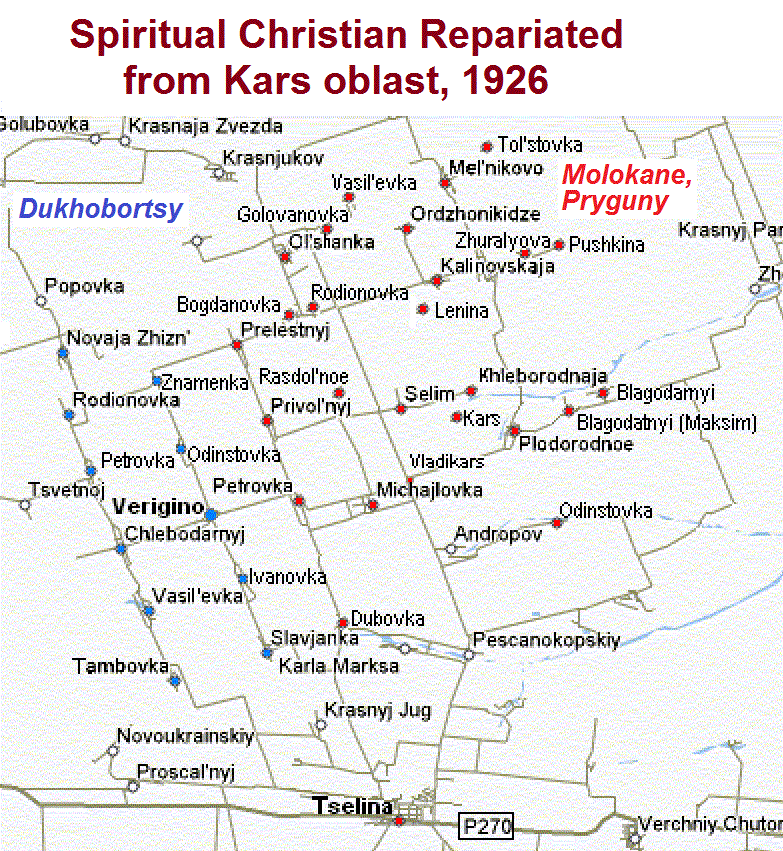
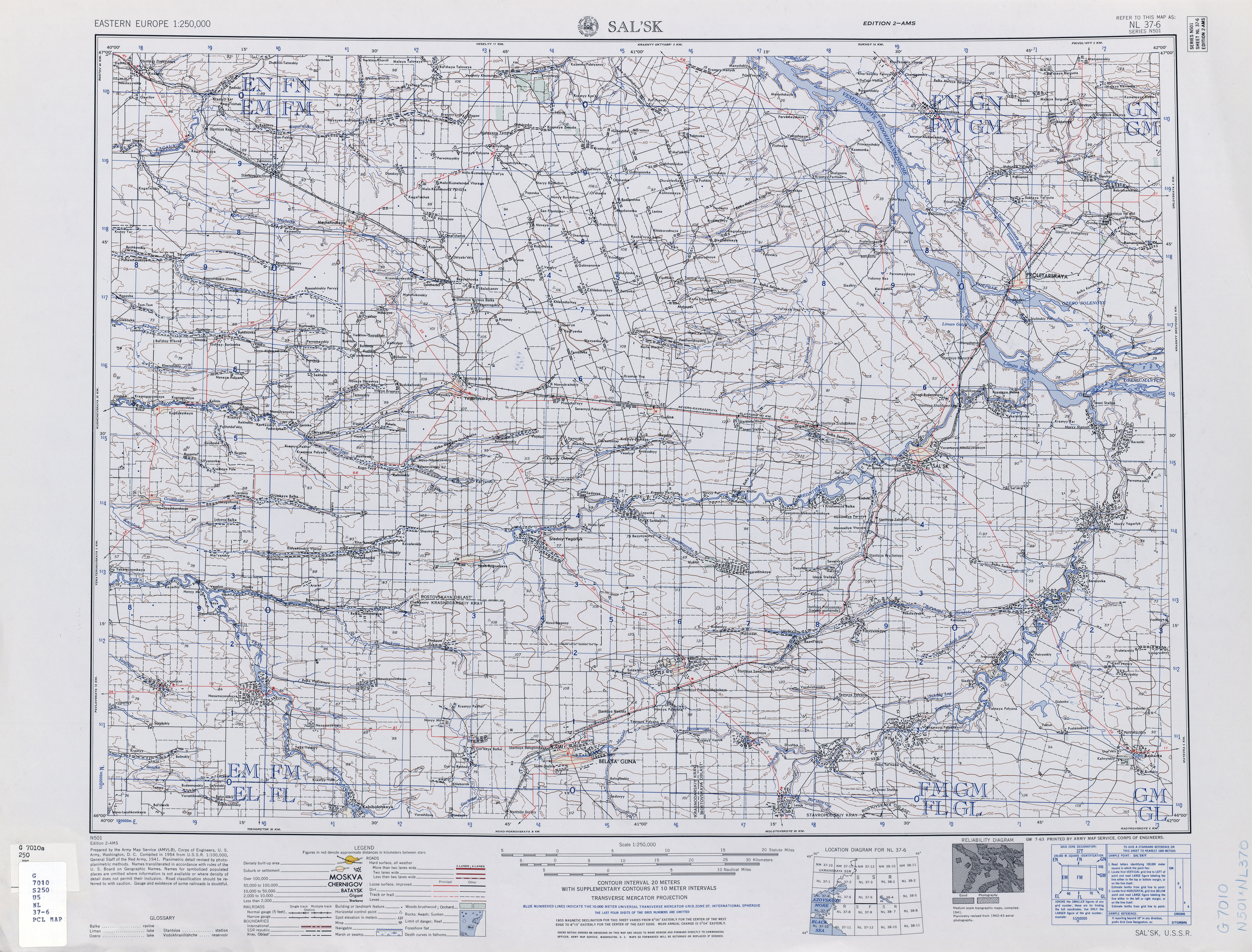
Though many high quality maps of Russia exist online, Zernina reports that she cannot use them because they are not "officially published", per rules for theses in Russia. She apologizes for the inaccurate, approximate Soviet era map on page 163, which was the only map she could use. Here's a list of better maps:

More

Saturday, 5 March 2016

Q69: What are 'Dukhobor' medallions, etc.

From: Alex Kalesnikoff, Calgary Alberta (February 24, 2016)

The other day, I was on the Internet and ... when I typed in 'Dukhobor' in error, I was led to the E-Bay site, where to my surprise items that are being sold as souvenirs, such as 'Dukhobor' medallions, etc.

Did you know about this? I thought you might be interested in knowing.


Answer

You did not misspell. 'Dukhobor' is the correct phonetic transliteration for the Russian word. In Canadian British English spelling, an 'o' was added before 'u' — 'Doukhobor'. (Q78: How Many Spellings of "Doukhobors"?)

Your search on eBay mostly found books, photos, trinkets, etc, for high prices. Many are free online, or available cheaper elsewhere. Buyer beware! Always shop around.

We did not know about the 'dukhobor' medallion (right) in old Slavic culture. The Dukhobor-Slavic-amulet-charm-talisman (right) and similar jewelry that you found are actual Slavic native faith symbols.

The Russian language label 'dukhobor' means 'spirit-wrestler/fighter' which describes the mythical function of this charm — to protect the wearer from bad spirits and illness.

During the Black Death plagues (1331-1770), many believed sweet smelling flowers and herbs would prevent disease cause by bad air. When there was no plague, people continued the habit of carrying herb flowers for protection, often sewing them on. When fresh flowers were not available, someone thought of sewing a flower image, which evolved into various traditions. The stitched flowers evolved into symbols later copied in metal.

By coincidence, the 'spirit-wrestler' label was independently applied to our ancestors by 1786, with no connection to this non-Christian symbol.

Ancient folk nature and sun symbols have been in use around the world, and are now sold as lucky charms, logos, etc. The Christian cross is a variation of the solar cross. Most Doukhobor organizations in Canada use the dove peace symbol.

Koozma knew about similar Slavic pagan symbols from years of research with Russian ethnographer Svetlana Inikova. Superstition in the form of sayings and amulets are things that Doukhobors have generally avoided, yet are sometimes recalled in oral history and found in some family collections in Canada.

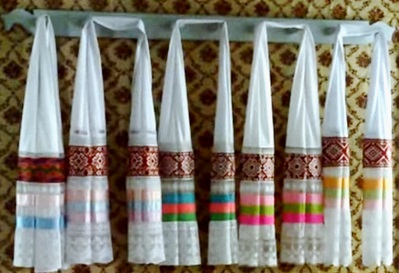
Each Doukhobor towel (rushnik) is embroidered with a
different message from a young wife to her husband.

A few of the old Slavonic symbols remain in Doukhobor folklore today embroidered on
rushniki (Ukrainian: ritual cloth) hanging in the Orphan's Home meeting hall, Gorelovka, Republic of Georgia (above).

Nikolai "Kolya" Sukorukov explains that these embroidered symbols are 
messages from a young wife to her future husband, not Nazi swastikas.
From video interview by Andrei Conovaloff, 5 July 2015.

Two Canadian Doukhobors, during the Doukhobor Heritage Tour 2015, became alarmed when they saw the 'swastika' above. They cried out: Why is a Nazi symbol here?

Correcting their error, Kolya explained (above) that one symbol, cross-stitched by a young wife, is the fern flower (tsvetok paporotnika : цветок папоротника), and on the other side, reversed, it becomes the overcoming grass (odolen trava : одолень трава). Interpretation: she is looking for a masculine, wise husband, whom she can help to be strong, and at the same time be feminine, a goddess (boginya : богиня).

He continued, the men interpret women's wishes by looking at their towels. Other adjacent towels speak of wanting lots of kids, continuing the family tradition, and showing everlasting love on earth — an early form of Doukhobor match-making.

Many of these symbols have multiple confusing names, synonyms and a variety of meanings across cultures and time. An early comprehensive book shows that some of these symbols represent herbal remedies. For example, "odolian trava" was identified as the mythical name for valerian, which a woman sewed into her girdle. (Grimm, Jacob. Teutonic Mythology, Vol. III, 1883, page 1208.)

In India swastikas are a "... holiday tradition ... On Diwali (Christmas with fireworks), we put out swastikas. The swastika has existed for 5,000 years in Asia as a symbol of good fortune. It's a very common religious symbol in Hinduism, Buddhism, and Jainism. Placing the swastikas on the doorstep is a way of extending good wishes to all who come through our home. ... swastikas were all around ... on wedding invitations, on street signs, during pujas. ..." (Shah, Parth. "Diwali Dilemma: My Complicated Relationship With The Swastika," Code-Switch: Race and Identity, Remixed, All Things Considered, National Public Radio (NPR), October 28, 2016.)

Similar towels hanging in non-Doukhobor Spiritual Christian meeting halls have different meanings, ranging from memorials for fasting, deceased, martyrs, Holy Spirit, to colorful decoration with no message.

Do any readers know if the 'dukhobor' symbol was ever used by Doukhobors?


More
  1. Slavic lore and rules of their manufacturing: Dukhobor
  2. Славянские Символы Родов Великих: Духобор (Slavic Symbols of Great Families: Spirit-wrestler)
  3. Таблица свастических Славянских символов : ДУХОБОР (List of Slavic Symbolic Svastikas: Spirit-wrestler)
  4. "Latvian mythology and its interpretation in folk art and songs." — Presentation of 51 slides by Dace Prauliņš, Department of Central & East European Studies, University of Glasgow, United Kingdom. — See slides 12-15 : Pērkons - Thunder : Sign symbolizes light, fire, life, health and prosperity ...
  5. "Fern flower (tsvetok paporotnika)" in Kushnir, Dmitriy. Slavic Light Symbols, Dec 28, 2014.
  6. "Swastika (Fylfot Cross)," Symbol Dictionary — See: "A variation of the Thunder Cross, or Cross of Perkons."
  7. Fire Cross Branches
  8. Pērkona zīme.
  9. Wikipedia: Slavic swastika, talisman, amulet, svarog, cross, sun cross, cross necklace, dreamcatchers, Молвинец, etc.
  10. Grimm, Jacob. Teutonic Mythology, Vol. III, 1883. — An extensive cross-cultural comparison of mythology across Europe.
  11. Swastica (Armenian folklore)

See all Questions and Answers.

Tuesday, 10 September 2013

Q59: Doukhobor College Courses?

What is the history of Doukhobor topics taught at the college level?

This question arose from posting news about the course in-progress by Dr. Veronika Makarova: New Doukhobor Course at the University of Saskatchewan.

I am asking myself the question and answering. If I missed anything, please contact me, or post a comment below.


Answer

Several scholars have done the most college lecturing, and two taught credited courses.

Dr. F. Mark Mealing

In 1972, F. Mark Mealing from Robson, BC, received his doctorate in Anthropology from the University of Pennsylvania, Faculty of Arts and Science in Folklore and Folklife. His 734-page thesis: 'Our People's Way: A Study in Doukhobor Hymnody and Folklife.'

In 1974, Dr. Mealing helped form the short-lived Institute for Doukhobor Studies as a cooperative venture by Selkirk College and the Kootenay Doukhobor Historical Society which built the Doukhobor village Museum in Ooteshenie, in 2007 renamed as the Doukhobor Discovery Centre.

In September 1980, Dr. Mealing taught Anthropology 202, Doukhobor Folklore (Monday, Wednesday, Friday) at Selkirk College. The course was 'a broad introduction to the history, beliefs and views, and traditional crafts and expression of Doukhobor people' (Castlegar News, Sept. 10, 1080: A8). Course credits were transferable to the University of BC, University of Victoria and Simon Fraser University. During the next two years, Mealing taught the same course Wednesday nights at David Thomson University in Nelson, BC.

Doukhobor Studies was taught at Selkirk College every other year from about 1984 to his retirement in 1999.

Eli A Popoff

Historian Eli A. Popoff of Grand Forks, BC, taught Doukhobor courses several times at the USCC community centres and Selkirk College. His lectures were based on his evolving Stories From Doukhobor History, 1992, 159 pages. His series is now being republished in Iskra.

Koozma J. Tarasoff

Since the 1970s, I guest-lectured at the University of Waterloo, U. of Ottawa, U. of Calgary, Asbury College (Ottawa), Moscow State University, and organized sessions for Learned Societies of Canada.
In October 20-22, 1997, I was a Lansdowne Lecturer (2 lectures, 1 seminar) at the University of Victoria, BC. My topics were:
  • Spirit Wrestlers: Early Canadian Pioneers
  • Doukhobors at the Threshold of the Millennium
  • Doukhobors, Citizenship and Multiculturalism
An updated version of the third lecture was published in 1998 in Spirit-Wrestlers' Voices, as Multiculturalism and the rise of a new spirit, (pages 329-345, revised online in 2006).

In 2013, I edited and posted Wisdom of the Ages: Unified Doukhobor Beliefs as an online self-study course. In 2001, the first version was published in serial form in Iskra, and revised for Spirit Wrestlers: Doukhobor Pioneers....(2002).

Dr. Veronika A. Makarova

Born in Russia and educated at the University of St. Petersburg, Dr. Makarova has been at the University of Saskatchewan since 2003. She is Head of the Department of Religion and Culture and Chair of the Linguistics Program, and focused most of her recent work on Doukhobors. She is teaching RLST 398-01, Special Topics: Doukhobor Religion and Culture beginning September 5, 2013, for 11 weeks.

More: Questions and Answers, Comments