Michael Lucas was a charismatic political activist, author, professional graphic designer, accomplished musician, and advocate of peace and socialism.
He immigrated from Slovenia, and worked in Toronto. He served as chair and editor of Northstar Compass, the publication of the ‘International Council for Friendship and Solidarity with Soviet People’, Canada.
Michael was a lifetime advocate of East-West understanding, and chaired the USSR-Canada Friendship Society from 1972 to 1991. The organization had branches in 35 cities across Canada, and I served for several years as president of the Ottawa Branch. Doukhobors participated in other branches in British Columbia and Saskatchewan. Michael and I both agreed that friendship between the Soviets and the West was critical to prevent war, and organized meetings with Soviets in Canada and tourist groups to the Soviet Union in the 1970s and 1980s.
The Cold War in the 1980s was a very scary time. A popular slogan and bumper sticker in Canada and the USA was ‘Better Dead Than Red’. We needed to bring Soviets and Canadians face-to-face to mitigate hate, and approached the Canadian Department of External Affairs (now Global Affairs Canada) and other departments to see if we can use their reception rooms to host Soviet athletes and scientists for public meetings. ‘This was never done’, they said. ‘We can’t set a precedent.’
Where to meet? I volunteered using my home which could accommodate up to 60 people. Beginning in 1984 we began Living Room Discussions on Saturday afternoons, and hosted 17 sessions for about a year. In 1985 Michael and his wife Helen led 34 of us on a friendship tour of the Soviet Union.
Today, during this Second Cold War, we need to revitalize exchanges like Michael advocated since the 1940s. Since 1983 the USA Center for Citizen Initiatives has been organizing similar citizen diplomacy with 1000s of person-to-person bridges between Russia and the USA.
Bravo to Michael for helping to lead the way.
More
 |
| See 68 photos |
He immigrated from Slovenia, and worked in Toronto. He served as chair and editor of Northstar Compass, the publication of the ‘International Council for Friendship and Solidarity with Soviet People’, Canada.
Michael was a lifetime advocate of East-West understanding, and chaired the USSR-Canada Friendship Society from 1972 to 1991. The organization had branches in 35 cities across Canada, and I served for several years as president of the Ottawa Branch. Doukhobors participated in other branches in British Columbia and Saskatchewan. Michael and I both agreed that friendship between the Soviets and the West was critical to prevent war, and organized meetings with Soviets in Canada and tourist groups to the Soviet Union in the 1970s and 1980s.
The Cold War in the 1980s was a very scary time. A popular slogan and bumper sticker in Canada and the USA was ‘Better Dead Than Red’. We needed to bring Soviets and Canadians face-to-face to mitigate hate, and approached the Canadian Department of External Affairs (now Global Affairs Canada) and other departments to see if we can use their reception rooms to host Soviet athletes and scientists for public meetings. ‘This was never done’, they said. ‘We can’t set a precedent.’
 |
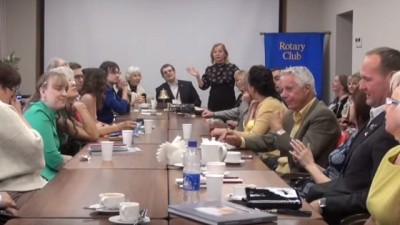
| Living Room Discussion at the Tarasoff house, Ottawa, March 23, 1985, led by Alexei Melnikov (right), a Soviet journalist in Canada who produced a short documentary: 'Russian Doukhobors in Canada'. Photo 837-31A, (c) K.J. Tarasoff. |
Where to meet? I volunteered using my home which could accommodate up to 60 people. Beginning in 1984 we began Living Room Discussions on Saturday afternoons, and hosted 17 sessions for about a year. In 1985 Michael and his wife Helen led 34 of us on a friendship tour of the Soviet Union.
Today, during this Second Cold War, we need to revitalize exchanges like Michael advocated since the 1940s. Since 1983 the USA Center for Citizen Initiatives has been organizing similar citizen diplomacy with 1000s of person-to-person bridges between Russia and the USA.
Bravo to Michael for helping to lead the way.
More
- Michael Lucas (political activist). Wikipedia, May 20, 2020.
- In Celebration of: Michael Lukac, March 7 1926 May 4 2020. Turner & Porter Funeral Directors.
- Greg Butterfield. On the passing of Michael Lucas, immigrant organizer and friend of Soviet people. Fightback News, July 20, 2020.
- Jed Lehman. ‘Remembering Toronto Peace Activist Michael Lucas’. Global Research, May 25, 2020.
- Koozma J. Tarasoff. Opening Doors for Survival During the Cold War. 150 Canadian Stories of Peace (2017): 101-102.
- Communists globally mourn the passing of Comrade Michael Lucas in Toronto, The Communists (UK), May 23, 2020
- Comrade Michael Lucas from Canada passed away peacefully on 4th May morning. (video, 4 minute) Youth Television, Youtube, May 9, 2020. — 2017 video showing Micheal receiving gifts and a $1000 donation from a representative of the Nepal Workers Peasants Party (NWPP).