Showing posts with label Education. Show all posts

Sunday, 11 September 2022

Alex A. Wishlow, 91 (1930-2022), Creston, BC


We gladly send our sincere condolences to the wider Wishlow family in the passing of a memorable personality. Alex was a creative teacher for 37 years, and one of the first Doukhobors to adopt computer technology in his courses. He passionately worked to promote multiculturalism as the way to tolerance and understanding of others.

Alex chaired the Canadian Doukhobor Society (CDS) for many years and persistently reminded its members to be a great example to others. As part of a 65-member 1995 'Voices for Peace Choir' that went international, he actively promoted peace and nonkilling as the way to our future. Alex will be missed. May he rest in peace.

Creston’s Larry Ewashen and Alex Wishlow attend Castlegar unveiling of historic Doukhobor plaquesCreston Valley Advance, October 18, 2012 — Peter V. Verigin was declared a Person of National Historic Significance, and the migration of the Doukhobors from Saskatchewan to British Columbia an event of National Historic Significance.


Read my biography (above) of Alex titled: 'Educator in the Interior of British Columbia' from Koozma J. Tarasoff, Spirit Wrestlers: Doukhobor Pioneers' Strategies for Living (2002): 105-106.

In 2014, Alex addressed a meeting held at the Doukhobor Discovery Centre (photo above)

See his Facebook page with a family photos

Alex's obituary at G.F. Oliver Funeral Chapel is simple: 
Donate to the Doukhobor Discovery Centre in his memory.

Sunday, 6 March 2022

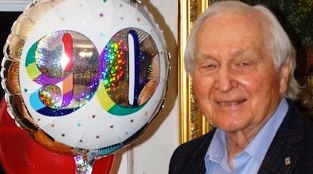
90 Years of Memories

On February 19, 2022, about 60 people and I celebrated my 90th birthday ONLINE!

My wife and our daughters arranged the event which featured prerecorded video messages, phone calls, and some sent an email or letter. Thank you all.

In early February my daughter Tamara and her husband John, and Kristina with her daughter Milena, decided to arrange a virtual party. They invited many people to submit short video messages at a website, or any way the guests would like. About 60 people participated resulting in a 1.5 hour video and more than a dozen emails, cards and letters.

Kristina wanted to create a photo album of my life, and we selected about 50 photos which became a slide show presentation of my '90 Years of Memories'.

See everything here:

  • Videos submitted (1.5 hours) — Link to be added.
  • Slide show of my life — Link to be added.
  • Emails received

During the planning process, I began to reflect on my 90 years and listed these highlights of my life so far, a short version of my biography and 50 Years of Doukhobor Studies.

  1. Born in 1932 in this farm house to parents and grandparents who came from Russian Doukhobor roots. Believed that hospitality, love and nonkilling are the way to a world without wars.

  2. Met Tyrus R. Cobb world famous baseball pioneer. Invited for tryout in 1953 to Pittsburgh Pirates in California. Did not make it, but exercises that I learned from Lloyd Percival of CBC Sports College of the Air persist today 70 years later.

  3. At the University of Saskatchewan in Saskatoon, where I took my BA in Arts and Sciences in the 1950s, I produced 50 monthly journals of The Inquirer at my grandparent's attic next door, which led me to become a journalist, photographer, scholar, and peace activist.

  4. After attending the World Festival of Youth and Students in 1957 in Moscow, this led me to make 12 additional trips to the Soviet Union and Russia as a bridge-building effort between the East and the West (1957, 1964, 1980, 1991, etc, ). The wisdom of getting to know the stranger persists today as one of key steps to help the people and the planet to survive.

  5. In the early 1960s, at UBC in Vancouver, I was privileged to get my MA in Anthropology and Sociology, with my thesis on 'A Study of Russian Organizations in the Greater Vancouver Area' (PDF, 15 GB). The Cold War, I discovered, was the critical element in what brings people together and what splits them apart.

  6. In 1964, as a Russian and English speaking grad of UBC, I was invited to the International Ethnological Congress in Moscow where I met anthropologists Margaret Mead and Sol Tax.

  7. In 1980, as guest Doukhobor peacemaker and photo journalist, I reported on the Summer Olympics in Moscow as a Slavic representative for North and South America. What an awesome responsibility!

  8. Over the past 60 years I have organized a number of scholarly ethnographic studies and exchanges across North America (including a 1990 3-month North American Ethnographic Expedition with Russian scholar Svetlana Inikova), the Soviet Union and Russia on my ancestors the Doukhobors and East-West understanding. Together with my work in the provincial and federal governments as social scientists, this led me to publish over 25 books and 50 articles; the gifting to the Saskatchewan Archives and BC Archives major collections of textual materials and photographs on Doukhobors, rural development, Native Indians, and ethnography; the creation of a Spirit Wrestlers website and blog with Arizona scholar Andrei Conovaloff.

  9. In November 2007, I presented a paper on 'Tolstoy and the Doukhobors' at the First Leadership Forum in Hawaii where the Center for Global Nonkilling formed; and served as reporter and photographer for 13 Ottawa Peace Festivals.

  10. In 1982 co-organized with Community Doukhobors, the First International Intergroup Symposium of Doukhobors, Molokans, Mennonites and Quakers, held in Castlegar, British Columbia, with many prominent people including the great grandson of Lev N. Tolstoy, a major world writer and proponent of nonkilling. The meeting endorsed a letter to the UN on disarmament and getting rid of wars.

  11. With distinguished Doukhobor lawyer Peter G. Makaroff (the first non-Anglo-Saxon grad in Western Canada with a law degree in 1918), and participating Doukhobor, Quaker and Mennonite reps, in 1964 and 1965, I coordinated and helped organize four major peace manifestations in Western Canada urging the government to cease research and production of chemical and biological weapons of mass destruction, and work towards the survival of our human species.

  12. Between 1996 and 1998, served as guest co-Curator with Dr. Robert Klymasz on 'The Doukhobors: Spirit Wrestlers' exhibit at the Canadian Museum of Civilization, commemorating the centenaries of the  Doukhobor destruction of weapons in 1895 in Russia and the January 1899 arrival of the first Doukhobors to Canada.

  13. We all know that it takes a village to raise members of a family. My grandparents and parents along with my newly acquired families and offspring deserve praise for their support. Son Lev is professor at Memorial University in Newfoundland where he is modeling the last Ice Age and is searching the major parameters of climate change. Daughter Tamara, now retired as a museum professional, recently spent the last three years working in Nunavut as Project Manager, Wrecks HMS Erebus and HMS Terror National Historic Site. Their spouses, Dorothee Bienzle is an accomplished researcher and doctor, and John Pinkerton is a retired international manager for Parks Canada. Their children Jaspar and Katya along with Tamara and John's offspring (Nicholas and Elena) are outstanding students, athletes and outdoors people like their parents. I always marvel at being so lucky to be part of their family circle. 

  14. As well, I marvel at the challenge of keeping alive my 30-year marriage with Kristina Kristova, a pioneering journalist who once served for 24 years as anchor person with the Bulgarian National Television. Her daughter Milena is a music teacher in Ottawa, while son Orlin is in Sofia, Bulgaria, as a professional keyboard composer / musician. Kristina introduced me to her most fascinating Bulgarian community who have given me the title of 'Honourary Member' although I have not learned much Bulgarian language.

  15. In the 90 years of my life, this family along with all the people that I have met around the world (in person, in books and in the media), I consider all of you remarkable and many are friends and wisdom people. Bolshoe spasibo! Thank you very much! You have taught me so much. I wish all of you to live at least to 90 with good health, joy, peace and happiness.

  16. Personally, I look forward to many more years of productive life. In my work, I never got rich in money, but rich in ideas, in friendship, and in the vision of my ancestors for a peaceful world without wars.

Friday, 5 November 2021

Business For Sale:
Family Pastimes Co-operative Games

Retiring Doukhobor seeks new owner to continue his family business of crafting cooperative board games about peace, health and ecology

Jim and Ruth Deacove

‘It’s time to retire’, says Jim Deacove. ‘’We haven’t widely advertised that Ruth and I are stepping down after 50 years of the co-operative game business, but word is getting round and a variety of offers are coming our way. The Sales Prospectus summarizes our offer. Some folks just want the portfolio of Intellectual Property.

‘Some want to move the business to another city. Some want to buy everything: the 100 acre farm, our house, the business. In the meantime it is a joy to come to the shop every day, read and answer the mail, fill the orders, make some more games in small batches. Just like the meaningful hobby that was started long ago, a social mission disguised as a business. Maybe 'Small is Beautiful' after all. Could be a perfect fit for a retired couple for a meaningful hobby.’

For details download the Family Pastimes Sale Prospectus. (PDF)

Contact: Familypastimes.com — Phone: 613-267- 4819.
               Family Pastimes, RR 4, Station Main, 796 Brooke Valley Road,
               Perth, Ontario, Canada K7H 3C6


Sale Prospectus summary:
  1. Registered trademark for next 12 years.
  2. No debt.
  3. Equipment — $222,000
  4. Finished goods — $95,000.
  5. Materials — $150,000.
  6. Intellectual property of every game, the artwork for labels, game faces, card parts, available at 10% royalty to Jim Deacove, annually on Gross Revenue.
  7. Books, like Co-operative Parlor Games (30 games, 36 pages)
  8. Rental use of all buildings: main shop, woodwork cottage, storage cottage, two 53-foot trailers for storage.
  9. Customer base from 50 years in business grew to $500,000 before the depression of 2008; since then, averaging $125,000 annually. Except during the Covid-19 period.
  10. Affiliates in the USA, Australia, and Europe.

More
  1. Jim Passing the Family Pastimes Torch: an interview with Jim and Ruth Deacove’, The Humm (Arts, Entertainment & Ideas in the Ottawa Valley), October 19, 2021.
  2. ‘Vaccine’ for a ‘Competitive Virus’, by Jim Deacove. Spirit Wrestlers, April 20, 2021.
  3. Cooperative games? Are you serious? A remarkable Canadian success story.’ By Jim Deacove, as retold to Koozma J. Tarasoff. In 150 Canadian Stories of Peace. An Anthology (2017), compiled by Gordon Breedyk, Mony Dojeiji, Koozma J. Tarasoff and Evelyn Voigt. Pages 265-266.
  4. Why I Wrote My Book on Spirit Wrestlers / Doukhobors?’, October 31, 2014. — Includes an illustrated feature on Jim Deacove.
  5. Film review: Krishnamurti’s Search for Truth.’ Film hosted by Jim Deacove, Cooperative Family Pastimes, Spirit Wrestlers website August 30, 2011.
  6. A Remarkable Evening With Cooperative Pioneers, Jim and Ruth Deacove’, Spirit Wrestlers January 22, 2011.
  7. Co-operative Games and the Inventor Jim Deacove’, August 6, 2008. — A full biography.
  8. Deacove farm (Perth, Ontario) Ploughshares board game.’ Hodge-Podge section of Spirit Wrestlers website July 23, 2006.
  9. Spirit of Co-operation in a Competitive Society’ (PDF), Spirit Wrestlers: Doukhobor Pioneers’ Strategies for Living, by Koozma J. Tarasoff (2002): pages 236-241.
  10. Spirit of Co-operation in a Competitive Society’ (PDF, 5.6 Mb), by Jim Deacove, in Spirit Wrestlers' Voices: Honouring Doukhobors on the Centenary of their migration to Canada, compiled and edited by Koozma J. Tarasoff (1999): pages 183-197.
  11. Jim Deacove, Board Game Designer, Board Game Geek.
  12. A Valley Gamemaker, by Mary Cooke, 2009, Seniors Young At Heart, Ever Learning.
  13. Jim Deacove, Author, Titles, Amazon.com.
  14. 5 Questions with Board Game Designer Jim Deacove, PuzzleNation, July 17, 2014.
  15. Family Pastimes - Jim Deacove, The Games Journal, November 2000.
  16. Does Your Family Play Cooperative Games? Cooperative Games Family Pastimes, by Melissa Taylor.
  17. Meet Jim and Ruth Deacove in Canada, Facebook, February 3, 2012.
  18. Buddy the frog goes to Family Pastimes cooperative games!, video by Juan Uribe, Sep 14, 2009.
  19. Co-operative Games, podcast interview by Sandy Goldman, Each for All, September 11, 2018.
  20. Hope, Peace and Play: An Interview With Jim Deacove of Family Pastimes, Fair Play Games.
  21. Jim Deacove (Family Pastimes Cooperative Games), Friday Special Blend, with Chris White, CKCU FM 93.1 Radio, August 14, 2020.
  22. Local Cooperative Game Company Goes Digital, The Humm, March 2015 (PDF, 22MB), page 8.


Passing the Family Pastimes Torch: an interview with Jim and Ruth Deacove 
by Kris Riendeau, Editor & Publisher, The Humm, October 19, 2021.

When the world seems to be changing incredibly quickly, it’s good to know that some things are made to last. In the case of Family Pastimes, those things come in colourful boxes and contain imaginative and cooperative games! Owners Jim and Ruth Deacove have been running this delightful business in Brooke Valley for 50 years and are now well into their eighties. I have fond memories of playing such games as “Sleeping Grump” and “Max the Cat” with my own kids (who are now aged 27 and 30), so when I heard that the Deacoves were getting ready to sell this established business, I contacted them for more details. 

theHumm: Congratulations on 50 years in business! What first inspired you to create cooperative games, and how did you turn that passion into a business? 

When our girls first started playing games, they were always squabbling and first we questioned our parenting methods until we realized that the structure of the games caused the conflicts. After all, the point of the game was to beat each other. We looked around Ottawa game stores and couldn’t find any games that nurtured the family values we promoted, share toys, help one another, be kind to pets, find peaceful ways to settle problems, aso. Nada. So, necessity being the mother of invention, we started inventing them. Played our creations at birthday parties. Folks asked where they could buy them. Ergo, a cottage industry was born. 

Although the world has changed rather significantly over the past half-century, Family Pastimes has stayed true to the cooperative game model. What have been some of the biggest changes in your games and the way you market and sell them? 

With new equipment, we made our handcrafted versions look more professional. The basic rule of thumb for my designs has always remained, Play Together. That is, I don’t have people against people. What has evolved is that early on, I marketed the games as Everyone Wins or Everyone Loses. My thinking has evolved away from this rather competitive Win/Lose paradigm to How well did we all do? Now we measure the degree of success and there is no losing involved. Didn’t get all of our carrots harvested before winter arrived? How many did we get in? We started out selling at craft sales, then to retail stores, and now we sell on our website www.familypastimes.com 

Why do you think it’s still important to offer kids (of all ages) cooperative, hands-on games to play?

What skills are fostered by playing Family Pastimes games that perhaps aren’t addressed by electronic toys and video games? The list is long from conducive to better health and liking one another; teamwork, shared decision making, openness, trust and safety, self worth and personal power, less aggressive behaviour, emotional maturity…all the myths about competition are dispelled. Cultural conditioning trains us to confuse success with trying to beat others. All games require overcoming some obstacle, but nowhere is it written that the obstacle must be other people. 

I understand that you are hoping to sell the business to someone new who can run it for the next 50 years. What kind of abilities and expertise would make someone a good match for this business?

Having a kind heart is essential. Family Pastimes is very much a social mission disguised as a business. As the business grew internationally, took on a fair-sized work force, the help of local business experts were necessary. Currently, Covid has made us small again and, to be honest, while we have been big and whoever takes on Family Pastimes again may choose to go big, they may realize what we are feeling now and that is that small is beautiful. 

Ruth and I are keeping the business almost at the level it was when we began 50 years ago, as a meaningful hobby. Digital printing, cutting and assembling parts, gluing game boards and boxes and so on are easily learned. It is a little more complicated preparing invoices and labeling cartons, because this is done by internet these days, but that also is easily learned. There are two, if not more, ways the hand-over could take place. A young couple with the technical skills in place could take over. But, also I picture a recently retired couple who are looking for a meaningful hobby would also be a perfect fit. In any case, interested folks can contact me at info@familypastimes.com and I will send them a detailed Sales Prospectus.

————
Update:   As of July 2026, this business has not been sold. 
————
Comments: Beginning in 2024, you can only self-enter a Comment below with a 'Google Account' (Gmail.com). This prevents irrelevant anonymous comments (spam and admail).  If you do not have a Google Account, email your Comment to KJTarasoff@gmail.com for posting.

Monday, 25 October 2021

Jim D. Kolesnikoff (1936–2021)

Jim D. Kolesnikoff, a stalwart of the Doukhobor Movement, died in Hamilton, Ontario on June 29, 2021, remarkably on the exact date of the Doukhobor Arms Burning in Russia 126 years ago. 

Three important historical occasions brought Jim and myself together.

  1. 1957 — December. At the all-Doukhobor youth conference: ‘Building bridges of understanding’. Jim was one of the hosts. The Saskatoon Doukhobor Students’ Group initiated meetings with Community Doukhobor students in British Columbia to jointly discuss ‘Where do we go from here?’ Jim is seated on the right end in this group photo. (See: ‘Young Adult Tour of Western Canada’, The Inquirer, December 1957, pages 8-12.)

  2. 1982 — June 25-28. During the International Intergroup Symposium that brought together over 1,000 Doukhobors, Mennonites, Quakers, and American Spiritual Christians from Russia, to Castlegar, BC. Jim served as Secretary of the Convening Committee of four (Jim Kolesnikoff, John J. Verigin Sr., Jim E. Popoff, and me Koozma J. Tarasoff as Coordinator) and signed a letter to the United Nations.

  3. 1999 — October 22-24. At the Doukhobor Centenary in Canada conference held at Ottawa University, Jim presented: ‘Understanding violent behaviour: the “Sons of Freedom” case’, published in Doukhobor Centenary in Canada (edited by Andrew Donskov, John Woodsworth and Chad Gaffield), 2000, pages 114-128.

These events brought Canadian Doukhobors together to focus on examining our identity in the new world today.

  • ‘Who are we?’
  • ‘What contribution can we make to world society?’ 

That’s how I knew Jim.

Jim was born in Watson, Saskatchewan. His family moved to British Columbia where he graduated from high school in 1954. For several years he worked for the Sunshine Valley Co-op and the Grand Forks Credit Union and was an active member of the USCC Union of Youth in a program of singing, the Russian language evening school program and Iskra.  

In the 1960s, Jim attended Moscow State University where he received his MA in Russian language and literature, returned to Canada, and in 1978 obtained his PhD in Slavic Linguistics at Simon Fraser University in Vancouver.

A big event in Jim’s life was meeting Nina, a Polish student on scholarship in Moscow. They married in 1968 and moved to Canada the same year. They lived in Edmonton, Alberta where Nina completed her PhD studies in the Department of Comparative Literature. The couple moved to Hamiliton, Ontario where Nina became a professor of Slavic Studies at McMaster University. Jim commuted to Toronto where he worked with a company (dissolved in 2002) importing precious and semi-precious metals, and jewelry from Russia to Canada.

In 2002 I published a short biography of Jim and his wife: ‘Slavic Scholars Broaden International Boundaries’, Spirit Wrestlers: Doukhobor Pioneers’ Strategies for Living (2002), pages 232-233. (PDF, 1.3 Mb)

Jim was interviewed by Gregory James Cran for his doctoral thesis: 'A Narrative Inquiry into the Discourse of Conflict among the Doukhobors and Between the Doukhobors and Government', University of Victoria, 2003, pages 105, 128, and 200. (PDF, 5 Mb). The thesis was modified into a book published in 2011 titled: Negotiating Buck Naked: Doukhobors, Public Policy, and Conflict Resolution, where Jim is quoted on page 81. (See my book review.)

Published Obituaries for James (Jim) Kolesnikoff

  • Iskra, No. 2166, September 2021, pages 35-38. Bilingual Russian and English.
  • Grand Forks Gazette, (photo) June 12, 2021. Photo 
  • Today in BC, Black Press Media (Surrey, B.C.) June 12, 2021

Wednesday, 6 November 2019

A Quaker Summary of Fighting

Book review.
  • Are you worried about increasing hate crimes?
  • Does it feel like our world is becoming more divided?
  • Do you care about peace?
In 2017 the Peace Program Coordinator and Communications Coordinator for the Canadian Friends Service Committee (Quakers) proposed to answer these questions scientifically by conducting a peace literature review and bibliography. He originally planned to compile a 50-page report to summarize:
  • What does science reveal about achieving interpersonal peace, avoiding conflict and hatred?
  • Do we really need to fight?
The short project continued for 2 years, and grew to 327 pages. To include as much as possible into the book, the font size was reduced, yet much had to be omitted. Perhaps a second volume will be published to compile the rest of their research.


Matthew Legge. Are We Done Fighting? Building Understanding in a World of Hate and Division (New Society Publishers, Gabriola Island, BC, 2019): 327 pp. Copyright by Canadian Friends Service Committee (CFSC, Facebook).

I read the book with much interest and then attended a book launch by the author on October 23th, 2019 at the Friends’ Meeting House, Ottawa, Ontario. Some 30 people attended. A question-answer period followed.

The event was audio recorded by Ken ‘Kensky’ Billings, and posted for you on pCloud, linked from his Digileak Canada website:
Matthew Legge (pronounced: ‘Le-ZHAY’) has been on a book tour across Canada, speaking on radio, at universities, bookstores, and Friends Meeting Houses; and teaching a few workshops. See schedule at bottom of AreWeDoneFighting.com. This is his first presentation fully recorded and posted online.


My Review

This book is a 2-year cooperative effort of many people: the author Matthew Legge — an anthropology graduate from the University of Toronto — and his staff at the Quaker Centre in Toronto.

Matthew emailed to me:
‘The book has about 750 end notes that made it into the final copy. I can't say how many hundreds of books and studies I read, many hundreds did not make it into the book. I didn't do 100% of the research myself. 2 other staff and volunteers did parts and sent me things.’
The book is mostly a literature review of many sources related to avoiding violence — 'Evidence and techniques you can use right now'. The research team examined publications in psychology, anthropology and sociology of peace, mostly focusing on cultural ‘interpersonal peace issues’, not inter-government politics.

The author presents many tips for avoiding personal conflict and misunderstandings in daily living, but little about preventing WW3. The intent was to examine what is known about ‘hate and division’ in society. A very challenging aspect of war prevention!

In 24 short chapters, each ending with helpful tips, the author attempts to reach people with different educational, political, religious and cultural backgrounds. The result is a comprehensive text with many insights into the fundamental issues of hate and division, without a guarantee of what will work or not work. Although very useful as an academic study, in my opinion it fails to be a practical guide to action.


Positives

Gems I found especially useful and noteworthy:
  1. Equality is a useful ingredient in respecting people and countries. Trying to be overly superior to others will not lead us to a peaceful world. We need to acknowledge that we are all part of one world community and need to work together to survive.
  2. The understanding of ‘power over’ and ‘power-from-within’ are useful concepts in avoiding exploitation and violence (pages 23-24). Working together for a ‘win-win’ outcome would also help. 
  3. ‘....The peace virus can demand patience and perseverance, and the way we live it out makes a difference to the results we get’ (page 49). Peace virus is transmitted to children through modelling (page 126). Parents and teachers, please take note and be a model for living.
  4. The ‘creative power of silence’ can be used to begin a meeting (page 44), as is done effectively in many Quaker meetings. This is mindfulness at work.
  5. Among the communication skills, try communication instead of changing someone’s beliefs by shooting down our opponent (page. 56). Recognize, acknowledge, and even respect other views. Work together on common ground issues such as climate change, disarmament, etc.
  6. Emotions are contagious — treat them with care (p. 84). We can all be manipulated towards goodness or violence. Psychologists tell us that our interdependence and malleability shapes what we think and do. Beware of psychological warfare (page 79).
  7. Effective communication involves shared values of rapport building, careful listening and observing, and seeking truths (page 94). Take note of body language. Use humour when appropriate, but avoid humiliation (page 90).
  8. War ‘is not natural’ (page 124), but is a learned behaviour. It follows that we can learn to create a peaceful world.
  9. There is a problem today with mainstream media where the bias is towards sensationalism, such as the bomb. How about seeking good news stories?
  10. Establishing Ministries of Peace around the world is ‘an intriguing idea for improving the capacity and will to engage in prevention’ (page 228).

Negatives

The 327 pages of fine print, of which 52 pages are end-notes and index with even finer print makes it very difficult to read.

Though over 1,000 books and articles are listed, many important items for peacemaking familiar to me were not listed. It appears that the author and his team did not look at my website and blog which are full of valuable aides for peacemaking. I suggest adding these 7 missing items/topics.
  1. The Center for Citizen Initiatives in California has escorted groups of “citizen diplomats” (mostly Americans) to Russia since 1984 to engage in personal dialog. President Sharon Tennison has visited Russia for 35 years and rejects the war propaganda. “Misunderstandings, fallacious accusations, flare ups and demonizing ... we see the need and possibility for changing this situation. When real people in large numbers get involved, amazing things begin to happen. Join us!” Next trip: June 2020.
  2. In June 1895 my ancestors burnt their guns as a public resolve to get rid of wars. The war / peace issue is very much part of the Doukhobor movement, and I continue to be part of that movement to create a world without wars. Since the 1950s, I have been working steadily on a study of Spirit Wrestlers / Doukhobors with connections to the wider peace movement. A dozen books have been published and countless articles are in print and many more are steadily being produced in my Spirit-Wrestlers website and blog.
  3. 'A Study of Russian Organizations in the Greater Vancouver Area', 1963, my MA thesis in anthropology and sociology. During the first Cold War, I attended the University of British Columbia and studied the issues of what brings people together and what splits them apart. I found that both hot and cold wars split societies apart and cause undue suffering to humanity. If   we are to achieve a sustainable nonkilling society, this means we urgently need to get rid of the ‘scourge of war’ and make war a crime against humanity!
  4. ‘Opening Doors For Survival: A Handbook on Soviet-West Initiatives’, 1986. I produced this unpublished practical manuscript which was expanded and published in very limited numbers in 1991 by Peace Train Foundation in Ottawa, Canada as Discovering Soviet-West Cooperation. A Handbook on Soviet-West Bridge-Building Initiatives. The insights into peace-making are as valid today as they were in the 1980s.
  5. 'Doukhobor — Quaker Connections : Talk with Young Friends in Ottawa', December 6, 2009 Presentation Outline, Comments (updated 2019). Includes useful suggestions of what young Friends can do to make a contribution to society. The article also includes the story of effective peace manifestations  in Western Canada in the 1960s involving Doukhobors, Quakers, Mennonites, Fellowship of Reconciliation, and other groups. 
  6. Dr. Glenn D. Paige’s book Nonkilling Global Political Science, (2002), advanced the thesis that it is possible for humans to stop killing each other. The thesis supports the conclusion of the World Report on Violence and Health (Geneva, 2002) that human violence is a ‘preventable disease’. In November 2007, Dr. Page organized the First Global Nonkilling Leadership Forum, Hawaii, at which I presented my paper: ‘Tolstoy and the Doukhobors’. Wisdom people from around the world united to create a Nonkilling Society. The forum launched the Centre for Global Nonkilling ‘to promote change for a killing-free society’. While killing is deeply entrenched in world culture, it is not universal. Nonkilling is a new paradigm for a brave new world. The wider peace community should take note.
  7. 150 Canadian Stories for Peace — An Anthology, 2017. One of my contributions here was 'Opening Doors for Survival during the Cold War' (pages 101-102). In 1984-1985 I held 17 living room discussions on East-West bridge-building. My article concludes: ’With fake news in today’s Cold War world, are we not repeating again the dangerous lies about our northern Russian neighbours and others? When will we ever learn?’

Contact the author Matthew Legge at Canadian Friends Service Committee (CFSC, Quakers), 60 Lowther Avenue, Toronto, Ontario M5R 1C7, Canada. Phone: 416-920-5213 Web: quakerservice.ca. Facebook/Twitter/Instagram: @CFSCQuakers. Get a free chapter of CFSC's book at: AreWeDoneFighting.com


More reviews

Enter your comment below.
For help, see 'Blog comment instructions'.
If you use the Safari browser on a MacIntosh computer, sorry, you cannot enter a comment.

Saturday, 13 October 2018

World Beyond War Conference 2018

Toronto, Ontario September 21 - 22, 2018.


Brief report from Greta Zarro, Organizing Director of World Beyond War:
  • #NoWar2018 was a huge success.
  • More than 200 attended.
  • See the conference on our video channel — youtube.com/worldbeyondwar
  • The theme of replacing war with the rule of law was well explored by activists and experts who formed new alliances, strategic plans for future work on education, closing bases, and divestment, and developed possible ideas for creative actions.
  • Our small budget and 3 half-time staff impressed several who thought we were a large well funded organization. Please donate.
  • Patricia Kambitsch of Playthink did some amazing illustrations to capture the vibe of the conference plenaries. See her work and more in our Facebook photo album.
  • Website updates will be posted as time permits.

Koozma J. Tarasoff’s Comments

On June 24 2018, I posted: Suggestions for 'World Beyond War' Conference in Toronto Sept. 21 - 22, 2018.

After watching the conference video Highlights of #NoWar2018, here are some of my quick impressions, questions and answers:
  • How can we persuade the world powers to get rid of nuclear weapons? Today the stockpile of nuclear weapons is 14,575. They are a serious threat to our civilization. Making money from killing is evil!
  • Canadian military heads are not too interested in peace because they look to the USA as a favourite country with their many dangerous toys of war. (William Geimer).
  • Canada’s Foreign Affairs Dept. claims it needs ‘hard power’ instead of peacekeeping resulting in increasing the military budget to $22 billion, the highest ever. Only 173 Canadian soldiers are in peacekeeping today. And we have Canadian soldiers in Latvia, Lithuania and Poland provoking Russia. (Tamara Lorincz).
  • Many or most soldiers returning home from the field suffer Post Traumatic Stress Disorder. War is evil. Let’s stop it and begin the process of living as civilized homo sapiens.
  • We are facing nuclear war, dying oceans, decaying cities, water shortage, growth inequality, etc., all adding to a breakdown of civil society. We need peace urgently so that we can work together to deal with the looming ecological global crisis. (Kent Shifferd).
  • We need to find alternatives to war with compulsory international mechanisms for nonviolent dispute resolution. (James Ranney).
  • Departments and other infrastructures for peace to promote legal frameworks for conflict resolution by peaceful means at home and abroad. (Saul Arbess).
  • Misinformation technologies are challenging the role of diplomacy in society. We need to persuade FaceBook to be accountable for its actions. (Branka Marijan).
  • The United Nations charter states that war is illegal, ‘with exceptions’. But the 1928 Kellogg-Briand Pact had no exceptions; it was an international agreement in which signator states promised not to use war ‘to resolve disputes or conflicts of whatever nature or of whatever origin they might be, which may arise among them’. (David Swanson).
  • Humans have the ability to choose not to go to war. We can, for example, create Departments of Peace in our governments. Where there is a will, there is a way. (Karen Johnson).
  • Americans have over 1.3 million military personnel in about 5,000 bases around the world requiring a $610 billion budget to service them. Yet only 5% of this budget ($30 billion) could solve starvation in our world. Where is our wisdom?
  • Peace education should apply to all levels in our education system, beginning with Grade one. Peace is everybody's business. (Rose).
  • There is a nationalist myth that Canada is a peaceful country that does not believe in wars. Advancing empire support and businesses abroad contradict this myth. (Yves Engler).
  • Colonial domination of indigenous peoples was an act of genocide and war. (Azeezah Kanji).
  • Mass movements win, while fringe movements don’t. We need to mobilize minorities for national consensus by resisting wars and building peace. (Kevin Zeese).

Saturday, 24 June 2017

Books and Videos about Russia

While writing my Book Review: Romanov, Introduction to Canadian Studies, I wished that such a book existed about Russia that was as interesting and fair as Dr. Romanov had written about Canada. So we began searching for such a book. In the meantime the Oliver Stone documentary about Putin appeared.

My recommendations for books and videos about Russia

Russia: A Reading Guide', Center on Global Interests (CGI), August 30, 2016
— 12 experts share the 50 books that shaped their understanding of Russia. Only one book is mentioned by two people.

Richardson, Paul E. & Mikhail Mondasov. The Spine of Russia, July 2016, 200 pages.
— In the Fall of 2015, a Russian and American journalist travelled 6,000 kilometers from Russia’s northwestern corner in the Arctic to Sochi, in the tropical climes of the Black Sea. The group tells the stories of Russians whose life and work is taking the country forward, and what they feel patriotic about, what is important to them.

Stone, Oliver. (book) The Putin Interviews: Oliver Stone Interviews Vladimir Putin, Skyhorse Publishing Inc, June 16, 2017, 288 pages. — Transcripts of all 20 hours from video.

Stone, Oliver. (video) ‘The Putin Interviews’, (4 hours total video) Showtime cable TV, June 12-15, 2017.

More books about Russia

To be fair to my list of books above, I include lists below recommended by journalists. I feel that many (not all) of these books are biased, because they seem to be limited in scope, often stuck in a paradigm of one ‘super policeman state’ rather than respecting wider regional players.

Basulto, Dominic. 'The 7 Best Books of Summer 2016 for the Avid Russia Watcher', Medium, June 16, 2016. — Former columnist for The Washington Post’s “Innovations”

Begley, Sarah. '9 Books That Can Help You Understand Russia Right Now', Time magazine, February 15, 2017.

Elkin, Dimitri. 'Top 10 books on Russia in 2016', Russia Direct, December 30, 2016. — The best books of 2016 include those that take a closer look at U.S.-Russia relations during the Cold War and perestroika, enabling readers to better understand the current Putin era.

Honig, Michael. 'Top 10 books on Vladimir Putin's Russia', The Guardian, April 20, 2016.

Lebedev, Sergei. '10 Books That Explain Russia Today', Publishers Weekly, February 19, 2016 — Lebedev, who was born in Moscow in 1981, picks 10 books that explain Russia's complicated past and present.

Weafer, Chris. 'Six ‘must-read’ books on Russia from last 25 years', Johnson's Russia List, September 10, 2015.

'The Top 10 Summer Books for Russia Watchers', The Moscow Times, July 2, 2015.

Readers:  Enter your recommendations in Comments, below.

Friday, 20 March 2015

500 Protest Bill C-51 in Ottawa

Over 500 people protested against Bill C-51 on Parliament Hill in Ottawa on Saturday afternoon, March 14, 2015.(1)

In freezing drizzle, hundreds gathered at noon in front of Prime Minister Stephen Harper’s offices, chanted and staged speakers, then walked to the "Peace Tower" on Parliament Hill where they peacefully, but loudly proclaimed their defence of freedom, to reject fear and stop Harper’s Secret Police Bill.

Events included 10 speeches, chants, "Bill C-51 Song" by the Ottawa Raging Grannies,(9) and '"Three Traitors": a play for today' performed by The Quaker Theatre Team.(10,11,12) The rally ended at 2 pm.

This Ottawa Day of Action Against Bill C-51, organized by #StopC51, was one of 73 held across Canada.

Many who took photos and videos posted them online. Local news covered the event. See me with camera behind the lady in yellow holding the sign in The Ottawa Citizen; and see my 101 photo album and a shorter slide show in Google+ Story.(7) Also see 94 photos by Mike Gifford.(8) Dr. Qais Ghanem made a 50-minute video of the speakers and singers(9) and a 5-minute video of the Quaker Theatre Team.(11); but Jane Keeler posted her 5-minute video of the Quaker Theatre play(12) and a 2-minute video of the singing Ottawa Raging Grannies the same day.(10)

The proposed legislation is in the form of an Omnibus Bill which the Conservative government is rushing to push through without any amendments, so as to bolster its own support of this year’s federal election.

If passed, the Bill would give full access (without our knowledge or consent) to 17 federal departments and agencies about personal data of its citizens, publicly designed to identify and suppress security threats. These agencies include the RCMP and Canada’s two spy agencies, the Canadian Security Intelligence Service (CSIS) and Communications Security Establishment (CSE). But also it includes the Canada Revenue Agency, the departments of Citizenship and Immigration, Health and Transport.

Privacy Commissioner of Canada Daniel Therrien has broader concerns about information sharing in the proposed legislation.

… Another bill, C-44, which is aimed at empowering CSIS, raises “fundamental questions for privacy,” he said, as well as U.S. whistle-blower Edward Snowden’s recent revelations about massive electronic surveillance operations.

“Is that the kind of society we want to live in, where ordinary Canadians, law-abiding individuals, are the subject of intrusive monitoring and profiling by national security agencies?” he asked. (2)

This dangerous piece of legislation opens the door to undermining the rule of law, human rights and democracy itself. It would be the first step in CSIS being turned into full secret police. The Bill threatens to stifle discussion on such issues as:
  • Questioning the right of government to go to war. (Recall the Preamble to the UN Charter: 'to save succeeding generations from the scourge of war….').
  • The right of government to expand its military efforts in the Middle East.
  • The right of government to meddle in the Ukraine.
  • Questioning army training for high school credits in Canada. (Army training for high school credit has first students, CBC News, Feb. 2, 2015.).
  • Challenging the gun lobby. (Remember that kids brought up without fear of guns and vigilantism leads to healthy citizens.).
  • Using the label of ‘terrorism’ as an excuse to arrest citizens without due process of law. This relates to the surveillance of environmentalists, indigenous peoples, and peace activists.
  • Those grassroots activists who oppose the Alberta tar sands, the TransCanada pipeline and tanker projects as well as the Trans-Pacific Partnership and Trade Promotion Authority.
  • Creating a Department of Peace in Canada.
Using the club of fear, the government claims that the state needs extra powers to counter radicalization and ISIS. However, the existing laws, many professionalists believe, are sufficient to deal with this threat in Canada. The real solution lies in prevention. In our foreign policy, we need to work for peace. We need to prevent soldiers from going abroad, being killed, injured and being affected by Post Traumatic Stress Disorder.

In other words, the Prime Minister and the state ought to stop militarizing Canada and bring its troops home. Using those billions of dollars saved, Canadians can then deal with climate change and clean environment, income inequality, full free universal public health care and education, culture and sports programs accessible to all, good governance, and serious attention to upgrading public infrastructure across the country.

More
  1. Campanella, Emanuela. 'Hundreds gather in front of PM's offices to protest anti-terror bill. The Ottawa Citizen, March 15, 2015.
  2. Berthiaume, Lee. 'All Canadians would be trapped in anti-terror legislation's 'web', warns privacy commissioner.' The Ottawa Citizen, March 6, 2015.
  3. Nick Rose. ‘Some Kind of Monster: A Brief History of Harper’s Big Fat Omnibus Bills.’ Vice Media, March 12, 2015.
  4. Alyssa Stryker and Carmen Cheung. ‘Six Things Protesters Need to Know about Bill C-51.’ The Tyee, March 14, 2015.
  5. Russwurm, Laurel L. 'Canada is about to lose Free Speech and Civil Rights. interweb freedom, March 12, 2015.
  6. Michael Geist. 'Why Anti-Terrorism Bill is Really an Anti-Privacy Bill: Bill C-51's Evisceration of Privacy Protection.' Michael Geist's Blog, March 12, 2015.
  7. 101 images online by Koozma J. Tarasoff; and a shorter slide show in Google+ Story.
  8. Stop C-51 - Ottawa, 94 photos by Mike Gifford, flickr.
  9. 1000 Ottawa Canadians Against Harper's Draconian Bill C51, 50-minute documentary video by Dr. Qais Ghanem, Dialog with Diversity, March 16, 2015. Shows speakers Paul Champ, Yavar Hameed, Clayton Thomas-Muller, Monia Mazigh, Larry Rousseau, Jessica Squires, and Ottawa Raging Grannies singing their "Bill C-51 Song" at minute 28:55.
  10. "The C-51 Picnic" by the Raging Grannies of Ottawa, 2-minute video by Jane Keeler, March 14, 2015. Lyrics for "Bill C-51 Song" by the Ottawa Raging Grannies.
  11. Quaker Theatre Group Against Bill C51. 5 min. video by Dr. Qais Ghanem, Dialog with Diversity, March 20, 2015. Script below.
  12. Three Traitors— a play by Carl Stieren, performed by the Quaker Theatre Team. 5-min video by Jane Keeler, March 14, 2015. Script below.
  13. Script: 'Three Traitors' by Carl Stieren, Carl-Ink.com, performed by the Quaker Theatre Team in Ottawa, March 14, 2015. Vidoes above. Thanks to Carl for submitting the script and links to videos.
  14. Anti-terrorism bill C-51 'dangerous' legislation, 100 academics say, CBC News, Feb 27, 2015.

Thursday, 16 October 2014

Disarmament Education Online

Educating ourselves and our youth about the huge advantages of peace compared to war is of utmost importance.

I am impressed with and recommend new resources and guides provided online by the United Nations Office for Disarmament Affairs, particularly the aids for Disarmament Education: Resources for Learning.

A short video on UN Web TV shows 3 boys performing a rap song (4.5 minutes) they wrote which was inspired by their disarmament lessons. The boys' creativity is appreciated when contrasted to youth playing war video games.

One item that caught my attention is the new book: Action for Disarmament: 10 Things You Can Do, by United Nations Department of Public Information, 2014. The book shows many ways people can engage in learning, and creatively use the materials provided online.

  1. Stay informed
  2. Start a club
  3. Create an event
  4. Sign up
  5. Facilitate a discussion
  6. Express yourself
  7. Host a film showing
  8. Voice your concern
  9. Plan a presentation
  10. Reach out

The book summarizes the history and modern uses of weapons: guns, bombs, nuclear and biological weapons. For example, at the height of the Cold War there were 60,000 nuclear warheads, today they are 17,000.


On page 17 is a picture titled: 'Weapons being burnt during the official launch of the "Disarmament, Demobilization, Rehabilitation and Reintegration" process in Burundi." Burundi is a land-locked republic in Southeast Africa.

This photo reminds me of my ancestors, the Spirit Wrestlers / Doukhobors, who on midnight of June 28-29, 1895 burnt their guns in Tsarist Russia in regions of the Southern Caucasus. 7000 participated in this first international recognized mass protest against militarism and wars.