Showing posts with label archives. Show all posts

Sunday, 6 March 2022

90 Years of Memories

On February 19, 2022, about 60 people and I celebrated my 90th birthday ONLINE!
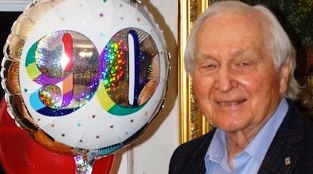
My wife and our daughters arranged the event which featured prerecorded video messages, phone calls, and some sent an email or letter. Thank you all.

In early February my daughter Tamara and her husband John, and Kristina with her daughter Milena, decided to arrange a virtual party. They invited many people to submit short video messages at a website, or any way the guests would like. About 60 people participated resulting in a 1.5 hour video and more than a dozen emails, cards and letters.

Kristina wanted to create a photo album of my life, and we selected about 50 photos which became a slide show presentation of my '90 Years of Memories'.

See everything here:

  • Videos submitted (1.5 hours) — Link to be added.
  • Slide show of my life — Link to be added.
  • Emails received

During the planning process, I began to reflect on my 90 years and listed these highlights of my life so far, a short version of my biography and 50 Years of Doukhobor Studies.

  1. Born in 1932 in this farm house to parents and grandparents who came from Russian Doukhobor roots. Believed that hospitality, love and nonkilling are the way to a world without wars.

  2. Met Tyrus R. Cobb world famous baseball pioneer. Invited for tryout in 1953 to Pittsburgh Pirates in California. Did not make it, but exercises that I learned from Lloyd Percival of CBC Sports College of the Air persist today 70 years later.

  3. At the University of Saskatchewan in Saskatoon, where I took my BA in Arts and Sciences in the 1950s, I produced 50 monthly journals of The Inquirer at my grandparent's attic next door, which led me to become a journalist, photographer, scholar, and peace activist.

  4. After attending the World Festival of Youth and Students in 1957 in Moscow, this led me to make 12 additional trips to the Soviet Union and Russia as a bridge-building effort between the East and the West (1957, 1964, 1980, 1991, etc, ). The wisdom of getting to know the stranger persists today as one of key steps to help the people and the planet to survive.

  5. In the early 1960s, at UBC in Vancouver, I was privileged to get my MA in Anthropology and Sociology, with my thesis on 'A Study of Russian Organizations in the Greater Vancouver Area' (PDF, 15 GB). The Cold War, I discovered, was the critical element in what brings people together and what splits them apart.

  6. In 1964, as a Russian and English speaking grad of UBC, I was invited to the International Ethnological Congress in Moscow where I met anthropologists Margaret Mead and Sol Tax.

  7. In 1980, as guest Doukhobor peacemaker and photo journalist, I reported on the Summer Olympics in Moscow as a Slavic representative for North and South America. What an awesome responsibility!

  8. Over the past 60 years I have organized a number of scholarly ethnographic studies and exchanges across North America (including a 1990 3-month North American Ethnographic Expedition with Russian scholar Svetlana Inikova), the Soviet Union and Russia on my ancestors the Doukhobors and East-West understanding. Together with my work in the provincial and federal governments as social scientists, this led me to publish over 25 books and 50 articles; the gifting to the Saskatchewan Archives and BC Archives major collections of textual materials and photographs on Doukhobors, rural development, Native Indians, and ethnography; the creation of a Spirit Wrestlers website and blog with Arizona scholar Andrei Conovaloff.

  9. In November 2007, I presented a paper on 'Tolstoy and the Doukhobors' at the First Leadership Forum in Hawaii where the Center for Global Nonkilling formed; and served as reporter and photographer for 13 Ottawa Peace Festivals.

  10. In 1982 co-organized with Community Doukhobors, the First International Intergroup Symposium of Doukhobors, Molokans, Mennonites and Quakers, held in Castlegar, British Columbia, with many prominent people including the great grandson of Lev N. Tolstoy, a major world writer and proponent of nonkilling. The meeting endorsed a letter to the UN on disarmament and getting rid of wars.

  11. With distinguished Doukhobor lawyer Peter G. Makaroff (the first non-Anglo-Saxon grad in Western Canada with a law degree in 1918), and participating Doukhobor, Quaker and Mennonite reps, in 1964 and 1965, I coordinated and helped organize four major peace manifestations in Western Canada urging the government to cease research and production of chemical and biological weapons of mass destruction, and work towards the survival of our human species.

  12. Between 1996 and 1998, served as guest co-Curator with Dr. Robert Klymasz on 'The Doukhobors: Spirit Wrestlers' exhibit at the Canadian Museum of Civilization, commemorating the centenaries of the  Doukhobor destruction of weapons in 1895 in Russia and the January 1899 arrival of the first Doukhobors to Canada.

  13. We all know that it takes a village to raise members of a family. My grandparents and parents along with my newly acquired families and offspring deserve praise for their support. Son Lev is professor at Memorial University in Newfoundland where he is modeling the last Ice Age and is searching the major parameters of climate change. Daughter Tamara, now retired as a museum professional, recently spent the last three years working in Nunavut as Project Manager, Wrecks HMS Erebus and HMS Terror National Historic Site. Their spouses, Dorothee Bienzle is an accomplished researcher and doctor, and John Pinkerton is a retired international manager for Parks Canada. Their children Jaspar and Katya along with Tamara and John's offspring (Nicholas and Elena) are outstanding students, athletes and outdoors people like their parents. I always marvel at being so lucky to be part of their family circle. 

  14. As well, I marvel at the challenge of keeping alive my 30-year marriage with Kristina Kristova, a pioneering journalist who once served for 24 years as anchor person with the Bulgarian National Television. Her daughter Milena is a music teacher in Ottawa, while son Orlin is in Sofia, Bulgaria, as a professional keyboard composer / musician. Kristina introduced me to her most fascinating Bulgarian community who have given me the title of 'Honourary Member' although I have not learned much Bulgarian language.

  15. In the 90 years of my life, this family along with all the people that I have met around the world (in person, in books and in the media), I consider all of you remarkable and many are friends and wisdom people. Bolshoe spasibo! Thank you very much! You have taught me so much. I wish all of you to live at least to 90 with good health, joy, peace and happiness.

  16. Personally, I look forward to many more years of productive life. In my work, I never got rich in money, but rich in ideas, in friendship, and in the vision of my ancestors for a peaceful world without wars.

Tuesday, 8 January 2019

Lev Tolstoy and American Philosophy

Lev Tolstoy and American Philosophy” (Лев Толстой и американская философия), including Canadian Doukhobors, was an open lecture with a Microsoft PowerPoint slide presentation given in Russia on October 11, 2018, at 5 pm by Dr. Irina A. Anosova.

This lecture stems from her 1995 PhD dissertation: "American Philosophy in the Context of Leo Tolstoy’s Spiritual Legacy." While researching Tolstoy, she became interested in Doukhobors, contacted Koozma, and came to Canada in 2005 and 2010 for field research. This short lecture was an overview of her message to appreciate Tolstoy and Doukhobors.

She was the second speaker for the event “Tolstoy Library: a century-long project” (Библиотека Толстого: проект длиною в век) celebrating the 190th birthday of Lev Tolstoy and the 100th anniversary of the Lev Tolstoy Library (No 2) on Vasilievsky Island, a bourough in the center of St. Petersburg, Russia.

Tolstoy Library and event poster.

The library was founded in 1918 and named in 1920 to commemorate the 10th anniversary of the death of L.N. Tolstoy. The library displays history, art, film and video, has meeting rooms and about 89,000 books.

Anosova's 23-slide presentation was in Russian, which she sent to Koozma to post online. We translated, edited, and added links. Slide #18 (Doukhobor meetings) was added because she mislabled slide #17 (USCC dove formation, 1999) as a “regular Doukhobor meeting.”

Download the enhanced Microsoft PowerPoint slide file (PPT 5,436 KB). <2018_Anosova_Tolstoy_American_Philosophy.ppt>

Dr. Anosova (centre) showing title slide in the library "green room".

Dr. Anosova reviewed the many American philosophers who influenced Tolstoy, and explained Tolstoy's connection with Canadian Doukhobors. She began with American transcendentalism from the 1700s through the mid 1800s (Franklin, Jefferson, Paine, Channing, Emerson, Thoreau); progressed to nonresisters (Mennonites, Quakers, Ballou, Garrison); then introduced Doukhobors.

Several photos gathered during her 2010 trip across Canada were used — women pulling plow, painting of a village in Saskatchewan, USCC centennial, USCC human dove formation, staff of the Doukhobor Discovery Centre, and a tribute to Koozma J. Tarasoff for all his help.

Other speakers presented the website “All of Tolstoy in one click” (Весь Толстой в один клик), readings from Tolstoy's three novels, the exhibit “Discovering Tolstoy again” (Открывая Толстого заново), and a Tolstoy family tree poster.

The event was announced in a poster (above), formal press release (below), then reported on a news blog with 6 photos (below) taken at the event attended by about 15 people. We hope many will see this story and the slides.

More by Dr. Irina Anosova,
Dept.of Philosophy, St. Petersburg State University of Culture and Arts, Russian Federation.

Wednesday, 17 October 2012

Q50: How to preserve historical documents?

From: Marjorie Malloff, Saskatchewan

While working on some of this historical material and then seeing how much still has to be done I am at times overwhelmed by the enormity of good material still to be processed and put some place. Do you find yourself in the same boat, or were you more successful and diligent? So much good stuff is locked in the Russian language, that I wonder what will become of it.

Looking forward to your thoughts and suggestions on this dilemma.


Answer

We need to digitize all documents and post them on the Internet, which provides low cost, wide distribution of searchable documents. Translating Russian documents is more difficult. This is time-consuming expensive work, but can be done if many donate time and funds.

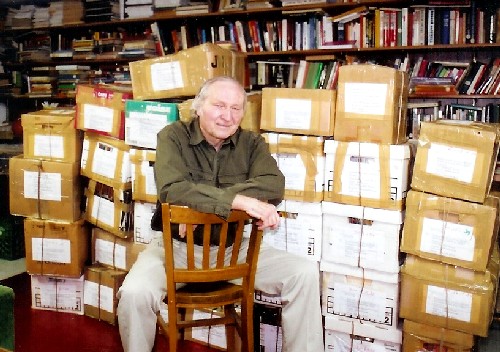
In my Ottawa study showing the last gift to the Saskachewan Archives, June 1, 2004.

For my part, I have donated much of my archival collection to the Saskatchewan Archives, which preserves a Doukhobor collection measuring 84.4 meters (277 feet) donated by 11 Doukhobor historians. 76% (64 meters) comprise the Tarasoff Papers. I trust the library to preserve the collection and provide access, but one needs to go to that library, documents are not digital and the Russian is not translated. Also, beginning in the 1950s, I have donated Russian and English materials to the Special Collections of the University of British Columbia in cooperation with librarian Jack McIntosh.

I still have a quantity of select archival materials at home for my day-to-day research and writing. For example, my on-going 49-volume Notes on the Doukhobor Social Movement now numbers 9,000 pages. Since the 1950s I have tens of thousands of photos, with over 1,400 Doukhobor historical photos donated to the Public Archives of British Columbia in Victoria, BC. At the age 80, I am still accumulating more text and photos, planning to produce more papers and an e-book.

For the past decade I have been posting much of my new materials and select old items on the Internet. I am pleased that Google digitized 6 of my books which you can search on line, but not yet preview, which requires cooperation with publishers.

But that does not address your question about older documents in Russian not in digital format, sitting on shelves, which cannot be found by searching the Internet for keywords.

Take inventory. Make it public.
  1. Organize and archive the documents by major topics in public spaces (library, museum, USCC, ...) using a library filing system, like box and folder.
  2. Describe and index each topic collection in a finding aid using many keywords.
  3. Post all finding aids on the Internet, so they can be found by search engines and easily read on mobile devices.
  4. Iskra is already organized, but its contents need to be posted, like we did with The Inquirer.
This gets you organized and public. Then each collection can be digitized by priority when possible. Handwritten documents must be typed or summarised. Russian OCR readers can convert most of the Russian text, but errors and alphabet updates must be corrected. Then digital Russian text can be computer translated, which requires extensive editing.

My webmaster, Andrei Conovaloff, researched some of this new technology for his own work and sent the following links to Jim Popoff in March 2012 to help with digitizing Iskra.
The new technology is spectacular and low cost, but volunteers and/or funds are needed to do the work, like the Psalmist Project. See how the Brethren are archiving now. Students at all levels can participate for credit. There are numerous opportunities for graduate projects and degrees. I wish our society would divert war money to the archival preservation of translation, interviews, ethnographic field work, film recording and more.

If any reader has a suggestion or can help, please comment below.

More: Questions and Answers, Comments